Large-size versions of illustrations are available by clicking on them.
RECORDS
OF
CAPTAIN CLAPPERTON’S
LAST EXPEDITION
TO
AFRICA:
By RICHARD
LANDER,
HIS FAITHFUL ATTENDANT, AND THE ONLY
SURVIVING
MEMBER OF THE EXPEDITION:
WITH THE
SUBSEQUENT ADVENTURES OF THE AUTHOR.
IN TWO
VOLUMES.
VOL. II.
LONDON:
HENRY COLBURN AND RICHARD BENTLEY,
NEW BURLINGTON STREET.
1830.
J. B. NICHOLS AND
SON,
25, Parliament Street.
[iii]CONTENTS
OF THE SECOND VOLUME.
| CHAPTER X. | |
| Page | |
| Character of the Africans in general — Their social qualities considered — Succinct remarks on the Natural History of the Interior — Yam Yams — Arabs — Falatahs — War of the latter people with Bornou and Fundah | 1 |
| CHAPTER XI. | |
| The Author resumes his Narrative — African huts — Recreations and evening amusements of his Master and himself — Illness of Captain Clapperton — His sufferings — Perfect resignation under them — His death — Burial — Character | 57 |
| CHAPTER XII. | |
| The Author’s severe indisposition and distress of mind — Conduct of Bello — Departure from Soccatoo — The Author almost perishes of thirst in the[iv] “Goober Bush,” where he is deserted by the faithless Pasko — The King of Jacoba — Horrid death of that monarch’s slaves — The Author’s arrival at Kano | 82 |
| CHAPTER XIII. | |
| Pasko — The Author pays his respects to the Governor, and leaves Kano — Chooses, near Bebajie, the road to Fundah — Almena mountain — The Author is seen and recognised by horsemen from Zeg Zeg — Arrives amongst the people of Bowchee — Their manners — A girl’s lamentation on being sold by her mother — The Author enters the immense plain of Cuttup — Anecdote of an old woman | 100 |
| CHAPTER XIV. | |
| The Author overtaken at Dunrora by four armed horsemen from Zeg Zeg, who force him to accompany them back to Zaria — His reflections — Arrives in Zaria — Treatment of the King and his son towards the Author — His entrance into Coulfo in Nyffé — Revisits Wow Wow — The noted widow Zuma | 128 |
| CHAPTER XV. | |
| The Author becoming entangled, whilst crossing a river, in the stirrups of his horse’s saddle, is thrown[v] from its back, and narrowly escapes drowning — Arrival at Khiama — Eccentric conduct of the Prince of that State — Anecdote of his messenger — Pasko’s thieving propensities turned to account — The Author enters Katunga, the capital of Yariba — His reception by Mansolah, its monarch — Song of five hundred of his Wives — Fetish-hut | 176 |
| CHAPTER XVI. | |
| Ebo the celebrated fat Eunuch — The Yaribeans not very delicate in the choice of what they eat — Dress of the different people in the interior — Treatment of invalids — Tattoo marks of different nations — The Author is urged to become Son-in-law to Mansolah, Generalissimo of his forces, and Prime Minister of State — Names of Towns — Departure from Katunga — Anecdote of a gang of robbers — Mungo Park’s son — Arrival at Badagry | 201 |
| CHAPTER XVII. | |
| Novel method adopted by Europeans for conveying slaves on board their vessels — Conduct of the Portuguese Merchants, resident at Badagry, towards the Author — The White Negroes — Manners and ceremonies of the Badagrians — Horrid indifference with respect to the Shedding of Human Blood — Murder of two of the King’s wives by moonlight | 238 |
| [vi]CHAPTER XVIII. | |
| The Fetish-huts and tree at Badagry — Owing to the insinuations of the Portuguese the Author is examined by the Priests of the Fetish, and compelled to swallow bitter water, being the only European that ever underwent that dreadful ordeal — His thoughts when informed of the circumstance — Astonishing preservation from an expected cruel death — Sacrifices of human beings under the branches of the Fetish-tree, exceeding in atrocity any thing heard of before — Song of the inhabitants, with Adólee at their head, on the occasion — The Author, on his visit to a Portuguese pirate, discovers the sacred Fetish-tree of the Badagrians growing in the heart of the forest, and covered with dismembered corpses of human beings — The Portuguese | 252 |
| CHAPTER XIX. | |
| Captain Laing, of the Brig Maria, of London, hearing that an Englishman was at Badagry, comes from Whydah to fetch the Author — His reflections on leaving Badagry, and on reaching the British vessel — The Maria sails for Cape Coast, where the Author lands, and is taken on board the Esk sloop of war, which Vessel sails for England — The Turtles — Arrival in England, &c. | 276 |
[1]WANDERINGS
IN
AFRICA.
CHAPTER X.
Character of the Africans in general — Their social qualities considered — Succinct remarks on the Natural History of the Interior — Yam Yams — Arabs — Falatahs — War of the latter people with Bornou and Fundah.
The character Plutarch gives of the Athenians is strictly applicable to the people of Africa in general, in times of peace:—“They are easily provoked to anger, and as easily induced to resume sentiments of benevolence and compassion.” This we found to be true in numberless instances; particularly amongst the gentler sex, whose apprehensions are quicker and[2] more lively, and whose finer feelings more easily excited than those of their male companions. We not unfrequently observed persons quarrelling and fighting in one moment, with all the bitterness of angry and elevated passions, and in the next as gentle as lambs, and the most cordial friends in the universe; forgetting their previous noisy dispute in the performance of reciprocal acts of kindness and good nature.
The African, ceaselessly engaged in sleeping, warfare, drinking, &c. takes little, if any, delight in his own family circle. His is no domestic life: his children never prattle round his knee; his eye never glistens with tenderness on receiving their innocent caresses; his numerous wives, who are valued as a distinct and inferior order of beings, weaken his affections and blunt his feelings; and he regards them with looks of indifference or contempt. With him,
are, indeed, unknown; and, provided his wants be supplied, unless aroused from his stupor by any particular event, he journeys calmly on, with the most listless indifference imaginable,[3] scarcely deigning to bestow a solitary thought either on his country, or his wives and children. He holds the dead, however, in the greatest veneration, hardly venturing to let the name of a deceased relative escape his lips; and if, when engaged in contentious bickerings, his opponent alludes to them in a disrespectful manner, he interrupts him with this energetic expression: “Curse me; slay me, if thou wilt; but do not rake up the ashes of the dead. Let them rest in peace, or thou thyself shalt follow them to the grave.”
The natives are passionately fond of storytelling, and listen for hours after the setting of the sun, with a gravity truly comic, to the recital of tales of the most wonderful and incredible description, in which they repose implicit belief. The following was told me with an air of great solemnity, and with a full conviction of its truth, by a native of Goober:—
“Doncasson, Prince of that province, ordered a number of men to build houses at the distance of three miles from Coonia, the capital, which they undertook to finish within a given number[4] of days. The workmen, contrary to their expectation, could find no water in the neighbourhood of the spot, nor, indeed, at a shorter distance than Coonia; and having no vessels large enough to convey a sufficient quantity within the time specified, they were put to their wits’ end, in what manner to act, fearing that in the event of the non-fulfilment of their engagement a dreadful punishment would await them. In this dilemma they applied for advice to a female fortune-teller, residing in the city, who, having accompanied them to the scite of the intended hamlet, ordered an immense heap of earth, sufficient for the walls of the buildings, to be thrown up; when the old woman immediately supplied them with the water required, in the same manner as Gulliver extinguished the dreadful fire that threatened to destroy the capital of the kingdom of Lilliput, on his visit to that country; and thus the buildings of Doncasson were finished a week earlier than was expected.”
The persons of the Africans, of both sexes, are perfectly well-formed. I never saw an individual in the whole country with a hump on his[5] back, or any other species of deformity whatever; and this will appear the more strange when it is considered that no people in the world pay less attention to their offspring in their tender years. We frequently saw individuals with only one hand, the other having been amputated as a punishment; but never met with a person that had lost a leg. The people used to deride us when we affirmed that some of our countrymen were furnished with wooden legs in lieu of natural ones, believing that a person could never survive the loss of so important a member.
NATURAL HISTORY.
Of the natural history of the regions we traversed I can say but little, my very limited and imperfect acquaintance with that interesting study, in either of its branches, incapacitating me from giving any thing like a description of the various productions of the soil, or of the numerous animals that inhabit the woods or the rivers.
Magnificent forests of tall trees are scattered over the face of the country from Badagry to Soccatoo, and afford, in their gloomy solitudes,[6] shelter to numerous species of reptiles and wild beasts. The palm, the cocoa, the tamarind, the banana, the fig, the date (a species of palm), the butter, and other trees, are indigenous; and several varieties of plum grow in woods of Yariba, as well as a tree bearing a fruit similar in size and appearance to our “love apple,” and in flavour, to the cashew apple of the West Indies. Stunted orange, lemon, and lime trees, bearing fruit of inferior quality, may also be found growing wild in that region, but are made little use of by the natives, who know not how to improve them; the people have likewise water-melons, guayavas, papaws, &c. &c. The cotton plant, indigo, rice, wheat, yams, maize, Guinea corn, dourra, six or seven other varieties of corn, the plantain, sweet potatoes, onions, and cassada, are cultivated to a great extent in the interior countries.
Reptiles are exceedingly numerous, but the bites of few of them, as far as I was able to learn, are attended with fatal effects. We frequently saw in the woods of Borghoo and Houssa a large species of snake swinging in the sun-beams,[7] with its tail encircling the branch of a tree; but on the approach of a human creature, it would attain the summit in an instant, and look from its elevation on the head of the person beneath. The boa constrictor we rarely met with alive; on my journey from Kano, however, I espied one of them, of about the bigness of a man’s thigh, coiled up like a rope, and partially concealed by fallen branches and leaves of trees. I watched the monster attentively for a moment or two, being within a few yards of the spot: but at length observing me, it attempted to hide itself, when I immediately discharged my piece at its head, and in all probability wounded the animal, although it eluded a rigorous search that I caused to be made after it. The beautiful reptile called at the Cape of Good Hope the puff-adder, is unknown in the central parts of the continent; but a slender green snake, elegantly variegated with black, which is sometimes met with in the former country, is seen in almost every inhabited place of the latter. I have frequently observed, on awaking in the morning, one or more of these reptiles, gliding from[8] underneath the mat on which I had been sleeping, towards the door of the hut, and so making their escape. The bite is speedily mortal. Another snake, about two feet long, of a greyish colour, whose bite is also fatal, is found in many parts of the country. Pasko snatched up an adder of this description one day, thinking it to be a bit of decayed wood, covered with lichen, which it greatly resembles; but feeling the reptile twisting itself round his fingers, he cast it from him before it had power to bite, and immediately fainted from excess of fear. The natives hold all poisonous snakes in the greatest dread, and can never be induced to touch them, even after they are destroyed, believing that, although there be no cut on the hand by which it could so enter, their venom yet attaches itself to the skin, and insinuates itself into the blood of the person that seizes it.
Of insects the most formidable are the ant, the locust, the mosquito, the centipede (a peculiarly hideous animal), and the scorpion. The bites of the two latter are attended with danger; but although they frequently visited us in our tents[9] and huts, we never had the ill-fortune to suffer from their attacks.
Wild animals, in incredible numbers, abound in the woods; amongst which are the lion, elephant, tiger, tiger-cat, panther, leopard, hyena, wolf, and hog. The camel is found in a wild state in Houssa; and that beautiful animal the giraffe, or cameleopard, also inhabits the forests of the same country. I saw three of them in my travels between Zaria, Kano, and Soccatoo; they are excessively timid, and are rarely, if ever, caught by the natives. Although the tremendous roar of the lion, which made the woods tremble, could be heard by us when travelling at all hours of the night; yet I never saw but two of those ferocious animals, a male and female; which incident has already been mentioned in a preceding part of my narrative.
The elephant is annually becoming more shy and scarce in the interior. The country people say that they have been taught the value of their tusks, and therefore studiously avoid, as often as possible, the haunts of man, by penetrating[10] more deeply into the bosom of their ancient forests. Be this as it may, they are not so frequently seen in Houssa as formerly, and less often slain; and although numerous traces of them were perceptible in the woods, we never met with a considerable number at one time in all our journeyings. Elephants are more numerous in the deep woods on the borders of the Quorra, near the island of Boussa, than in any other place whatever. This may be accounted for by the king of that country having interdicted his subjects, under dreadful penalties, from slaying them. The fetish of the same monarch is a white elephant; and it is believed that he can assume the form of that animal whenever inclination or necessity may prompt him to disguise himself. Hence elephants are held in considerable veneration by all ranks in Boussa; and the figure of a white one is worshipped as a god in that kingdom.
I have often heard it remarked, that the elephant is as sluggish in his motions as he is unwieldly in appearance; but this is by no means the case. In proportion to his size, he is as[11] fleet as other animals, which I learnt to my cost in South Africa; for on going out shooting one day I disturbed a huge elephant, which, unobserved by me, was standing at a very short distance. The animal immediately pursued me; but it being a few seconds before he could disentangle his legs from the thick underwood that grew on the spot, I was considerably in advance before he got into open ground. The beast ran much faster than I, and would have overtaken me in a few minutes, if a dog that was with me had not made an alarm which drew our party out of their encampment, fixed at no great distance, who came to my assistance, and drove the animal back. As it was, I was almost frightened to death, and resolved never again to come to such close quarters with an elephant, bulky as he might be; since that quality does not prevent him from using his gigantic legs with elegance and dispatch.
Of all untamed animals in Central Africa, hyenas are most to be dreaded; they are astonishingly bold and ferocious, and commit great depredations on the domestic animals of the[12] natives. The howl of these creatures is truly terrific, and their demoniacal laugh is enough to appal the stoutest heart; hundreds of them used to pass and repass our tent in the woods by night, our fires alone preventing them from commencing an attack on our persons. The wild hog also does a great deal of mischief; they visit the plantations in immense droves, and destroy the corn, or whatever else may be growing on them. They inhabit the woods of Houssa, but more particularly those in the vicinity of Soccatoo, where they are found in considerable numbers; but no pains are taken by the inhabitants of that city to exterminate them; in fact the Mohammedan portion of the community would rather embrace a leper than touch the skin of one of these abhorred animals; and there cannot be a greater affront than to give a Falatah the epithet of “pork-eater.”
The domestic animals are the camel, horse, ass, ox, pig, goat, sheep, &c.; turkeys, ducks (the Muscovy kind), geese, the Guinea and common fowl, are also tamed. The turkey is no where to be met with after leaving Yariba; nor is the[13] camel seen in that or any other country between it and the coast. Although the pig is detested by the Falatahs, the Mohammedan negro feasts on its flesh without the slightest reluctance, as do likewise the Pagan natives indiscriminately. The large species of ox with the hump, was first brought into Houssa, Nyffé, Borghoo, Yariba, Cuttum Cora, Cubbé, &c. by the Falatahs, the native breed being diminutive, and without the hump. The beef of both kinds is always dry, and tough as leather; and as by reason of the heat it never gets perfectly cool, or solid, it is very indifferent eating. The sweetest and most palatable animal food, is the flesh of kids, which is publicly sold in the markets at a reasonable rate.
The native horse of the countries above enumerated, is particularly small and shaggy; it is generally of a mouse colour, with hair as soft and fine as silk; and, like the ass, has a black streak placed transversely on the back and shoulders. The finest horses are imported from Bornou, which country supplies every other in the interior with that useful animal; and these are handsome,[14] powerful beasts. The ass is common in the interior, and for size, speed, strength, and beauty, surpasses any animal of its kind I have ever seen, not even excepting the most approved of the famous Spanish breed. They are highly valued by the natives, and in some instances are preferred to the horse. Sheep and goats are plentiful, but are of very inferior description; none of the former are to be found with the enormous tail of fat which so peculiarly distinguishes that animal at the Cape; but, as in all tropical countries, they have hair instead of wool. Dogs and asses are eaten in Yariba, and their flesh is much sought after.
Of the feathered tribe, there are various species, of rich and brilliant plumage. Parrots, Guinea fowls in a wild state, and a variety of doves, are seen in the branches of the beautiful trees, and by their chattering and cooing, impart a grateful animation to the spot near which they may happen to take up their abode. The golden pigeon is sometimes to be seen; its ground colour is a rich and vivid blue, and the feathers on the breast and under the wings are[15] tinged with a glittering yellow, whence it takes its name. The grey pelican abounds on the margins of rivers and streams in Houssa; it is much less than the white pelican, and the beak in particular is considerably smaller than that of the latter species. The former are found in immense numbers, more especially at a place called Zulamee, and build their nests close to the water’s edge, near to which they always stand to feed their young. The eggs are esteemed as a delicacy by the natives; but the flesh of the bird is of so offensive a flavour that it cannot be eaten. It is somewhat singular that the opinion of the pelican feeding its young with its blood is as general in Houssa as it is amongst the lower class of people in Europe; and to this belief I must acknowledge myself a proselyte! I have stood for a long while together by the side of this stupid animal, watching its motions, and seeing it bending its head for its offspring to extract their nourishment. The young ones thrust their beaks into a small round aperture at the lower part of the back of the neck of their parent, and they swallow the substance[16] that flows freely through. If it be not blood that issues from the old bird, it is a red liquid so closely resembling it, that the difference cannot be perceived. I took a sketch of a pelican feeding its young in this manner, in Houssa, which is now in my possession; and I should not have said so much on the subject, if my assertions had not been questioned by several of my countrymen.
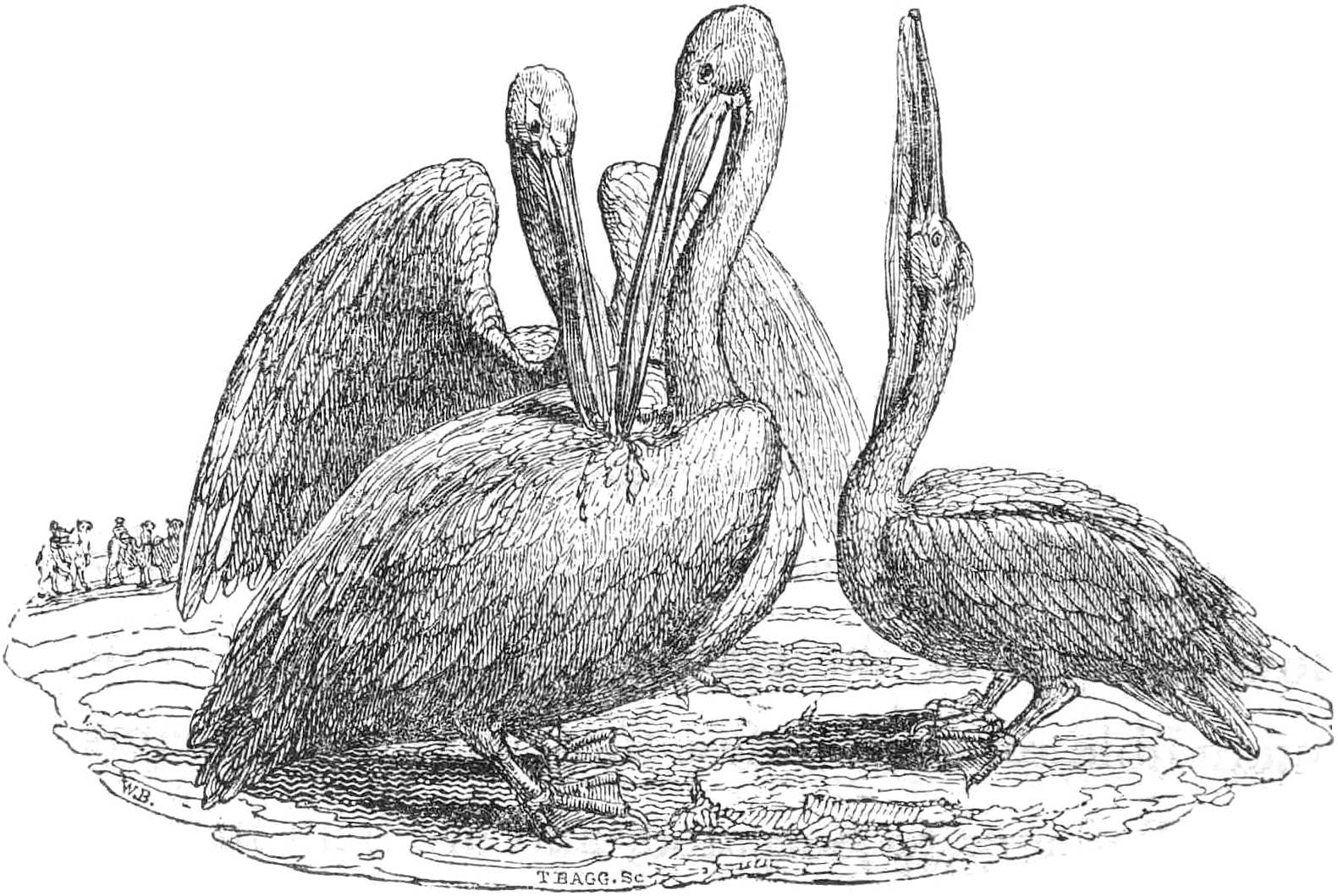
[17]I met with few of the species of birds to be found in Southern Africa, in the more central parts. A rook having a white ring round its throat, is the same in both regions, as is also a small bird called in the former country finy fink, and in the latter the “harvest-bird.” Its feathers are fine, soft, and silky; but retain their splendid colour only whilst the corn is in the ground, changing its plumage to a russet brown as soon as the grain is fairly housed, which is just about the period that its young are able to take wing. There are two varieties of this beautiful bird, the colours of the one being yellow and black, and those of the other a bright scarlet, or red and black.
The rivers swarm with fish, which, generally speaking, are not very delicious eating; and the consumption of them is confined chiefly to the lower orders of the community. Crocodiles in incredible numbers infest the rivers and streams from Badagry to Soccatoo, and are held in considerable dread. I never saw any of these amphibious monsters of such exceeding length and enormous dimensions as I have heard spoken of;[18] the largest I saw measuring no more than from fourteen to eighteen feet in length, and of proportionate bulk. They sometimes attack the human species; but such instances of their ferocity are not so often displayed as the natives would wish strangers to believe, for, being fond of the terrible, they magnify the most trifling incident in the world to one of excessive horror. The eggs of the crocodiles are eaten by the people, and greatly esteemed; they are certainly preferable to their hen’s eggs, which are rarely more than half hatched, and when dressed look and taste like water and curdled milk. They are also superior in flavour to the eggs of the penguin, and although larger, closely resemble them in appearance when boiled, the yolk in both being of a pale yellow, and the more liquid part of a delicate blue. The former are used as charms by the natives of Yariba and Borghoo, not only to deter crocodiles from visiting their villages, but likewise to avert the “Evil Eye.”
[19]THE YAM YAM.
The Yam Yam, in his most conspicuous traits, is alike different from the Falatah, the Arab, and him that claims a Bornou descent, resembling, as nearly as possible, the Caffre of the southern interior. The same open, manly countenance—the same jetty blackness of skin—the same noble but restless eye—the same advantageous stature, and athletic, powerful form, are observable in both savages; and they have a like fondness for pastoral pursuits; but the Yam Yam differs from the Caffre in being a cannibal. He is accused by every nation of the revolting crime of eating his own species; yet the united testimony of every nation might be questioned as arising from prejudice or dislike, if he did not confess it himself. A Yam Yam told me at Kano, deliberately and seriously, that his countrymen not only devour the bodies of their enemies taken in battle, but feed on the flesh of their friends and companions, purchased from human shambles!
[20]THE ARABS.
This ancient and extraordinary people are spread like locusts over the central parts of the continent; and, like locusts also, have left marks of their devastating qualities wherever they have appeared. Both Saracen and Moor fall under the general denomination of Arab; and although it is said that the former made an irruption and settled in the northern parts as early as the seventh or eighth century, and the Arabs three or four centuries subsequently to that era, there does not appear at this time to be the least difference in the persons or manners of the whole. At whatever period they crossed the desert, however, it is certain that the wild and fanatical religion of Mohammed accompanied them, and that they preached it with zeal and energy amongst the natives, making innumerable converts to the new and strange doctrine.
The Arabs in Houssa and other parts have, unhappily, lost all trace of their ancient splendour, as well as the characteristic features of their countrymen. Like the Jews in Barbary, monopolize not only all the trade, but likewise all[21] the money concerns of the state and people; degenerating from a restless, but high-minded and imaginative race, to the vilest and most grovelling on the face of the earth. They pluck the ignorant and superstitious aborigines of their substance with impunity, and perpetrate the most revolting crimes for the bare love of gain. Some of them are observed straggling from one end of the African continent to the other, practising, like wandering quacks, the most shameful impositions in the different towns and villages through which they may happen to pass. An Arab mallam selling the small balls of tin to a native chief, which has been already mentioned, is a proof of this; and hundreds of other examples might be adduced, if necessary, as a further corroboration of the truth of my assertion. They also tell fortunes, and by various incantations pretend to discover the authors of robberies or mischief of any kind that may have been effected. Some again remain stationary in cities and in courts, ever ready to take advantage of circumstances to cheat and embezzle, and to enrich themselves at the expense of the[22] prince or the public; and, although they are so numerous in the interior, I do not believe there exists half a dozen honest men amongst them. Unacquainted with the brilliant achievements that shed so rich a lustre over his earlier history, the Arab of the internal districts of Africa ceases to retain the politeness, the gallantry, the lofty enthusiasm, and the love for the fine arts, which distinguished his ancestors under the Califs; and even the desire of collecting and preserving Arabic manuscripts, which for a long time prevailed amongst his countrymen, is now wholly extinct. Intolerant and bigoted in their religious principles, the Arabs look with invincible contempt on all those differing from them in opinion; and their dislike to Christians in particular is inveterate and deeply-rooted. They did their utmost to prejudice the minds of the rulers as well as the canaille of Africa against us, by propagating the most unfavourable rumours of our character and our motives; and partially succeeded in convincing them that we were either spies or robbers; insomuch that the term “Christian” became in disrepute[23] with a large portion of all ranks, and a watchword for reproaches and indignities of every description. Jealous and malevolent, and fearful that through our means the great fabric of imposture they had reared with so much facility on the basis of superstition would be overthrown, as well as their lucrative trade with the natives ruined, they watched all our actions with distrust and alarm; and although they covered their faces with smiles on visiting us, or on accosting us in the streets, those looks of kindness were put on only to lull us into a security, and to impress us with the belief that they were our best friends. Their relentless malice at length displayed itself; for by repeatedly throwing out indirect insinuations on our integrity in the hearing of Sultan Bello, these Arabs succeeded in undermining our reputation in the eyes of that monarch; the consequences of which hastened the death of my valued master, together with the failure of the African Mission—for, to the perfidious endeavours of those scoundrels I must attribute our detention in Soccatoo, and all the misfortunes which attended that restraint.
[24]THE FALATAHS.
The Falatahs, as a people, are perhaps not less extraordinary than the Arabs, whom they formerly resembled in their unsettled, wandering habits, and simple manners. No one can tell their origin, from what country they at first emigrated, or to what extent they have scattered themselves. They have overrun the continent from east to west, and are found tending their flocks and herds near the sea, and warring with success in the interior: some of them profess the Mohammedan religion, and some worship stocks and stones; but all speak the same language, and have the same ceremonies and amusements. The negroes who have travelled farthest have declared to me that Falatahs are every where to be met with, seldom mixing with the owners of the soil; but, like the gipsies of Europe, keeping themselves a peculiar and distinct people.
When I was at Graham’s Town, Cape of Good Hope, in 1824, two copper-coloured men, who had incautiously separated themselves from their companions, were found wandering in the[25] woods in the vicinity of the place, and brought into it by a body of Caffres; they excited at the time a great deal of curiosity, and conjecture was afloat as to what particular nation they could have belonged to. For my part, from what I now know, I have every reason for believing that those very men were Falatahs; and I have a strong persuasion within my own breast that the tribe called in Southern Africa the Red Caffre, and the Falatah of the eastern and central parts, are one and the same people! I do not affirm that they are actually the same; I only state it as my decided conviction that they have sprung from one common source. I know nothing of the language of the Red Caffre, but he certainly does not differ from the Falatah in personal appearance; and by all accounts the manners, customs, and ceremonies of both are precisely the same. It would be a truly magnificent undertaking to traverse the unexplored regions between Leetakoo and the (so called) Mountains of the Moon; and every way worthy the courage and enterprise of an Englishman. I really believe that a person acquainted with the genius and[26] usages of the natives, and possessing a persevering, undaunted spirit, with an unruffled temper, would find no insurmountable difficulties against accomplishing this object, stupendous as it may at first appear; he might soon and easily accommodate himself to the manners of the Africans, which are generally mild and simple, and do not differ, in many very essential points, from the Cape to Bornou; and leaving gradually, and almost imperceptibly, the healthy for the insalubrious climates, his frame would be prepared, by such degrees, to encounter the transition.
At one time the Falatahs never resided in towns, but rambled, with their flocks and herds, from place to place, as pasturage and water might invite their steps. They journeyed in companies, having no particular chief, or regular form of government; and their numbers were at first too contemptible to excite the notice, still less the fears, of the aborigines. Into Houssa they stole insensibly by “ones and twos,” and finding that fertile and beautiful country much to their liking, they took up a permanent abode[27] in the woods at no great distance from the spot on which Soccatoo now stands.
By some secret intelligence or correspondence, hordes of their straggling countrymen soon gathered around them, and they at length built a town in the province of Goober, in Houssa, and chose for themselves a chief, named Danfodio. This man was well versed in the religion of Mohammed, and had derived from the figurative language and splendid diction of the Koran, a visionary and romantic turn of mind, which prompted him to undertake novel and daring exploits, not unworthy that great legislator whose work he had so intently studied. He began at first to meddle with the polity of the ruling prince of Goober, and adopted the language of dictation to that imbecile monarch, which not being altogether agreeable to the royal mind, the newly built Falatah town was levelled with the dust, and the chief himself, with all his people, driven out of the country into the woods, wherein they erected another town; and the Falatahs from the east and west flocked, in considerable numbers, to the standard[28] of their countryman. Finding his strength daily and hourly increasing, Danfodio divided his men into bands, or companies, and nominating a captain to each fifty, bade them go forth and conquer in the name of the Prophet, for that God had given them the lands and houses of the natives. He also embraced the opportunity of impressing upon the minds of the leaders, with admirable eloquence, the most prominent features of the religion they professed; and artfully insinuated the exalted and unfading happiness which those who fell in the cause of Mohammed would be entitled to in the other world. The captains, filled with ardour and enthusiasm, found little difficulty in the accomplishment of the task imposed upon them by their crafty leader. With a handful of men the flourishing and important city of Kano was taken and pillaged; and other parties overran the country and subjugated the people, telling them that the Almighty had given them their possessions for an inheritance; and that they themselves, with their offspring, must ever after be their slaves and bondsmen. The stupid natives[29] were palsied with fear, and understanding little or nothing of the Koran, knew not what to think of the strange doctrines of the Prophet sprung up so suddenly and unexpectedly amongst them. Danfodio’s pretensions, therefore, were seldom disputed; the Houssans have often declared to me that the strength and inclination to “shake the spear!” were denied them; they had no will of their own,—their hands fell powerless by their sides, and they felt as if they had been touched by the finger of a god, or were under the influence of an eastern talisman. Abandoning their wives and children to the mercy of the invaders, they consented to lose their liberty, and fell, like “silly sheep,” into the snare that had been laid for them with so little art; not even attempting to struggle with their oppressors; or if so, making efforts as puny and ineffectual as the fluttering of a fly in a spider’s web. Of all the provinces in Houssa, Goober alone made a show of resistance; its monarch invested Danfodio in his own town, but being repulsed with loss, made a precipitate retreat to Coonia, the capital[30] of his kingdom. He was pursued thither with slaughter by the Falatahs, who, in their turn, surrounded his town, and succeeded in slaying him in a sally, when the inhabitants, deprived of a leader, immediately capitulated, and bowed their necks to the yoke of the Falatah chieftain. All Houssa was now in subjection; Bornou was attacked with success; the dynasty of that ancient kingdom tottered to its foundation, and its monarch trembled on his throne. The Falatahs pushed their almost bloodless conquests to Nyffé, and conquering part of that country with the whole of Cubbé and Youri, had the audacity to enter Katunga, the metropolis of Yariba, which being an idolatrous city, was set on fire; but the inhabitants, recovering from the panic into which they had been so suddenly thrown, rallied, and turning upon the incendiaries, compelled them to make a precipitate, and disgraceful retreat. For some reason, which I could never exactly comprehend, Danfodio hastily recalled his victorious soldiers, and concentrating his power in Houssa, founded the city of Soccatoo, somewhere about[31] the year 1798, which he resolved should be the metropolis of his usurped empire. Here he lived in peace for many years, uniting in his own person, like his celebrated prototype, the sacerdotal and kingly offices; and ruled his people with candour, equity, and justice. As soon as the Arabs were made acquainted with these sudden and important changes, they hastened, with well-timed speed, to do homage to the success of his arms and the wisdom of his councils; and ingratiated themselves so effectually into the favour of the conqueror, by flattering his self-love with artful and well-directed encomiums, that he loaded them with benefits, and intreated them to remain for ever in his newly-acquired territory. He also presented them with horned cattle, camels, and slaves, and offered them the most fertile lands in Houssa, if they would consent to teach his subjects to read the Koran, and give them an acquaintance with the Arabic language and literature.
In the midst of these proceedings, the terrible Danfodio, at whose name thousands of[32] negroes trembled, became religiously mad, and was often seized with paroxysms of remorse, for having erected a throne, by the shedding of so much Mussulman blood. In his lucid intervals, a melancholy preyed upon his mind, and he delivered his conscience into the hands of the Arab emirs who surrounded him. These hungry and insatiable adventurers plied the fanatical prince unceasingly for more valuable presents, as the only means of appeasing the wrath of offended Heaven; in which object they were eminently successful; but this failed in alleviating the malady that afflicted Danfodio, and he expired in great anguish in one of his fits about the year 1816, to the infinite joy of his conquered subjects, and the sincere regret of the interested Arabs, and the aspiring Falatahs. Amongst all people, however, he bore the reputation of being one of the most extraordinary men that had ever existed in the interior of Africa; and his enterprizing spirit, artful stratagems, and perfect acquaintance with the African character, which the whole tenor of his conduct evinces, show that the honor he had[33] acquired was not founded on popular clamour, or national prejudice; but that his mind was greatly superior to those of the semi-barbarians that surrounded him. He had made great and important changes in the laws and government of the people he had subjugated to his sway, and created on the ruins of the most flourishing and beautiful kingdom in the interior, a new dynasty which is likely to become, in time, the most formidable power in the whole continent.
Mohammed Bello, the present Sultan, and eldest son of Danfodio, ascended the throne, by the unanimous voice of the Falatahs, shortly after his father’s decease; but the government of the conquered territory to the westward of Houssa, was awarded to Mohammed Ben Abdallah, his cousin. Atego, a younger brother of Bello, attempted to raise a rebellion in furtherance of his own ambitious projects in opposition to the rightful heir, but being completely defeated in a pitched battle, by the partizans of Bello, was taken prisoner, and liberated after a year’s imprisonment in a common dungeon. He is now on a friendly footing with his brother,[34] but is a contemptible fellow, and appears to have sunk the dignity of the prince in the meanness of the man.
On receiving intelligence of the death of the Sultan of the Falatahs, the people of Goober, and many of those of the other conquered provinces, impatient of the galling yoke which they had been compelled, much against their own inclinations, to bear, rose simultaneously into an open and general revolt, and put to death, indiscriminately, every Falatah that had located himself in their country. Then, forming themselves into a confederacy, with a variety of leaders at their head, they for a long time waged an exterminating war with the successor of Danfodio; but their movements being unconnected and irregular, and anarchy having the ascendancy in their councils, Bello had reconquered several of the mutinous districts at the period of our arrival, and made a great slaughter of the miserable inhabitants. The towns whose gates were not instantly opened to their summons, the Falatahs surrounded, and intercepting all communication between the people residing in them and[35] those of the neighbouring country, prevented any provisions being obtained by the besieged, and in a manner starved them into capitulation. The insurgents had made, however, for Africans, a gallant defence; and well knowing what they had to expect from their sanguinary adversaries, would not surrender till all their domestic animals had been consumed, and they themselves reduced to the extremity of feeding on decoyed vultures, which, next to human flesh, they most cordially abhor. Having obliged them at length to open the gates, the Falatahs rushed in, and pouncing upon the emaciated and unresisting inhabitants, made dreadful havoc of them, putting the old men and councillors to the edge of the sword; thrusting a sharp stake into their bodies, and exhibiting them on the tops of the walls and other conspicuous places, as melancholy trophies of their success, and as a spectacle of horror for their shuddering countrymen to profit by. In this situation the ghastly corpses were exposed, till they had fallen to pieces by the action of the air, or been devoured by birds of prey. The old women, and young people of both sexes, who[36] had escaped the general massacre, were driven in triumph to Soccatoo, and retained as slaves by their imperious conquerors. This was the dismal fate of the inhabitants of Coonia, the capital of Goober, the prince of which country, named Doncasson, with other young men, laboured as a slave till a year or two before Captain Clapperton’s first arrival at Soccatoo, (about 1822,) when, effecting his escape, with the most determined of his countrymen, he was elected their captain, and being joined by numbers of the disaffected, marched forthwith to the metropolis of the kingdom of his ancestors, and vigorously assaulting it by surprise, the Falatahs, in their turn, after a short and ineffectual resistance, surrendered to the infuriated Gooberites.
The merciless Doncasson retaliated upon the inhabitants the dreadful cruelties which they had so inhumanly inflicted upon his countrymen not long before; in addition to which, the left hand of every young woman in the town, in spite of their cries and tears, was amputated; after which, being set at liberty, they returned with their mutilated bleeding members, to Soccatoo.[37] I saw several of the unfortunate creatures in that city who had undergone this barbarous operation; the hand had been cut off at the wrist, and the wound being left to nature for a cure, several of the young women had bled to death on the road.
Sultan Bello meantime had not been an unconcerned or inactive spectator of the exploit of Doncasson; he immediately assembled a strong force, and made repeated attacks on Coonia, but was repulsed with loss in all his attempts. The belligerents likewise fought two pitched battles, in which the Falatahs were discomfited, and their Sultan wounded by a poisoned arrow; by this means the Falatahs were no longer considered as invincible by the original natives; and, foiled in all their manœuvres, they returned crest-fallen and defeated to Soccatoo. Bello soon recovered from the effects of his wound, but was ever after so excessively afraid of the Towayahs, as Doncasson’s followers were called, that, unless protected by a strong escort, neither he nor his people dared to venture near their territories.
The Gooberites, at the period of my departure from Soccatoo, had received a considerable[38] reinforcement of cavalry from the Sheikh of Bornou, and were daily becoming stronger and more formidable to the Falatahs. Numerous bands of their young men infested the Goober, or Gondamie “bush,” through which the road to Kano lay. Here they hid themselves in caves and unfrequented places; but on receiving intelligence from their scouts of the approach of a body of the enemy, less powerful than themselves, they would suddenly emerge from their concealment, and springing upon the ill-fated Falatahs, generally contrived to capture or destroy them. Hence the rapidity with which we travelled through the dreaded bush—a rapidity that, in one instance, had nearly cost me my life; and hence the exclamation of “O, the Goober Bush!” so general amongst the Falatahs.
WAR WITH BORNOU.
The war between the Bornouese and Falatahs, which has been already mentioned as raging at the time of our arrival in Kano, and which had caused the Arabs in that city great uneasiness, originated from the following cause:—A famine[39] having impoverished the natives of the former country, and threatened them with utter destruction, the Sheikh sent a number of handsome horses, for which his kingdom is celebrated, as presents to the Governor of Kano, and the chiefs of other Falatah towns. The animals were delivered to the care of the ambassadors, who depicted to the receivers of them, in lively colours, the destitute condition of the people of Bornou; and intimated a wish that the Falatahs would relieve their wants, by returning as much corn and other provisions as they could readily spare, without putting themselves to an inconvenience. The custom of giving and receiving presents is of very ancient standing in Africa, and sanctioned by universal adoption. Instead of acceding to the reasonable desires of the Ruler of Bornou, the Chiefs of all the towns, excepting the Governor of Kano, kept indeed the horses, but followed the example of many rude nations of antiquity, as well as that of more modern times[1] and sent back the ambassadors to[40] their monarch, with bundles of sharp-pointed spears, hinting by these hieroglyphics, that if the Sheikh wanted corn, he was to come and fight for it. The Governor of Kano, however, went even a step beyond this, for he not only retained the horses sent him, but bound the unsuspecting ambassadors hand and foot, and taking them to the market-place, the pitiless Falatah publicly butchered them in cold blood. The consummation of this atrocious act, to which I was myself a spectator, elicited a universal murmur of disapprobation from the slaves, who form by far the major part of the inhabitants of the city; and it was generally feared, from their deep but not loud execrations, that they would have risen into open revolt, and revenged the murder of the Bornouese, by wreaking their vengeance on the head of the perpetrator of the abominable crime. This effervescence of the public mind, nevertheless,[41] had subsided at the period of my departure for Soccatoo, without producing any of the effects so much dreaded by the free population of Kano; and the recollection of the revolting and sanguinary action of the Governor was swallowed up in other and more important incidents.
As soon as the news of this melancholy catastrophe reached the ears of the Sheikh of Bornou, who was then at Kouka, the capital of his empire, he was so violently exasperated, that he swore by the Prophet he would have an immediate and ample revenge of the Falatahs for the insult they had offered him; and for this purpose, instantly assembling a numerous and powerful army, he hastened to chastise his relentless enemies. The inhabitants of every Falatah town opened their gates to the Sheikh till he reached Murmur, (the place in which Dr. Oudney died and was buried by my lamented master, in the former journey,) where the people who refused to follow the example set them by their countrymen; and prepared to defend themselves to the last extremity. The Bornouese, being unwilling[42] to lose so much time as the investment of the town, in a formal manner, would inevitably occasion, contrived to ensnare a number of vultures, by baiting a crooked bit of iron, sharpened at the extremity, and resembling in shape a small sized English fish-hook, with pieces of putrid beef. These instruments, to which a long string was attached, were eagerly seized by those voracious birds, which by this means were caught with little difficulty. The soldiers of the Sheikh had no sooner obtained as many as they fancied would be necessary, by this stratagem, than they tied pieces of burning cotton to the claws or tails of the vultures, and so set them at liberty. The affrighted birds instantly flew into the town, and alighting on the thatch of the dwellings, of course set them on fire, and a general conflagration was the almost immediate consequence.
This unlooked for calamity distracted the attention of the besieged; and all flew to arrest the progress of the flames, and to snatch their children from their burning habitations; whilst the Bornouese, taking advantage of the general[43] consternation that prevailed in the town, made a sudden rush on the massy gates or doors, (which are made of the bark of the date tree, fastened and strengthened with iron clasps,) and so desperate was the assault, that in less than a minute’s time they had entered the place, and were engaged in their work of death and slaughter amongst the inhabitants.
The infuriated Bornouese pursued their way through the burning streets, amidst the crackling huts of the people, and the general devastation and ruin—respecting neither party, but frequently overwhelming both themselves and their enemies in one common destruction. The male Falatahs were marked out as peculiar objects of the vengeance of the victorious troops, one only escaping to tell the dismal tale to his countrymen; but not yet satiated with blood, the pagan soldiers in the army of the Sheikh captured all the unoffending females who were running about in every direction, with their offspring in their arms, or on their breasts; and, as with the Gooberites, after amputating one of their hands, ejected them from their town, snatched their children from their[44] embraces, and compelled the poor creatures to wander without protection, and almost dead with grief and intense suffering, to other towns and villages, before arriving at which many of them were released by death.
Several other Falatah towns were treated in a similar dreadful manner by the Bornouese, who marched hastily towards Kano; but when about a day’s journey from that city, were intercepted by the troops of the king of Jacoba, and other allies of Bello, and coming to an engagement, the latter were utterly routed by the Sheikh, after a short but sanguinary contest. The Bornouese obtained immense booty by this victory, and on drawing near the walls of Kano, the governor went out to meet them with the joint forces of that city and the province of Zeg Zeg, when the Falatahs again suffered a mortifying defeat, and were obliged to flee back into Kano, the immense wall of which, with its ponderous doors, alone prevented the victorious Sheikh, flushed with success, and glutted with revenge, from following them into the town, and annihilating every soul; in which he[45] would undoubtedly have been assisted by the murmuring slaves.
Bello, meantime, was gathering together an immense army to attack the Sheikh, who, being made acquainted with the circumstance, in order more effectually to secure the booty he had already required, having fulfilled to the letter his terrible denunciation on the insolent Falatahs, thought proper to raise the siege of Kano, and return to his own kingdom, laden with provisions and spoil; nor did the Gooberites leave it in the power of Bello to make reprisals on his triumphant adversaries; so that they were suffered to retreat unmolested to Bornou.
The old coffee-pot, tent, and drum, which the disappointed Falatahs boasted, amongst other things, they had captured from the Bornouese, and which were publicly exhibited as trophies of a victory they had never won, were owned, the day before I left Soccatoo, by the discomfited king of Jacoba, as his property, and restored to that monarch immediately. The prince informed me that the soldiers of the Sheikh were[46] so loaded with articles of greater value, that they did not think it worth while to have the trouble of conveying an old worn-out tent, coffee-pot, &c. to Bornou, and therefore left them behind for the use of their opponents.
I could hardly forbear laughing to see the animosity which the Falatahs evinced against the unconscious coffee-pot, and the dreadful punishments they inflicted upon it, on all occasions, as if this inanimate vessel could satisfy their thirst for vengeance on their enemies. I have heard of boys in England, during the period of the war with France, desperately lopping off the tops of thistles with a walking-stick, and exclaiming, with appropriate gesticulation, “Oh, if you were Frenchmen, we would behead you in this manner!” The expression of the Falatah, with regard to the coffee-pot, was very similar. I have seen him lift his spear in a transport of rage, and while his eyes flashed fire, cry out with dreadful vehemence: “Oh, if you were the Sheikh of Bornou, thus would I pierce your vile body!” accompanying his words and gesture by making, with all the fury of excitement and disappointed revenge, a valorous thrust at[47] the ill-used breakfast-preparer of the king of Jacoba. When it came to be understood, however, that the coffee-pot did not actually belong to the Bornouese monarch, but was the property of one of their most faithful allies, they were overwhelmed with shame and chagrin; but hushed up the matter as well as they were able, vowing, that as soon as the Gooberites should give them a short respite, they would be amply revenged on their spirited and successful antagonists.
WAR WITH FUNDAH.
Fundah was described to me as being a large and populous city, the capital of a kingdom of the same name, and situated on the banks of the Niger. It is defended by a high wall, except the part facing the sea; and canoes are continually plying up and down the river, between the town and the bight of Benin. The inhabitants, having received a quantity of European fire-arms from the coast by this water-conveyance, no sooner heard of the Falatah conquests, than they perforated the wall of Fundah with innumerable little holes, barely large enough to[48] admit the barrels of muskets, and light for the soldiers to distinguish objects without. The city never was invested in Danfodio’s time, that prince wisely contenting himself with the subjection of Houssa, &c.; but Bello, his successor, having cast an envious eye on so rich and flourishing a kingdom, had long premeditated the conquest of dominions that lay so near and so commodious for the accomplishment of his ambitious views; and attempted to carry his well-matured design into execution a few weeks only after Captain Clapperton had quitted Soccatoo on his former journey (1824).
The Sultan accordingly, assembling all his forces, marched with a formidable army towards the devoted Fundah; and halting about a half mile from that city, sent the following singular and characteristic message to the king:—
BELLO’S MESSAGE.
“Ruler of Fundah! deliver up your country, your riches, your people, and your slaves, to the beloved of God, Mohammed Bello, king of all the Mussulmans, without reluctance on[49] your part; for if you do not suffer him quietly and peaceably to take possession of your kingdom, in order to propagate the religion of the only true Prophet in it, he will shed your blood, and the blood of your children, and the blood of your household; not one shall be left alive: while your people he will bind with fetters of iron, to be his slaves and bondsmen for ever—God having so spoken by the mouth of Mohammed!”
KING OF FUNDAH’S ANSWER.
“Sultan of the Falatahs! The king of Fundah does not know you or your Prophet; he laughs your boastings to scorn, and despises your impotent threats. Go back to your country, and live in peace with your people; for if you persist in the foolish attempt to invade his dominions, you will surely fall by his hands; and instead of his or his subjects being your vassals and bondsmen,—your slaves shall be his slaves, and your people his people. Your chiefs and warriors, and mighty men, will he slaughter without mercy, and their blood shall be sprinkled[50] on the walls of his town; while even your mallams and emirs will he thrust through with spears, and cast their bodies into the woods, to be devoured by lions and birds of prey!”
This insulting and contemptuous message to the beloved of God, the high-minded Bello, irritated the choler of the Falatah monarch to so great a degree, that he immediately ordered his cavalry to advance to the very walls of Fundah; and the conquest of that important city was already effected in his imagination;—the glory and fame he was about to acquire filled him with pride of heart, and the brightest visions of aggrandizement floated in his fancy. The cavalry were dressed in flowing white tobes; and as they drew near, the mallams, preceding the horse, read aloud sentences from the Koran, as they were wont to do, till, approaching within a few yards of the fatal wall, they made a simultaneous pause for the infantry to come up. The mallans then embraced the opportunity of reading a few Mohammedan prayers in Arabic, which no one understood or cared about; and the army unconcernedly prepared to make the[51] attack. They were quite easy as to the result of it; and contrary to the solemnity of the Moslam character, laughed, joked, and made merry amongst themselves, playing all manner of antics, just like a fool shaking his bells before the mouth of a cannon about to sweep him to destruction.
Meanwhile the king of Fundah had not been idle. Anticipating what was actually taking place, he had prepared to meet the shock of his powerful antagonist by every means that could be devised in so pressing an emergency, rallying the drooping spirits of his people, and dissipating the dread that even the sound of the Falatah name could not fail of inspiring. The apertures already mentioned as being formed in the wall, the prince caused to be filled with muskets; and placing a soldier at each, watched attentively the motions and advances of his enemies. He waited till, as it has already been remarked, the foe, by a strange indifference, began to play the fool almost close to the walls. Another moment—and a thousand Falatah jaws were extended to shout the war-cry of their countrymen, “Allah[52] Ackbar!” previously to making the premeditated assault; but before they had uttered the first syllable of the sentence, their mouths were suddenly closed by the salute of a volley of musketry from the fatal wall, which did dreadful execution amongst them. Hardly knowing what to make of this rough and ungracious reception, so entirely different from what they had ever before experienced, they were petrified to the spot, and could neither fly, nor prosecute the assault against the town; but kept their stupid eyes foolishly staring into each other’s countenance, as if to ask the meaning of what had taken place.
Whilst the Falatahs were in this state of horrid suspense, and before they could have time to recover their presence of mind, another well-directed discharge of fire-arms from the holes in the wall, completed the general consternation, broke the charm that had bound them to the soil, and away scampered the heroic Mohammedans in all directions—Bello, the beloved of God, and king of all the Mussulmans! being the first to set them the example. At that instant the men[53] of Fundah, rushing from the gates, accelerated the flight of the invaders, who were terror-stricken on hearing the war-cry of their pursuers, a loud, wild yell, close at their heels; many of them were killed, and many taken prisoners, not one of them daring to make the shadow of resistance, or even venturing to look behind him. Being loaded with booty, the successful people of Fundah discontinued the carnage, and returned in triumph to their city.
In this disastrous affair, the Falatahs left five hundred of their best troops dead on the field, besides a vast number of prisoners and wounded; two hundred of the finest horses in their empire also fell into the hands of the conquerors, so that the threat of the Fundah monarch was more than partially accomplished. This, in African warfare, was considered as a sanguinary contest: indeed Bello himself was so severely humbled at the decisive and signal overthrow, that, for a long season afterwards, he was ashamed to show himself to his people. What surprised the Falatahs and their prince was the death of so many mallams, who, being[54] placed in front of the horsemen, were consequently more exposed to the fire of the enemy, and the first victims to the Fundah musketry; but the greatest wonder of all was the loss of an Arab emir, who received two shots in his breast, and fell dead from the side of the sultan. These men were supposed to have a charmed life, and in all probability believed themselves that they were invulnerable; but the result proved on what a fragile tenure they had held their pretensions to impenetrability, and opened, in some measure, the eyes of the multitude to their abominable deceptions.
The preceding information was first furnished to me by the king of Jacoba; and afterwards corroborated in all its particulars by Mohammed, a Houssa man, and servant of mine, who accompanied me to Dunrora. He had been himself a spectator of the bloody scene he described; and fought with the cavalry in the Falatah army, in their memorable exploit before the walls of Fundah.
Bello, it was asserted, would not risk the dangers of a second campaign, the first having[55] given him a quietus, which, it was generally believed, would effectually damp his ardour for conquest during his lifetime. The Falatahs, a proud, conceited people, and excessively vain of their national spirit, carefully exclude from their conversation even an allusion to a defeat; whilst their victories are always made the most of, and repeated a thousand times in every company.
The great eagerness and anxiety which Bello displayed on Captain Clapperton’s former visit to Soccatoo, to maintain a friendly intercourse with the English nation, arose undoubtedly from the expectation, that by the assistance he should derive by that means, he would find little difficulty in overcoming his enemies: a universal despotism which he had attempted, singly and unprotected, to erect over the minds and persons of every Pagan nation in the interior, being a desideratum with him, towards the accomplishment of which his thoughts and actions were unceasingly directed.
[56]FOOD OF THE NATIVES.
In Houssa, and, generally speaking, in every country in the interior (except Yariba), the natives have but two meals a-day, one before sunrise, and the other after sun-set. The breakfast of the higher classes consists either of rice and milk, or flour and milk, boiled with honey, and butter manufactured from cow’s milk. The supper, which is considered the principal meal, is made of a small quantity of meat stewed in butter, and poured over a bowl of tuah. Poorer people breakfast on flour and water only; and their evening’s repast is composed simply of flour boiled in water till it attains the consistence of pudding, seasoned with a sauce made from a certain herb, which to the palate of an European would be most disgusting stuff indeed. With this, however, they are perfectly contented; and, indeed they are infinitely happier than the same class of people in Europe.
[57]CHAPTER XI.
The Author resumes his Narrative — African huts — Recreations and evening amusements of his Master and himself — Illness of Captain Clapperton — His sufferings — Perfect resignation under them — His death — Burial — Character.
My master and myself enjoyed tolerable health for some weeks after my arrival in Soccatoo, I say tolerable, for perfect health we felt not even a single day in Africa. We variously employed our leisure hours as inclination or circumstances might guide our choice. We each went a-shooting repeatedly: this was Captain Clapperton’s favourite amusement, and almost the only out-of-door exercise he was at all eager to cultivate. He frequently went out with his gun at an early hour in the morning, and returned not till the evening was pretty far advanced. On all of these occasions the Captain[58] was dressed in the costume of the country, which consisted, besides other articles, of a large, flowing tobe, and a red cap with a white muslin turban: the tobe was confined to his waist by a broad belt, in which a brace of pistols and a short dagger were stuck;—thus accoutred, my master looked more like a mountain robber setting out on a predatory excursion, than a British naval officer. His beard, also, which he had permitted quietly to grow, had undisputed possession of his chin, and was of a truly patriarchal length, extending even below his breast. This imparted to his countenance a venerable expression, and to his general appearance a degree of dignity, that excited the envy and admiration of the Arabs and Falatahs, who attach great importance to large bushy beards, which they all strive to obtain by various means.
The hut in which we resided was a round building, about thirty yards in circumference, having so small an entrance that we were obliged to stoop on going into it, and its appearance very much resembled an immense bee-hive. It[59] had no window or other aperture whatever, besides the door-way already alluded to, so that light was admitted only from that channel; and the heat of the apartment was from the same cause rendered almost insupportable, being nearly ten degrees higher than in the shade outside. The hut was inclosed in a square yard, at one end of which the horses were confined, and the camels at another; and sheds were erected close to it, as sleeping apartments for the servants and slaves.
For the erection of the walls of their huts, the natives use clay and earth, without hair, or any other substance. The mortar is made into round masses, somewhat larger than a skittleball, which being dried and hardened in the sun, are fit for use, and placed in tiers like bricks in England. As soon as the walls are raised to the usual height, the roof is constructed and placed on them; and the interstices between the tiers of balls and the balls themselves being filled up with moistened clay, the whole surface is plastered over with the same material by the hands of the workman, which, like the tail of the[60] beaver, is his only tool, and the hut is then fit to be inhabited.
Before retiring to rest of an evening, cigars we had brought from England with us were generally produced; and we inhaled their grateful fragrance oftentimes for an hour or two. This was the only luxury left us; our tea and sugar had been consumed long before, and we fared in every respect like the Falatahs themselves. Squatted on mats in our huts, we spent the lingering hours in reading aloud, or chatting of our respective homes, and reciting village anecdotes; and it is really incredible to believe to what a ridiculous consequence the most trivial incident in the world was magnified in these our solitary conversations; and how often we laughed at jests which had been laughed at a thousand times before. But this can only be felt in an equal degree by persons similarly circumstanced with ourselves; every other avenue to enjoyment had been effectually blocked up; nor could we derive any pleasure from the society of the treacherous Arab or interested Falatah.
Sometimes, although neither of us was gifted[61] with a voice of much power or compass, we attempted to sing a few English or Scotch tunes; and sometimes I played others on my buglehorn. How often have the pleasing strains of “Sweet, sweet Home,” resounded through the melancholy streets of Soccatoo? How often have its inhabitants listened with breathless attention to the music of the white-faced strangers? and observed to each other, as they went away, “Surely those Christians are sending a blessing to their country and friends!” Any thing that reminded my master of his native Scotland was always heard with interest and emotion. The little poem, “My native Highland home,” I have sung scores of times to him, as he has sat with his arms folded on his breast opposite to me in our dwelling; and notwithstanding his masculine understanding, and boasted strength of nerve, the Captain used to be somewhat moved on listening to the lines:
Thus our lonely evenings were spent; and when the time, the place, and the thousand other circumstances, are considered, the puerility of our amusements may surely be pardoned us. Such entertainments could not fail of awakening melancholy but pleasing associations within us; and to picture to our imaginations when in the bosom of Africa, and surrounded by wretches who sought our destruction, our own free and happy country, its heathy hills and flowery fields, and contrast them with the withering aspect of existing scenes, afforded us many an hour of delight and sorrow, gladness and gloom—although filling us with hopes that proved delusive, and expectations that we found, by fatal experience, to be in the highest degree visionary;—for, like the beautiful apple said to grow on the borders of the Red Sea, our hopes wore a fair and promising outside, but produced only bitter ashes.
[63]For two months our manner of living and occupation were nearly unvaried. The Sheikh of Bornou had entered Houssa, during this period, with a multitude of men, and was reported to have laid siege to Kano, after the fall of which city he was to march to Soccatoo. This news terrified the inhabitants of the latter place to so great a degree, that every individual of consequence in it fled to the more secure and remote town of Magaria; and we were obliged to follow their example; but, events not turning out agreeably to anticipation, we returned to Soccatoo in about a week or fortnight afterwards.
On the 12th of March all thoughts of further enjoyment ceased, through the sudden illness of my dear kind master, who was attacked with dysentery on that day. He had been almost insensibly declining for a week or two previously, but without the slightest symptoms of this frightful malady. From the moment he was first taken ill, Captain Clapperton perspired freely, large drops of sweat continually rolling over every part of his body, which weakened him exceedingly; and, being unable to obtain any one, even[64] of our own servants, to assist, I was obliged to wash the clothes, kindle and keep in the fire, and prepare the victuals with my own hands. Owing to the intense heat, my master was frequently fanned for hours together: indeed, all my leisure moments were devoted to this tedious occupation; and I have often held the fan till, from excessive weakness, it has fallen from my grasp.
Finding that, from increasing debility, I was unable to pay that unremitting attention to the numerous wants of the invalid which his melancholy state so peculiarly demanded, I sent to mallam Mudey on the 15th, entreating him to lend me a female slave to perform the operation of fanning. On her arrival the girl began her work with alacrity and cheerfulness; but soon becoming weary of her task, ran away, and never returned to our hut. I was therefore obliged to resume it myself; and, regardless of personal inconvenience and fatigue, strained every nerve, in order to alleviate, as much as possible, the sufferings occasioned by this painful disorder. My master daily grew weaker, and suffered severely[65] from the intolerable heat of the atmosphere, the thermometer being, in the coolest place, 107 at twelve at noon, and 109 at three in the afternoon.
At his own suggestion I made a couch for him outside our dwelling, in the shade, and placed a mat for myself by its side. For five successive days I took him in my arms from his bed to the couch outside, and back again at sunset, after which he was too much debilitated to encounter even so trifling an exertion. He expressed a wish to write once, and but once, during his illness, but before paper and ink could be handed to him, he had fallen back on his bed, completely exhausted by his ineffectual attempt to sit up.
Fancying by certain suspicious symptoms, that my sick master had inadvertently taken poison, I asked him one day whether he thought that in any of his visits to the Arabs or Tuaricks in the city, any venomous ingredient had been secretly put into the camel’s milk they had given him to drink, of which he was particularly fond. He replied, “No, my dear boy, no such thing has been done, I assure you. Do you remember,”[66] he continued, “that when on a shooting excursion in Magaria, in the early part of February, after walking the whole of the day, exposed to the scorching rays of the sun, I was fatigued, and for some time lay under the branches of a tree? The soil on that occasion was soft and wet, and from that hour to the present I have not been free from cold. This has brought on my present disorder, from which, I believe, I shall never recover.”
For twenty days the Captain remained in a low and distressed state, and during that period was gradually but perceptibly declining; his body, from being strong and vigorous, having become exceedingly weak and emaciated, and, indeed, little better than a skeleton. There could not be a more truly pitiable object in the universe than was my poor dear master, at this time. His days were sorrowfully and ignobly wasting in vexatious indolence; he himself languishing under the influence of a dreadful disease, in a barbarous region, far, very far removed from his tenderest connections, and beloved country; the hope of life quenched[67] in his bosom; the great undertaking, on which his whole soul was bent, unaccomplished; the active powers of his mind consumed away; and his body so torn and racked with pain, that he could move neither head, hand, nor foot without suppressed groans of anguish; while the fire and energy that used to kindle in his eye had passed away, and given place to a glossy appearance—a dull saddening expression of approaching dissolution.
In those dismal moments, Capt. Clapperton derived considerable consolation from the exercise of religious duties; and, being unable himself to hold a book in his hand, I used to read aloud to him daily and hourly some portions of the Sacred Scriptures. At times a gleam of hope, which the impressive and appropriate language of the Psalmist is so admirably calculated to excite, would pierce the thick curtain of melancholy that enveloped us; but, like the sun smiling through the dense clouds of a winter’s day, it shone but faintly; and left us in a state of gloomier darkness than before.
Abderachman, an Arab from Fezzan, intruded[68] himself one day into our hut, and wished to read some Mohammedan prayers to my master, but was instantly desired to leave the apartment, with a request that he would never enter it again. This individual was the only stranger that visited him during his sickness.
The Captain’s sleep was uniformly short and disturbed, and troubled with frightful dreams, in which he often reproached the Arabs with emphasis and bitterness; but being myself almost a stranger to the language (Arabic) I could not distinctly understand the tenor of his remarks.
The unceasing agitation of mind, and exertion of body, which I had myself undergone in my unremitting duties, (never having in a single instance slept out of my clothes,) weakened me greatly; and a fever having come on me not long before my master’s death, hung upon me for fifteen days, and brought me to the very verge of the grave. Almost at the commencement of this illness, there being no other person to assist me in the manner I could wish, I obtained permission to take Pasko again into our service. As soon as he entered the hut, the repentant[69] old man fell upon his knees before the couch of his sick master, and intreated so piteously to be forgiven for the offences of which he had been guilty, that he was desired to rise, with a promise to overlook all that had passed, if his after-conduct should correspond with his apparent penitence.
By this means, the washing and all the drudgery were taken from my shoulders, which enabled me to devote my whole time and attention to my affectionate master’s person; and, indeed, all my energies were required to bear me up under the pressure that almost bowed me to the dust. I fanned the invalid nearly the whole of the day, and this seemed to cool the burning heat of his body, of which he repeatedly complained. Almost the whole of his conversation reverted to his country and friends, although I never heard him regret his having left them; and he was patient and resigned to the last, a murmur of disappointment never escaping his lips.
On the first of April the patient became considerably worse; and, although evidently in[70] want of repose, the virulence of his complaint prevented him from enjoying any refreshing slumbers. On the 9th, Maddie, a native of Bornou whom my master had retained in his service, brought him about twelve ounces of green bark, from the butter-tree, recommended to him by an Arab in the city; and assured us that it would produce the most beneficial effects. Notwithstanding all my remonstrances, a decoction of it was ordered to be prepared immediately, the too-confiding invalid remarking that no one would injure him. Accordingly, Maddie himself boiled two basons full, the whole of which stuff was swallowed in less than an hour.
On the following day he was greatly altered for the worse, as I had foretold he would be, and expressed regret for not having followed my advice. About twelve o’clock at noon, calling me to his bed-side, he said,
“Richard! I shall shortly be no more; I feel myself dying.” Almost choked with grief, I replied,
“God forbid! my dear master; you will live many years to come.”
[71]“Do not be so much affected, my dear boy, I intreat you,” rejoined he; “you distress me by your emotion; it is the will of the Almighty; and therefore cannot be helped. Take care of my journal and papers after my decease; and when you arrive in London, go immediately to my agents, and send for my uncle, who will accompany you to the Colonial office, and see you deposit them with the Secretary. After my body is laid in the earth, apply to Bello, and borrow money to purchase camels and provisions for crossing the desert to Fezzan in the train of the Arab merchants. On your arrival at Mourzuk, should your money be expended, send a messenger to Mr. Warrington, our Consul for Tripoli, and wait till he returns with a remittance. On your reaching the latter place, that gentleman will further advance you what money you may require, and send you to England the first opportunity. Do not lumber yourself with my books, but leave them behind, as well as my barometer and sticks, and indeed every heavy or cumbersome article you can conveniently part with; you may give them to mallam Mudey, who will[72] preserve them. Remark whatever towns or villages you may pass through, and put on paper any thing remarkable that the chiefs of the different places may say to you.”
I said, as well as my agitation would permit me, “If it be the will of God to take you, Sir, you may confidently rely, as far as circumstances will permit me, on my faithfully performing all that you have desired; but I hope and believe that the Almighty will yet spare you to see your home and country again.”
“I thought at one time,” continued he, “that that would be the case, but I dare not entertain such hopes now; death is on me, and I shall not be long for this world; God’s will be done.” He then took my hand betwixt his, and looking me full in the face, while a tear glistened in his eye, said in a tremulous, melancholy tone:
“My dear Richard, if you had not been with me I should have died long ago. I can only thank you with my latest breath for your devotedness and attachment to me; and if I could live to return to England with you, you should[73] be placed beyond the reach of want; the Almighty, however, will reward you.”
This pathetic conversation, which occupied almost two hours, greatly exhausted my master, and he fainted several times whilst speaking. The same evening he fell into a slumber, from which he awoke in much perturbation, and said that he had heard with peculiar distinctness the tolling of an English funeral bell; but I entreated him to be composed, observing that sick people frequently fancy things which in reality can have no existence. He shook his head, but said nothing.
About six o’clock on the morning of the 11th April, on my asking him how he did, my master replied in a cheerful tone, that he felt much better; and requested to be shaved. He had not sufficient strength to lift his head from the pillow; and after finishing one side of the face I was obliged myself to turn his head in order to get at the other. As soon as he was shaved, he desired me to fetch him a looking-glass which hung on the opposite side of the hut; and on seeing the reflection of his face in it, observed[74] that he looked quite as ill in Bornou on his former journey, and that as he had borne his disorder for so long a time, there was some possibility of his yet recovering. On the following day he still fancied himself to be convalescent, in which belief I myself agreed, as he was enabled to partake of a little hashed guinea fowl in the course of the afternoon, which he had not done before during the whole of his confinement, having derived his sole sustenance from a little fowl soup and milk and water.
These flattering anticipations, however, speedily vanished, for on the morning of the 13th, being awake, I was greatly alarmed on hearing a peculiar rattling noise issuing from my master’s throat, and his breathing at the same time was loud and difficult. At that moment, on his calling out “Richard!” in a low, hurried, and singular tone, I was instantly at his side, and was astonished beyond measure on beholding him sitting upright in his bed (not having been able for a long time previously to move a limb), and staring wildly around. Observing him ineffectually struggling to raise himself on his[75] feet, I clasped him in my arms, and whilst I thus held him, could feel his heart palpitating violently. His throes became every moment less vehement, and at last they entirely ceased, insomuch that thinking he had fallen into a slumber, or was overpowered by fain tings, I placed his head gently on my left shoulder, gazing for an instant, on his pale and altered features; some indistinct expressions quivered on his lips, and whilst he vainly strove to give them utterance, his heart ceased to vibrate, and his eyes closed for ever!
I held the lifeless body in my arms for a short period, overwhelmed with grief; nor could I bring myself to believe that the soul which had animated it with being, a few moments before, had actually quitted it.
I then unclasped my arms, and held the hand of my dear master in mine; but it was cold and dead, and instead of returning the warmth with which I used to press it, imparted some of its own unearthly chillness to my frame, and fell heavily from my grasp. O God! what was my distress in that agonizing moment? Shedding[76] floods of tears, I flung myself along the bed of death, and prayed that Heaven would in mercy take my life!
* * * *
The violence of my grief having subsided, Pasko and Mudey, whom my exclamations had brought into the apartment, fetched me water, with which I washed the corpse, and with their assistance, carried it outside the hut, laid it on a clean mat, and wrapped it in a sheet and blanket. After leaving it in this state nearly two hours, I put a large neat mat over the whole, and sent a messenger to make Bello acquainted with the mournful event, as well as to obtain his permission to have the body buried after the manner of my own country; and also to learn in what particular place the Sultan would wish to have it interred. The man soon returned with a favourable answer to the former part of my request, and about twelve o’clock on the morning of the same day, a person came into the hut, accompanied by four slaves, to dig the grave; and wished me to follow him with the corpse. Accordingly, saddling my camel,[77] the body was placed on the animal’s back, and throwing a British flag over it, I requested the men to proceed. Having passed through the dismal streets of Soccatoo, we travelled almost unobservedly, at a solemn pace, and halted near Jungavie, a small village, built on a rising ground about five miles south-east of the city. The body was then taken from the camel’s back, and placed in a shed, whilst the slaves were employed in digging the grave. Their task being speedily accomplished, the corpse was borne to the brink of the pit, and I planted the flag close to it; then, uncovering my head, and opening a prayer-book, amidst showers of tears, I read the impressive funeral service of the Church of England over the remains of my valued master—the English flag waving slowly and mournfully over them at the same moment. Not a single soul listened to this peculiarly distressing ceremony; for the slaves were quarrelling with each other the whole of the time it lasted.
This being done, the flag was taken away, and the body slowly lowered into the earth; and I wept bitterly as I gazed, for a last time, on all that remained of my intrepid and beloved master.[78] The grave was quickly closed, and I returned to the village, about thirty yards to the eastward of it, and giving the most respectable inhabitants of both sexes a few trifling presents, entreated them to let no one disturb the ashes of the dead; and also offered them a sum of money to erect a shed over the spot, which having accepted, they promised to do.
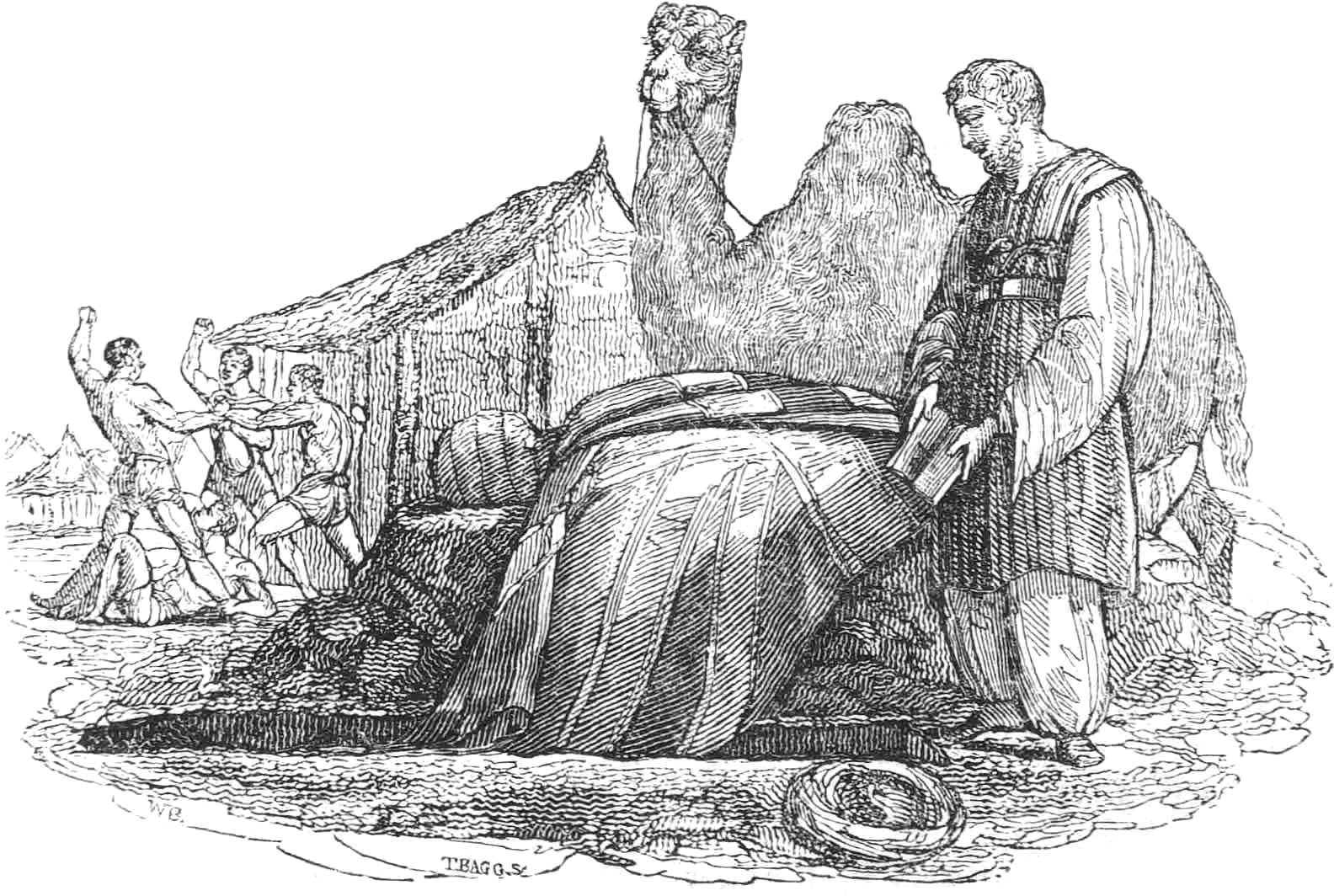
Thus perished, and thus was buried, Captain Hugh Clapperton in the prime of life, and in the strength and vigour of his manhood. No one could be better qualified than he by a fearless, indomitable spirit, and utter contempt of[79] danger and death, to undertake and carry into execution an enterprise of so great importance and difficulty, as the one with which he was entrusted. He had studied the African character in all its phases—in its moral, social, and external form; and like Alcibiades accommodated himself with equal ease to good, as well to bad fortune—to prosperity, as well as to adversity. He was never highly elated at the prospect of accomplishing his darling wishes—the great object of his ambition—nor deeply depressed when, environed by danger—care, disappointment, and bodily suffering which hanging heavily upon him, forbade him to indulge in hopeful anticipations. The negro loved him, because he admired the simplicity of his manners, and mingled with pleasure in his favourite dance; the Arab hated him, because he was overawed by his commanding appearance, and because the keen penetrating glance of the British Captain detected his guilty thoughts, and made him quail with apprehension and fear.
Captain Clapperton’s stature was tall; his disposition was warm and benevolent; his temper mild, even, and cheerful; while his ingenuous,[80] manly countenance, pourtrayed the generous emotions that reigned in his breast. In fine, he united the figure and determination of a man, with the gentleness and simplicity of a child; and, if I mistake not, he will live in the memory of many thousands of Africans, until they cease to breathe, as something more than mortal; nor have I the least doubt that the period of his visiting their country will be regarded by some as a new era, from which all events of consequence, that affect them, will hereafter be dated.
The grave was dug on a naked piece of ground, with no remarkable object near it to invite attention;—no mournful cypress or yew weeps over the lonely spot—no sculptured marble shines above all that remains of heroic enterprize and daring adventure! But the sleeper needs no funereal emblem to perpetuate his name and actions, having erected for himself a nobler and far more imperishable mausoleum in the breasts of his countrymen and the civilized world, than all the artists in the universe could rear over his ashes.
Returning, after the funeral, disconsolate and oppressed, to my solitary habitation, I leaned[81] my head on my hands, and could not help being deeply affected with my lonesome and dangerous situation. A hundred and fifteen days’ journey from the sea-coast; surrounded by a selfish and barbarous race of strangers;—my only friend and protector, and last hope, mouldering in his grave, and myself suffering dreadfully from fever: I felt as if I stood alone in the world, and wished, ardently wished, I had been enjoying the same deep, undisturbed, cold sleep as my master, and in the same grave. All the trying evils I had encountered—all the afflictions I had endured—all the bereavements I had experienced, never affected me half so much as the bitter reflections of that distressing period. After a sleepless night, I went alone to the grave, and found that nothing had been done to it, nor did there seem to be the least inclination on the part of the inhabitants of the village to redeem their pledge. Knowing it would be useless to remonstrate with such wretches, I hired two slaves in Soccatoo the next day, who went to work immediately, and the shed over the grave was finished on the 15th.
[82]CHAPTER XII.
The Author’s severe indisposition and distress of mind — Conduct of Bello — Departure from Soccatoo — The Author almost perishes of thirst in the “Goober Bush,” where he is deserted by the faithless Pasko — The King of Jacoba — Horrid death of that monarch’s slaves — The Author’s arrival at Kano.
The acute suffering, both in mind and body, and the ceaseless agitation and excitement in which I had been kept during the illness, and at the death and burial of my master, occasioned my disorder to increase rapidly on me; and on the 16th, being enabled with difficulty to crawl round the hut, I was obliged to lay myself on my mat, from which I had not strength to arise till the 27th; old Pasko, during that period, ministering to all my wants. Whilst I was thus confined, the weather was so dreadfully warm, that I was under the necessity of having a tub of[83] water at my side, into which, at intervals, I used to plunge my hands and arms, besides occasionally sprinkling my burning head and body. I had abandoned every hope of recovery from the effects of my complaint, and was prepared, in some measure, to undergo the last struggle, when, on the 26th, I found my health suddenly improve in a manner altogether as unexpected as strange; and on the following day I was enabled to sit erect on my mat. In the course of that day (27th) the Godado, mallam Mudey, and Side Sheikh abruptly entered my hut, with a commission from the Sultan to search my boxes, that prince having been informed, just before, that they were filled with gold and silver; although his sole intention, I well knew, was that of ascertaining what fire-arms were in my possession.
Weak as I was, I remonstrated sharply with these ministers of the king’s will, whilst they were prosecuting the search; but it was of no avail—every thing was ransacked and turned topsy-turvy.
They expressed the greatest astonishment on[84] finding not even sufficient money to defray my expenses to the sea coast; but, nevertheless, took an inventory of the contents of the boxes, and carried it to their sovereign. Foreseeing what would happen, I had taken the precaution to secrete about my person the gold watch intended for the Sultan, as well as the private watches of Captains Clapperton and Pearce. The Godado and his coadjutor returned a short time afterwards, with a command from their monarch to deliver up to them the following articles, viz.—a rifle and a double-barrelled gun, two bags of ball, a canister of powder, bag of flints, ream and half of paper, and six gold (gilt) chains; for which he promised to pay me whatever I might demand. I consequently charged him a quarter of a million of cowries for the goods, which I was to receive, on account of the Sultan, of Hat Sallah; and an order was given me to receive that sum in Kano, and what more I might require in my journey over the Desert.
On the 28th I made Ben Gumso a present of four yards of blue, and the same quantity of scarlet damask, an unwritten journal-book, two[85] pair of scissors and two knives. With these articles, which to him were invaluable, I endeavoured to get still further into the good graces of this old Arab emir, who, by a singular piece of good fortune, had just begun to exercise a powerful influence over the mind and actions of the superstitious Sultan.
After escaping from the death he was threatened with at Katunga, which has already been related, this emir returned to Soccatoo; and, like his cheating countrymen, procured a handsome livelihood by writing charms, &c. &c. for the Falatahs. Ben Gumso accompanied Bello in his engagement with the Towayahs, when that monarch was pierced with a poisoned arrow. The Arab’s panacea was resorted to on this occasion; and having written his charm on a piece of wood, it was washed off, as usual, into a calabash of water, and hastily swallowed by the prince. By some means the venom never took effect, and the Sultan having recovered from his wound in a few days, attributed the cure solely to Ben Gumso’s specific. To display his gratitude for the good which had been done[86] him, Bello admitted the fortunate charmer into his councils, and covered him with honors and emoluments.
This being the case, I conceived a trifling present would be well timed; and therefore, after putting it into his hands, entreated him to use his interest with his royal master, in order to obtain his permission for my leaving Soccatoo, and making the best of my way homewards. Accordingly, Ben Gumso represented to the Sultan in lively colours the injustice, as well as impolicy, of detaining any longer in his dominions a subject of the powerful king of England; and advised him to hasten my departure as much as he could, insinuating, that if I were to die in Soccatoo, a report would be circulated and believed, that he had murdered both the white men, by which he would most certainly acquire a bad character.
This artful reasoning overcame the scruples of the Falatah prince, and word was sent me almost immediately, to appear before him. Bello had the gravity of a Mohammedan about him on my entrance, and putting on all the dignity[87] he could assume, looked like Pluto trying a ghost for the sins it had committed on the earth. However, I did not tremble in his august presence; and after a little preliminary conversation, the Sultan asked me which route I should prefer in order to reach my own country.
Now, although my master had intimated his wish for me to proceed with the Arabs to Fezzan, a few days only before his death, I much feared that the papers, &c. entrusted to my care would be taken from me, and myself murdered, by that wily and treacherous race, whose behaviour to my master, after his arrival in Houssa was most abominable. I therefore disliked them—hated them; and would rather cast myself, unarmed and unprotected, upon the good faith of the natives, than go in their train. Under these impressions and prejudices, I answered the Sultan, that I wished to arrive in England in as short a time as possible, and the route through Boussa to Cubbé was most likely to accomplish that object. “It is impossible,” angrily rejoined the prince, “to travel in that direction; the rainy season is already set in; the rivers are[88] overflowed; the low lands are under water; and how do you think to reach the sea-coast in safety? It will be far better for you to go over the desert, with the Arabs; and to facilitate your progress, I will write to Hat Sallah to get a trustworthy person to accompany you; he will also furnish you with camels and provisions, and pay you the money I am indebted to you.” I simply replied, “Very well, Sultan.” He then wished to know whether Captain Clapperton had forgiven Pasko, in his book, for the robberies he had committed; and on my answering that, owing to the illness of that gentleman, he had been unable even to look into his Journal, the monarch observed, that on Pasko’s arrival in England, my king would undoubtedly behead him. I assured him, that if the man’s future conduct proved to be good, not one of my countrymen would think of punishing him; but this the Sultan was in no haste to believe, and said, imperatively, “I cannot suffer him to accompany you; he must stay here to clean and repair my guns!”—this latter consideration evidently possessed greater weight with him than Pasko’s[89] safety, which he cared nothing at all about. Not in the least daunted, I besought Bello to permit him to accompany me as far as Kano, as interpreter; to which he rather reluctantly consented, on condition that I should procure him a horse to return, and pay him the sum of 150,000 cowries, which, of course, I agreed to; and seeing that the Sultan had nothing more to say, I bowed profoundly, and retired. This was my last interview with the Falatah sovereign, and I saw him no more.
On the evening of the 3d of May a person came with a message from the Sultan, who said that a camel and some provisions would be sent me in the course of the morning, and that I was to depart on the next day. Neither camel nor provisions, however, were delivered; and, rising early on the appointed morning, I bade a last farewell to Soccatoo, a town in which I had suffered so dreadfully; and, accompanied by a messenger from the kind old Godado, and Pasko and Mudey, we proceeded with our camels and horses to a large plain, five miles to the east of Magaria, where we arrived in the afternoon; and rested[90] for the night under the wide-spreading branches of a large tree growing on the margin of an insignificant lake. Mosquitoes were in such numbers, and so troublesome, that we could not sleep till morning, when a refreshing breeze springing up, drove them away.
At this flat we joined a party of above four thousand people, of all ranks and of every nation; some going on a pilgrimage to Mecca; some to the sea-coast to purchase goora-nuts; many Tuarick salt-merchants returning to Kilgris; but all travelling in company for mutual protection, and bending their way towards Kashna, where merchants of every description meet, and disperse from thence to their different destinations. An infinite number of camels, horses, and bullocks, attended the party; and the king of Jacoba, with 50 slaves, was also in their train. These poor creatures had been driven from his kingdom by the above prince to Soccatoo, as a present or tribute to Sultan Bello; but that monarch having learnt the dreadful losses he had sustained in men and cattle, in consequence of his war with Bornou,[91] and the number of villages which had been plundered and burnt by the soldiers of the Sheikh, would not accept of the slaves, but desired the king of Jacoba to re-conduct them back to his own dominions.
At eleven o’clock in the morning of the 4th of May a signal to depart was made by a loud blast from a thousand horns, producing a frightfully discordant noise; and in about an hour afterwards the whole party was in motion. On entering the dreaded “Goober Bush,” a wild and uncultivated tract of ground, covered with stunted trees, we were obliged to redouble our pace in order to escape the fangs of the merciless Towayahs. Boussa Jack (a horse so called from having been made a present of by the king of Boussa) I rode myself, on account of his swiftness and agility; but being unused to so violent an exertion, the little animal became much fatigued, and began to lag behind the others. The weather was at that time intolerably hot; vegetation shrank before the piercing rays of the sun, and the dust raised by the hoofs of the horses, &c. arose in huge volumes in every[92] direction, entering my eyes, my mouth, my nostrils, and penetrating even the pores of my skin. Not a breath of air fanned the leaves of the trees; I was almost suffocated for want of it, but snuffed up only sand and dust. The camels were far a-head: I was faint and exhausted, and ordered Pasko to fly to them for a drop of water. The horse would, or rather could, proceed no further; I was obliged to dismount, and seat myself under a tree; there, holding the bridle of the poor animal in my hand, I begged, I prayed the thousands of Falatahs and Tuaricks that were passing, for a mouthful of water to quench my parching thirst; but the unfeeling, iron-hearted wretches mocked my misery, and scoffed at my piteous entreaties, observing, one to another, “He is a Kafir; let him die!”
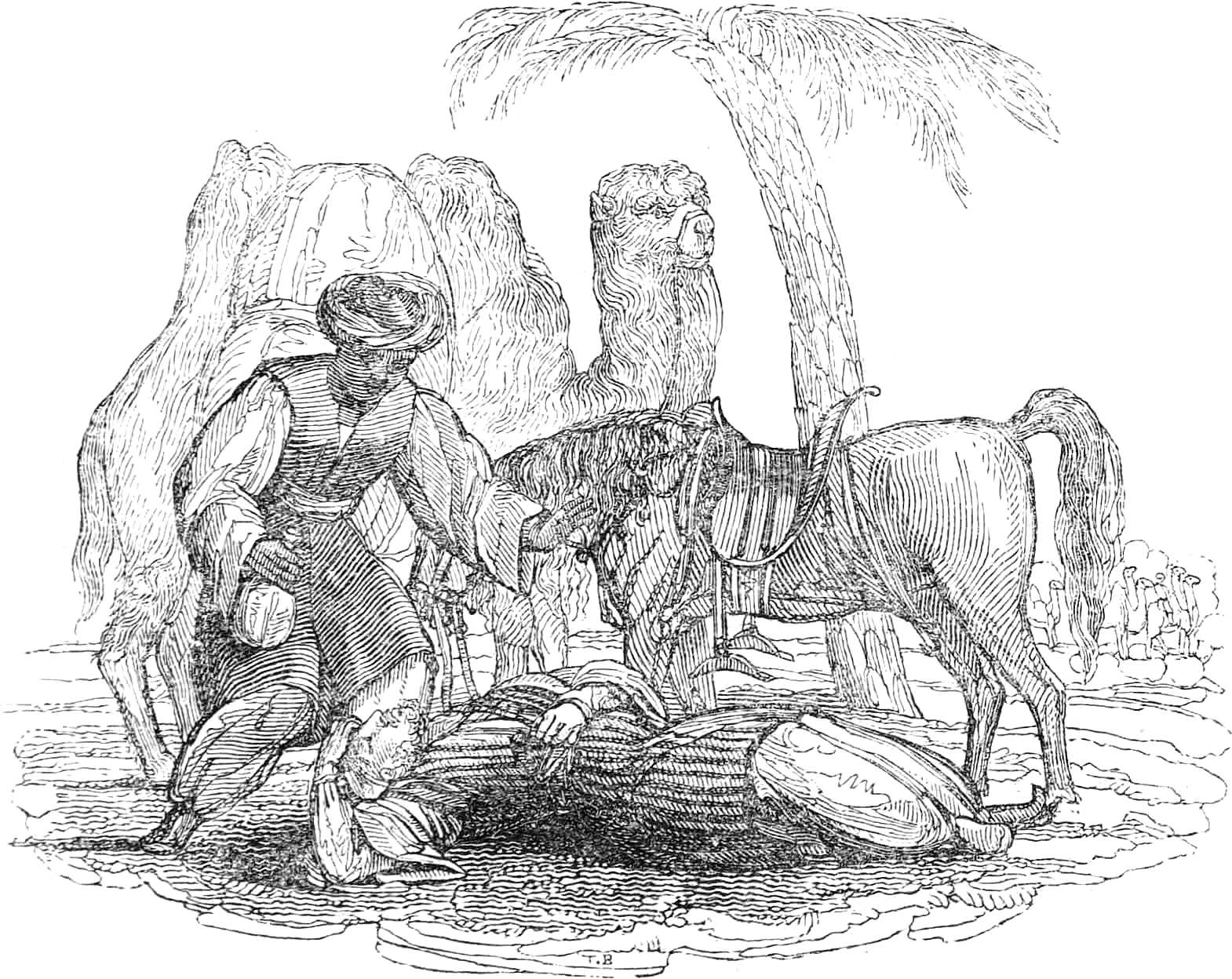
This cruel disappointment almost choked me; I was so hoarse that I could no longer be heard, and, falling flat on my back, let the bridle slip from my fingers, and, covering my face with my hands, tears came involuntarily into my eyes. At length a young Falatah, from Foota Toora, accidentally seeing me lying along the[93] earth with a horse standing listlessly by, came to the spot, and exclaimed, in a tone of kindness, “Christian, Christian, why don’t you go on?” On hearing him, I again sat up, and answered, “I am faint and sick for want of water; no one will relieve me; and how can I go on?”[94] On hearing this, the young man generously presented me with a small calabash full (about a pint), part of which I drank, and with the remainder washed the nostrils of Boussa Jack, and sprinkled a little into his mouth. His countrymen, who observed the compassionate Falatah performing this benevolent action, upbraided him in violent terms for having given water to the Christian; but my amiable preserver, showing them a double-barrelled gun, remarked that he had obtained it of my countrymen, who were all good men, and would do no harm. I, as well as the horse, was greatly refreshed with the small quantity of water thus taken, but soon becoming again weak and dispirited, I was nearly reduced to as bad a condition as before. A few hours afterwards my legs were swollen so prodigiously, that my boots split into fragments, and fell from my feet; and I experienced the most acute pain in every part of my body. At length I perceived Pasko, whom I had sent for water three or four hours previously, comfortably seated with Muley the camel-driver, under[95] a tree,—my provision basket lying open before him, a calabash of the purest water gurgling down his throat, and him, with his sable companion, thoughtlessly enjoying himself with a zest that almost distracted me. I rode hastily up to the spot, and, pulling out a pistol, had more than half an inclination to send the heartless old savage to his long account, but suddenly checked myself. No! I could not take away the life of a fellow-creature, even in the height of excitement; and, replacing the pistol in my belt, I simply asked the reason of his brutal treatment of me. The old fellow answered with his usual demoniacal grin, and as composedly as if nothing was the matter, “I was tired.”
The young Falatah to whom I owe my life came to me on the 7th, and informed me that the whole of the slaves of the King of Jacoba being missing, a party of horsemen had been sent in quest of them, and were just returned with the shocking intelligence of having seen thirty-five of their dead bodies lying along the road; and that hundreds of vultures were already hovering over them. The other fifteen[96] could not be found; but were strongly suspected of having shared in the same fate. These unfortunate creatures had the task of carrying loads on their heads the day before, but, being unable to keep up with the rapid pace of the camels, were necessarily obliged to be left behind, and thus perished miserably of thirst and fatigue. I congratulated myself on my own good fortune, in having so narrowly escaped a fate so peculiarly frightful; and thanked the Almighty with fervor and sincerity for having snatched me from the very jaws of death. On his leaving me, I gave the Falatah a pair of scissors and twenty gun-flints, as a small recompense for the eminent service he had so cheerfully rendered me.
On our road to Kano, the King of Jacoba became very sociable with me, and was my constant companion. After pressing me to visit his kingdom, in which he asserted he would make my stay agreeable, he told me that the Yam Yams, who inhabit the mountains contiguous to Jacoba, were anthropophagi, in which assertion he was borne out by two Yam Yams, who were slaves in Kano when I was in that city. The[97] Prince said further, that people of the same nation, who had assisted him in his war with Bornou, were surrounded, with some of his own troops, on a plain near Jacoba, by the Sheikh’s soldiers, and the carnage on both sides was dreadful. The fight lasted a whole day, when, in the evening, the Jacobeans, with their ferocious allies, were entirely routed, and the King himself, who commanded them, very narrowly escaped being taken prisoner. On the following morning the discomfited Yam Yams repaired to the field of battle, and bearing off a great number of dead bodies, roasted them before large fires, kindled for the purpose, and devoured them without yams, corn, or, indeed, any other provisions!
Soon after our arrival at Markee, on the 19th, a spouse of the chief, a finely-formed and intelligent-looking young woman, came to me with tears in her eyes, and implored me to give her some magonie [medicine], as she had no child. I accordingly presented her with a couple of tea-spoonfuls of oil of cinnamon, and ordered her, with a suitable caution, to put two[98] drops of the liquor into a pint of cow’s milk, which was to be swallowed three times a day till the whole was consumed; observing that, on my return to Markee, I had not the least doubt of seeing her the happy mother of a numerous progeny!
The husband was no sooner acquainted with the circumstance than he came and thanked me in the heartiest manner for the good I had done, gave me abundance of fresh milk, fowls, rice, &c. and told me at the same time that on my return from England, he would reward me with a large sum of money, which I dare say he will do. When I bade the happy couple adieu next morning, they squeezed my hand affectionately, and said, “Christian! God send you safely to your country, and may you speedily come back to Markee!”
I arrived at Kano on the 25th of May, and instantly delivered Bello’s letter and orders to Hadje Hat Sallah; but the Arab, after perusing them, declared at first that he would have nothing to do with me. He had nearly lost his head, he said, on Captain Clapperton’s account on a previous occasion, and positively refused to[99] lend me a single cowry. “I have no objection,” he continued, “to let you have, in goods and a slave, the amount of your demand on the sultan, but I shall certainly do no more.” I accordingly received from Hat Sallah a strong female slave, and a quantity of unwrought silk, and scarlet caps, beads to sell on my journey. My weakened and diseased camels, which would be of no service to me, I parted with, and dismissed their keeper, Maddie.
[100]CHAPTER XIII.
Pasko — The Author pays his respects to the Governor, and leaves Kano — Chooses, near Bebajie, the road to Fundah — Almena mountain — The Author is seen and recognized by horsemen from Zeg Zeg — Arrives amongst the people of Bowchee — Their manners — A girl’s lamentation on being sold by her mother — The Author enters the immense plain of Cuttup — Anecdote of an old woman.
Not having sufficient money at my disposal to purchase fresh camels, or provisions and presents for the different chiefs of towns on the road to Fezzan, I was necessitated to take a different route, which I was not at all sorry for; and for that purpose purchased a horse and two asses. Bello had not forgotten to desire Hat Sallah, in his letter to him, to send back Pasko to Soccatoo the day after my arrival at Kano, and procure me a substitute. I begged of him, however, to suffer the Haussan to accompany me to[101] Coulfo in Nyffé, and promised to have him conveyed back to Kano on my arrival there. He at first refused to accede to my wishes, but the temptation of a present, the best argument in the world in such cases, made the old Arab smile an assent to my proposition; and calling Pasko into his presence, he gave him permission to attend me to Coulfo, but enjoined him to return the moment he had entered that city, on pain of having Jerrub (the Devil) sent after him. The old offender, who could be moved by nothing else, at the bare sound of Jerrub was flung into a violent fever, and hastened to me in great trepidation shortly after, every member of his body trembling like an aspen-leaf. After giving me to understand, as well as his agitation would allow him to do, the conversation he had had with Hat Sallah, and in consequence thereof his reluctance to quit Kano with me, I endeavoured to deride him out of his superstitious prejudices; but they had taken so firm a grasp on his mind that all my exertions were ineffectual; and he still persevered in his resolution of remaining behind. Knowing Pasko’s tender regard[102] for the softer sex, however, I made this a means of accomplishing my object. I had consented he should take the slave that Hat Sallah had sold me, to wife, for he had forgotten the lovely Mattah, of tuah celebrity, and felt great loneliness in the absence of female converse; I therefore assured him that unless he would consent to accompany me, a separation should instantly take place. The event showed that I had touched the right chord; on hearing my decision, he trembled more violently than ever, and while rivers of tears flowed down his furrowed cheeks, exclaimed, in a tone of agony that rendered his expression almost inarticulate, “O, don’t—I—will—go.” This weighty point being decided, I made the necessary preparations for my departure.
On the 29th, Hat Sallah hinted that it would be well for me to pay a visit to the governor of Kano, who was at Faniso. I agreed with the Arab in opinion, and waited on his Excellency in the course of the morning, who, on my leaving him, said, “When you return to your[103] country, Christian, give the Falatahs a good name.”
In the afternoon we left Kano, and travelling at a rapid rate, halted on the banks of the Kogie, four hours’ journey from that place, but the river being much swollen, we did not dare to cross it. To our infinite disappointment I found that the tent poles had been left behind, and was therefore obliged to send back one of the servants to fetch them, giving him a sword in proof that he was despatched by me. The scoundrel, however, never returned; and it being necessary for us to rest on the margin of the stream that night, I slung the tent to the branch of a tree, and fastened the lower part of it to the earth. In the evening the rain poured down in torrents, accompanied by awful and tremendous thunder, so that in the night, our tent being completely drenched, the bough to which it was appended broke with its increasing weight; and falling on us as we were reposing on our mats, we found it impossible to sleep, and were obliged to remain in that miserable plight till the next morning.
[104]We arose at an early hour, and as soon as things were put in some kind of order, I sent Pasko to Kano, to endeavour to apprehend the fellow that had absconded with my sword, for I fancied that one rogue was better qualified to detect another, than an honest man: but the man not having been seen in the city, Pasko was unsuccessful in his search, and returned, very much down in the mouth, bringing with him the tent-poles. The river Kogie by that time was become fordable; but, in consequence of the strength and rapidity of its current, we crossed with extreme difficulty. No sooner was this object effected, and before we had time to clothe ourselves, than four armed slaves from Soccatoo hastened up to us, and demanded the four thousand cowries, which, it will be recollected Pasko had borrowed of Ben Gumso, to defray the expenses of his marriage with the accomplished, but hard-handed, Mattah Gewow. Pasko protested that he had left property in Soccatoo to the value of fifty thousand cowries, out of which Ben Gumso might satisfy himself. This answer by no means pleased the myrmidons of the illustrious Arab[105] emir, who, for the sake of little more than a shilling of English money, had despatched four men to the distance of between two and three hundred miles to arrest the debtor; and they were about to take the affectionate lover away by force, when I thought it time to interfere, and paid them the money they demanded. The armed scoundrels then went their way, taking with them the whole of Pasko’s wearing apparel, which he had left on the opposite side of the stream; so that the every-way unfortunate man was obliged to have a rough mat tied to his waist, till I could procure him a more becoming garment. This little matter being adjusted, to the complete satisfaction of the husband of Mattah, we slept on the borders of the stream for the night, and pursued our journey on the morning of the next day. At two o’clock we arrived at a small walled town called Madubie, in which I erected my tent; and in the evening the chief’s daughter visited me with milk, and a huge bowl of beef and tuah, sufficient for the whole of us for supper.
The weather had been violent during the[106] night, but clearing up early on the 1st of June, we dried the tent, and journeyed onwards till we arrived at the Gora, a narrow, but deep and rapid river. As on the former occasion, the men experienced considerable difficulty in attaining the opposite side, and I was greatly afraid they would be washed away and drowned by the swiftness with which the water rolled on; but, happily, after a world of exertion, they crossed in safety, and at one at noon, passing near the walled town of Bebajie, I desired them to proceed a-head. I myself followed alone at some distance, for I dreaded being seen by any of the straggling inhabitants, who, if they happened to recognize my features, would infallibly detain me amongst them. In half an hour we came to two other roads, the one leading to Nyffé, and the other to the far-famed Fundah.
When Capt. Clapperton found himself dying in Soccatoo, he intimated to me that if I attempted to return through Nyffé and Yariba, the inhabitants of one of those countries, who must have heard of our having taken presents to their common adversary, would undoubtedly[107] put me to death; and this was the reason he wished to impress so strongly upon me the necessity of my accompanying the Arabs over the desert. I paused for an instant, as I looked on each of the said roads; but, feeling an earnest desire, which I could not repress, to visit Fundah, on the banks of the Niger, and trace that much-talked of river in a canoe to Benin; and, perhaps, fearing that my departed master’s observation was well-grounded, I did not hesitate a great while, but travelled on the latter road.
About six in the evening we erected our tent near to Koofa, a small walled town, in which I was fortunate enough to obtain a little sleep for the first time since leaving Kano. The town is situated at the base of an immense rock, on which there is not the slightest trace of vegetation; and, although extremely populous, is no more than two miles in circumference. To the eastward of it is a range of high hills, stretching from north to south as far as the eye can reach; and their slopes being green and luxuriant, they wore a delightful appearance.
On the three following days, we crossed several[108] rapid streams, and passed through many insignificant walled towns. The country traversed on those days, although level, was picturesque and beautiful; and all nature was covered with a lively verdure.
On the 4th of June we came to the foot of a high and craggy mountain, called Almena, rising abruptly from the plains. It consists of gigantic blocks of granite, fearfully piled on each other, and at a distance resembled the rocks in the vicinity of the celebrated logan-stone, in Cornwall. Mohammed, an intelligent mussulman, who was acquainted with the traditions of the whole country, seating himself on a mass of rock, gave me the following story:—
“About five hundred years ago, a queen of the Fantee nation, having quarrelled with her husband about a golden stool, fled with it from her dominions, followed by a great number of her subjects; and built a considerable town at the foot of this mountain, which she called Almena. Her irritated husband pursued the queen with an army; but, losing a great part of his men from sickness and other causes, adopted[109] the language of a suppliant instead of the bearing of the general of an army, and prayed to be admitted into the town, and live in peace with his ambitious spouse. His petition was granted, and the newly-built town flourished under their joint government till about ten or twelve years afterwards, when the natives of the country rose against them, and putting the principal inhabitants, with their sovereign, to death, took the remainder into slavery, and levelled the ill-fated Almena with the dust.”
The town, of whatever kind it might have been, was formerly surrounded by a wall, the ruins of which are yet visible.
We halted at another walled town, called Gatas, in the afternoon, where I accidentally met with some Kano merchants from Cuttup. The inhabitants, discovering by some means that I was a Christian, came in crowds to see me; but behaved in an orderly and respectful manner. I invited the most respectable females into my tent, which they all greatly admired, and in return for this civility shortly afterwards presented me with milk and foorah. The inhabitants[110] of Gatas, as well as those of every other town I had passed through since leaving Kano, are natives of Houssa, and tributary to the Falatahs.
We halted at the outside of Damoy on the 5th, the inhabitants of which informed me that the range of hills I have already mentioned as extending to the verge of the horizon, are inhabited by the terrible Yam Yams, whom they all declared to be confirmed cannibals. That singular people formerly carried on an extensive traffic with the natives of the surrounding country in elephants’ teeth, which they exchanged for red cloth, beads, &c.; but having about five years before assassinated and eaten a gaffle of merchants, all communication had, from that period, been cut off, between the savage mountaineers and their timid neighbours of the plains.
We arrived at Nammaleek on the 7th: the town is defended by a mountain nearly perpendicular, and thickly covered with wood. Thousands of hyænas, tiger-cats, jackalls, monkeys, &c. which exist on the latter, kept so terrific a noise during the night, that although much fatigued,[111] I could not close my eyes. These animals are so bold and rapacious, that the poor inhabitants of Nammaleek cannot preserve a single bullock, sheep, or goat; in consequence of which no animal food was to be had in the town. The chief put us into a hut, and presented us with tuah, which being most unpalatable stuff, by reason of a little sauce, prepared from the juice of the monkey’s bread-fruit tree, which had been mixed with it, I could not taste a mouthful.
I intended to have remained in the place for a few hours on the following day, in order to take medicine; for, having a slight fever on me, I felt extremely unwell; but the curiosity of the people not permitting me to embrace an opportunity of opening my medicine-chest, excepting in their presence, I felt no inclination to try the experiment. In the course of the day (7th) two messengers unluckily recognized me, and asked whither I was journeying. On my acquainting them, the horsemen instantly rode off, and, as I subsequently learnt, returned to Zaria, and informed the King of Zeg Zeg that the[112] Christian was on his way to Fundah, with two asses, loaded with riches, and a beautiful horse, as presents to the monarch of that kingdom.
Leaving Nammaleek on the 8th, and keeping in a south-westerly direction, at the base of a range of mountains, we observed an opening through them, and rode to the opposite side. Our course then lay more easterly; and, having crossed one large and three small rivers, whose names I could not learn, we arrived at Fullindushie, the frontier town in Catica, or Bowchee, in the afternoon. On our journey we met, on their way to Soccatoo, as a tax paid to Sultan Bello from a neighbouring country, thirty slaves, men, women, and children, who were all ill with the small pox. The males were tied to each other by the neck, with thongs made of twisted bullock’s hide; but the women and children were unconfined: notwithstanding the loathsome disease that hung upon these poor wretches, they all appeared merry, thoughtless, and happy, as though they had been enjoying their freedom in perfect health.
The inhabitants of Fullindushie were the first people in Africa I had seen that disdained to[113] confine their well-proportioned limbs in any kind of dress; they went perfectly naked, and laughed immoderately on seeing me; whilst I, on my part, made myself equally merry at the singularity of their appearance. Their sable locks were bedecked with huge lumps of red clay and grease—their bodies shone with a clammy unction, any thing but agreeable to the eye, or pleasant to the smell—a massy piece of blue glass hung from a hole in the upper lip—and from the lobe of the ear dangled a misshapen fragment of red wood, about the largeness of a man’s thumb.
Their features do not resemble, in the slightest degree, those of the Negro, but are fine, regular and handsome, bearing a striking similitude to the European, such as impressed me at first sight;—yet, with all these pretensions to superiority over their jetty neighbours in personal appearance, they yield to them in cleanliness and decency; for, although an artless, good-tempered, social race, the Bowchee people are filthy in their habits, and disgusting in their manners; their sheep, goats, and poultry eat[114] and sleep in the same room with them, and a most intolerable odour is exhaled from all their dwellings. When the females of Catica go to market, they wear a twig tied to the middle, and hanging down in front. Nothing can be more graceful or picturesque than a troop of these modest damsels proceeding to market bedizened in this manner; and I could hardly tell what to make of a body of about a hundred of them which met me near La Zumee. The Bowchee people appear to have no affection for their offspring—the gentle appeals of nature are unknown to them—parental tenderness dwells not in their bosoms; and they sell their children as slaves to the greatest strangers in the world, with no greater remorse of conscience than if they had been common articles of merchandize. As a proof of this strange and unnatural apathy on the part of a mother towards her child, the following touching scene took place at Fullindushie whilst I was in the town:—
A travelling slave-dealer passing through the place, had purchased several of their children, of both sexes, from the inhabitants; and amongst[115] others, a middle-aged woman had an only daughter, whom she parted with for a necklace of beads. The unhappy girl, who might have been about thirteen or fourteen years of age, on being dragged away from the threshold of her parents’ hut, clung distractedly, like a shipwrecked mariner to a floating mast, round the knees of her unfeeling mother, and looking up wistfully in her countenance, burst into a flood of tears, exclaiming with vehemence and passion:—“O mother! do not sell me; what will become of me? what will become of yourself in your old age, if you suffer me to desert you? Who will fetch you corn and milk? Who will pity you when you die? Have I been unkind to you? O, mother! do not sell your only daughter. I will take you in my arms when you are feeble, and carry you under the shade of trees. As a hen watches over her chicken, so will I watch over you, my dear mother. I will repay the kindness you showed me in my infant years. When you are weary, I will fan you to sleep; and whilst you are sleeping, I will drive away flies from you. I will attend on you[116] when you are in pain; and when you die I will shed rivers of sorrow over your grave. O mother! my dear mother! do not push me away from you; do not sell your only daughter to be the slave of a stranger!”—Useless tears! vain remonstrance! The unnatural, relentless parent, shaking the beads in the face of her only child, thrust her from her embraces; and the slave-dealer drove the agonized girl from the place of her nativity, which she was to behold no more.
Quitting Fullindushie, the day after our arrival, in the course of the afternoon, we halted at La Zumee, a small town with a good population. On entering it I observed two men, sitting under a date-tree, to which I instantly walked up, and accosted the one, whom, being neatly dressed, I conceived to be the chief; but was surprised to find that the person I addressed was a Kano merchant; and the individual by his side, a dirty contemptible old fellow, dressed in a filthy sheep skin, I was obliged to pay my respects to as the chief of La Zumee. Having pointed out an empty hut for my use, he disappeared,[117] but returned in two hours after with an apology for not sending me provisions, saying that his wives were at work in his gardens; and on their leaving them he would remember me. Accordingly about three hours after the chief had left me, the industrious ladies brought me a couple of fowls, and tuah and rice, for which I gave them a pair of scissors and fifty needles; the latter articles, like cowries, being the circulating medium of the country. Surrounding the town is a remarkably broad and deep ditch, on the outside of which the country is well cultivated, and the soil appears to be rich and highly productive. On the 10th we slept at Coorokoo, a small walled town, and on the following day pitched our tent on the banks of a large river called Coodoonia, (flowing swiftly to the north-west, and entering, it is said, the Niger near Fundah,) where we lay without food till the next day.
Arising at an early hour in the morning, we succeeded in crossing the water, which reached to our chins, and immediately proceeded towards Cuttup, where we arrived after three hours travelling.[118] Having heard on my route from Kano, so many different accounts of Cuttup, its wealth, population, and celebrated market, I was surprised and disappointed on finding it to consist of nearly five hundred small villages or hamlets, almost adjoining each other; for I had been given to understand, in the hyperbolical relations of the natives, that it was a magnificent and powerful city, the wealth and prosperity of its inhabitants rendering it of more importance than any other in the interior. The villages occupy an immense and beautiful plain, embellished with a variety of elegant trees, amongst which I observed, for the first time since I had left Yariba, the plantain, the palm, and the cocoa trees, all flourishing in vernal luxuriance. The sun shone brightly upon the numerous rural hamlets as I passed through them; the oxen and cows were chewing the cud in front of the tidy looking habitations; flocks of sheep bleated from the inclosures; fowls were clucking in the lanes; small birds were careering in the sky;—all bore an air of peace, loveliness,[119] simplicity, and comfort, that delighted and charmed me.
A considerable traffic is carried on at Cuttup, in slaves and horned cattle; the latter of which are bred by the Falatahs, (great numbers of whom reside there for no other purpose,) who sell or exchange them to the natives. Slaves, as well as bullocks and sheep, are exposed in the market, which is held daily; and also red caps, country cloth, gum, salt, goora nuts, trona, beads, tobacco, rings, needles, cutlery articles; and honey, rice, milk, &c. People from the most remote parts resort to the market in vast numbers, to purchase these various articles of merchandize; and return with them to their respective countries. The chief or sultan as he is called, being a very great man, I thought it would not be amiss to give him a present worthy his dignity and exalted station, and accordingly took him eight yards of blue and scarlet damask, prints of my own gracious sovereign and the late duke of York, with several articles of minor value, in return for which I received a sheep,[120] the humps of two bullocks, and stewed rice sufficient to satisfy the appetites of at least fifty hungry men. I was honoured by a visit from ten of the king’s wives two days after my arrival, who expressing the most rapturous delight on observing the gilt buttons on my jacket, I cut them off, and presented them to their sable majesties, who accepted them with a loud laugh of thankfulness, and sticking them in their ears, bade me farewell, and danced away.
Unlike the princes of Houssa, Nyffé, Borghoo, &c. the king of Cuttup gives his wives unrestricted liberty, which they are never known to abuse; but in other respects they are treated in much the same manner as the women of those sovereigns. During my stay in Cuttup I was never in want of a bullock’s hump, (by far the most delicate part of the animal, and frequently weighing from twelve to fifteen pounds,) the king invariably receiving as a tribute from the butchers, the hump of every bullock they slaughter; and one of these delicious oily excrescences was brought me daily by a person purposely despatched from the queens. Being[121] much in want of money, I ordered it to be published in the market-place that I had needles and beads for sale, which brought a number of individuals into my hut, who purchased freely, giving at least eighty per cent more for my property than for the needles of the Arabs; but whether the buyers actually fancied mine were of more excellent quality than those they had been in the habit of using, or whether it arose from a spirit of curiosity to preserve something belonging to so rare a creature as “the white man,” I was at a loss to conjecture.
An old woman came to me one afternoon, sobbing aloud and full of grief; telling me in a tone of peculiar dolefulness, that all her little savings, the accumulation of years of industry and frugality, had been stolen from a hole in her hut, in which she had concealed it a short time before, by some of her dishonest neighbours; and entreating me to favour her with a charm that would effectually prevent a recurrence of so ignominious an action in future. Being ever willing to oblige the simple-hearted Africans, and knowing also the profound veneration[122] in which a charm of mine would be held by all ranks, I gave the poor woman a teaspoonful of common sweet oil, and urged her to pour it on the money she intended hiding, stating, that if any person should dare to touch it without her permission, he would instantly be punished with suffering and death. I likewise desired her to give the virtues of the charm as extensive a circulation as possible amongst her acquaintances, who would be so awed by the terrible denunciation threatened by the charmer, that fear itself would deter them from exercising their pilfering propensities on her property. The countenance of the venerable matron brightened up at these expressions; and substituting tears of gratitude and pleasure for those of disappointment and sorrow, she fell on her knees before me, embraced my feet, and looking up with a mingled expression of naïveté and maternal tenderness, poured out a full tide of thanks and blessings on her protector, as she called me, which made me blush for the deception I had practised; but I was consoled with the reflection, that in consequence of the invincible[123] superstition—the ignorance—the unconquerable prejudices of the people, and the fear in which I was held, the very object aimed at by me, would in all probability be fully accomplished.
On the 16th I paid my respects to the King of Cuttup and his amiable, laughter-loving consorts; and then pursuing my journey to Fundah in a more cheerful mood than I had felt for a long time, arrived at a small town called Coogie, in the middle of the afternoon. The journey, however, was not of the most agreeable description; the road at one moment winding over a sharp, rugged precipice, and in the next through pools of water and deceitful hollows; we were oftentimes up to the neck in filth and wet; to add to which, flies were innumerable, and so troublesome to the asses by their mischievous propensity to bite and sting, that the irritated animals, flinging off their riders in the mire, and playing all manner of wanton pranks, detained us a considerable time in the course of the forenoon.
The next day our journey was not a whit[124] more pleasant or comfortable. The rain fell in torrents, and the water, roaring down the sides of the mountains, rolled in one mighty stream, with inconceivable impetuosity through the vallies, and carried every thing in its progress. This continued for hours, when the thick clouds dispersing, the sun broke forth in all his majesty, and the tumultuous elements were lulled into peace. We crossed a stream, or river, called Rary, in the course of the day, and slept at Dungoora, a small town, in which we found ourselves very hungry, but could get nothing at all to eat.
We pursued our course on the 18th, and arrived at Dunrora, a paltry town, containing four thousand inhabitants, by six o’clock in the evening. Our route, for some part of the journey, lay over steep and craggy precipices, on the summit of one of which the horse that carried the portmanteaus struck himself against a sharp piece of rock jutting up out of the narrow foot path, and was precipitated a distance of eighty yards, the ropes which were fastened to the portmanteaus arresting his further progress. I[125] was filled with alarm on observing the helpless little animal tumbling head over heels down the frightful declivity, and expected at least that he would have been dashed to pieces before reaching the bottom; but, some stunted trees luckily growing on the side of the precipice, he became entangled in the manner which has just been related. We had been travelling about half an hour, after leaving the spot on which the accident occurred, when reaching a yet more elevated situation, an extensive and delightful prospect suddenly burst on our view; and several days’ journey might plainly be seen before us.
I halted for a moment to gaze upon the fine and noble scene around me, which rivalled in magnificence and beauty the appearance of the landscape from the Kong mountains. About half a day’s journey to the east stood a lofty hill, at the foot of which lay the large city of Jacoba, the metropolis of a kingdom of the same name, to which, it will be recollected, I was invited a short time before, by its monarch; but not having felt any inclination to depart a step[126] out of the direct road, had declined embracing the offer. Mahomet, my servant, declared that a river, called Shar, or Sharra, deriving its source from the lake Tschad, flows about half a mile from Jacoba; and that canoes can be paddled from the said lake to the Niger at any season of the year. The Sharra enters the latter river at Fundah, when, in conjunction with its sister streams, after laving its banks before the towns of Cuttum Currifee, Gattoo, and Jibboo, it joins the salt water; but at what particular place, my informant was ignorant, never having heard the word “Benin” till I mentioned it myself. Fundah lies due west of Dunrora.
Not being aware that the chief of Dunrora was so very eminent a character, my present to him was of a trifling nature, consisting only of a pair of scissors and a few needles, which were returned to me shortly afterwards, with a contemptuous message, importing that I would be pleased to bestow it on a less exalted individual, or send something of greater value. On demanding the reason of such strange conduct from the people[127] who surrounded me, they answered that I had insulted the dignity of themselves and their chief by offering so insignificant a gift, he being a mighty man; but feeling no disposition to add any thing to it, I dismissed the messenger empty-handed to his mighty master.
[128]CHAPTER XIV.
The Author overtaken at Dunrora by four armed horsemen from Zeg Zeg, who force him to accompany them back to Zaria — His reflections — Arrives in Zaria — Treatment of the King and his son towards the Author — His entrance into Coulfo in Nyffé — Revisits Wow Wow — The noted widow Zuma.
As I was loading my beasts to depart on the morning of the 19th, I observed four armed men ride up at full gallop to the residence of the chief of Dunrora, whose horses were covered with foam. The great man was no sooner made acquainted with the nature of their errand, than he came hastily to me, followed by a multitude of people, and told me that I must instantly return with the horsemen to Zaria, the king of Zeg Zeg having despatched them purposely to escort me to that city. I was amazed—thunderstruck. It was in vain to remonstrate with a[129] chief whom I had unwittingly offended: “If I suffer you to proceed on your journey to Fundah,” said he, “I shall lose my head; you must submit.” Entreaty, cajolery, and persuasion, were alike useless; the orders of the armed men were imperative; they were backed by a thousand bows and arrows; and with a heavy heart and cruel reflections, I turned the head of my horse towards Cuttup.
Thus was I obliged, after seventeen days’ perilous travelling from Kano, with a fair prospect of reaching the celebrated Fundah in twelve or thirteen more, from whence four days’ sail would bring me to the salt water—a new country opening before me, and my mind filled with the most lively anticipations of solving the geographical problem, as to whether the Niger actually joins the sea in that direction;—thus was I obliged to abandon my fondest and long-cherished expectations, and return to Zeg Zeg; thence to be transported the Lord knew whither! I felt depressed and miserable at this sudden and unexpected change in my[130] affairs; and was really indifferent as to my future proceedings; caring not whether I lived or died.
On our arrival in Cuttup, I was attacked with dysentery, and, much against the inclination of my escort, obliged to remain there four days, suffering during that period, and indeed a long while afterwards, more dreadfully than I can or will describe. Finding me very tractable, and too ill to make the least exertion, the horsemen left me in Cuttup, and in their stead substituted two homely, peaceable men, who proceeded with me in a different direction, towards Zeg Zeg.
The following day the asses were excessively troublesome through the attacks of forest flies, myriads of which swarm around and alight in great numbers on men and beasts. These insects bit the asses so severely that blood streamed copiously from their sides, and the animals at length became so restive, that Pasko and Mohammed, who rode on them, were frequently thrown to the ground; besides which the loads on their backs were seriously damaged by reason of the asses rolling themselves in the earth, and rubbing their backs against the trunks of[131] trees. We slept in our tent in the midst of a large wood, surrounded by vast numbers of bamboo, palm, and cocoa trees; and, although very ill, I found myself considerably stronger.
At Cokalo, a Bowchee village, where we arrived on the 27th, the inhabitants were so poor, that they sent us nothing but corn; but the chief, in honor of our arrival, made a fetish, and having roasted a fatted dog, stewed a snake in oil and water, and boiled a quantity of corn. He then invited his people to a feast; and they partook of the good things set before them with peculiar relish. With a benevolence truly amiable, a small bowl of the corn so prepared, enriched with a portion of the reptile, and the liquid in which it had been dressed, was brought me from the chief’s table; and, supposing it to be fish swimming in oil, I ate a mouthful or two with a very good appetite. It had, however, a peculiar, although certainly not a disagreeable flavour with it, and I carelessly asked a person standing near, the name of the animal I was eating; but on his assuring me that it was part of a land fish, my appetite forsook me, and Pasko, who[132] had been casting many a longing eye on the delicate morsel, devoured the remainder with looks of infinite delight, asserting that it equalled in goodness the best dried ling he had ever tasted.
On the following morning we arrived on the banks of the river Coodoonia; but there it was broader, deeper, and more rapid than at Cuttup, insomuch that it was dangerous to cross it. In attempting to convey, on a small bamboo raft, one of the portmanteaus to the opposite side of the stream, I found that it would not bear its weight, and I snatched it from the sinking frame, a few feet only from the margin of the water. Being convinced, therefore, that it would be dangerous to cross till the river became shallower, I strenuously objected to the wishes of my guard, (who almost dragged me into it,) and insisted that I would risk neither my person nor property on so fragile and dangerous a conveyance as the one at the ferry. The men, finding me resolute in my determination, poured out a volley of abuse, and threatened in insolent terms to go immediately and[133] inform their sovereign of my refusal to accompany them. I desired the fellows to give my best respects to his majesty, and said that they were at liberty to go as soon as they pleased; and they left me in great anger, cursing me as they went, whilst I slowly returned with my horses and asses to the village we had left an hour before.
Whether the messengers did or did not go to their king, I cannot tell, but they did not come back till nearly a fortnight afterwards; and during that time I was ill in the village, with nothing to eat but boiled Indian corn; for I by no means relished the huge luncheons of roasted dogs which were served up twice in the day. The inhabitants, who came in hundreds to see me, like their countrymen, were destitute of apparel of any kind, yet behaved with becoming decency; and I never had cause, in a single instance, to complain of the conduct of those simple-minded savages. The male portion of the community seemed to have no occupation or employment whatever, spending the whole of their time in lounging and loitering about their native[134] village; whilst the women were more laudably engaged in extracting an oil from a small black seed and from the guinea-nut.
My escort returned on the 11th July, and in a tone of deep submission begged me to go along with them, urging as a reason that the king of Zeg Zeg would not give his permission to my proceeding a single step, unless I visited first at Zaria, the capital of his dominions. Accordingly, our beasts were loaded, and I followed them a second time to the banks of the Coodoonia, but found the river still too deep to ford; and one bamboo raft being insufficient to bear a heavy article without sinking, I caused two of them to be lashed together, which answered the purpose extremely well. The portmanteaus, &c. were first taken over, and I, laying myself flat on my face, was next pushed across by the two messengers, who swam behind, and dexterously propelled the frame forward by their hands and feet. The horses and asses were not quite so fortunate, for the current being strong and swift, they were borne by it nearly a quarter of a mile down the stream, and[135] could scarcely stand from exhaustion for some time after they were dragged out of the water. Every thing being at length safely landed on the opposite side, we left the borders of the river, and pursuing a north-east course till sunset, pitched our tent on a rising ground, near to a small stream.
Leaving our encampment at half-past six in the morning, we halted outside Accoran, the first walled town I had seen since quitting Nammaleek. The west end of it is defended by a gigantic naked rock, and the other parts by a mud wall and a spacious ditch. The inhabitants are Bowchees, but so miserably poor that not even a single goat or fowl could be procured in the town. We were again in motion on the 13th, and traversing an agreeable country intersected with shallow streams, arrived at Cowro in the afternoon. The palm and cocoa, which had been so numerous since leaving Dunrora, suddenly disappeared after we had passed Accoran, and we saw no more of those beautiful trees till we reached the kingdom of Yariba. We remained at Cowro three days,[136] the beasts and their riders being equally fatigued; and its chief, a noble looking Houssan, behaved with the most studied civility towards his guests. He was neatly clad in a white tobe, trousers, and cap; but he wore no sandals, and his feet were stained with hennah. In return for the chief’s kindness, and the excellent provisions he supplied us with, I made him a present of an old piece of carpeting, a scarlet cap, white turban, and gilt chain, which he received with extraordinary demonstrations of gratitude.
Having been ferried across a large river called Makkamee, we entered a town of the same name, situated at the distance of a quarter of a mile from its banks, where we slept; and on the following day, halting at Wautorah, a walled town, I shot a few pigeons, which so terrified the inhabitants that they did not approach me for some hours afterwards. The morning of the 19th was damp, foggy, and disagreeable; and Mahomet, who, with all his intelligence, was an idle scoundrel, wishing to have a holiday, refused to proceed any further with me. The messengers longed also for a similar indulgence,[137] and fancying, no doubt, I should be unable to go on without them, followed my servant’s example; but, seeing through their design, I immediately ordered Pasko and his faithful wife to load the beasts, and so left the town without them. Unluckily, a path leading to the gardens of the inhabitants misled me; but having discovered my error after an hour’s travelling, instead of returning by the beaten track the way I had come, I crossed the country in the direction I conceived the main road to take. Owing, however, to the swampy nature of the soil, I did not attain it till four o’clock in the afternoon, when, after a journey of two hours, the beasts becoming exhausted, I pitched the tent by the road-side, and being greatly distressed for want of water, slaked my thirst with some, which, oozing from the fissures of a neighbouring rock, made a gentle gurgling noise, that drew my attention to the spot.
We struck our tent on the morning of the 20th, and crossing a large river flowing to the southward at one o’clock, entered the spacious and handsome town of Eggebee an hour afterwards.[138] Eggebee is governed by one of the king of Zeg Zeg’s principal fighting men; and for its excessive cleanliness, the tidiness of its inhabitants, their prosperity and apparent happiness, yields only to Wow Wow; and strongly reminded me of my own far distant country. It is situated on a fine, highly-cultivated plain; and nothing can be more agreeable than the prospect of the country for miles round. I have seen many charming landscapes in Africa—many which come nearer to my ideas of the garden of Eden than any others I have beheld—but none so pleasingly, softly beautiful, as that near Eggebee. The earth, clad in simple and lovely magnificence, was embellished with superb trees filled with singing birds—plots of Indian corn waved in the wind—a luxuriant vegetation sprung up at every step—every living thing revelled in enjoyment—happiness, peace, and plenty dwelt on the enchanting spot. It was evening when I took a stroll a little way into the country—a calm cloudless, lovely evening. The earth had just before been refreshed by a shower, and the sun[139] was setting in all his glory; the neatly-attired maidens of Eggebee, returning to the town with calabashes of milk, sang as they went along; birds of golden plumage fluttered on the branches of the noble trees; insects of dazzling brightness buzzed in the air; the stridulous notes of the grasshopper was heard from the ground; smoke ascended in circling volumes to the skies from the dwellings of the people; and the music of guitars and dulcimers swelled from the town,—all was soothing, serene, heavenly. I was a sojourner in a strange land; I thought on my country, my kindred, my home, till melancholy reflections rushed upon my mind, and I longed to lay down my burden of care and suffering, disappointment, vexation, and sorrow. “I am unhappy,” I said to myself, “in all this loveliness; I have no portion in the pleasure that surrounds me. Why am I an Englishman, why am I not rather an African? I should then be simple as he, thoughtless as he, happy as he.”
The delightful town of Eggebee contains a population[140] of not less than fourteen thousand souls; and its wall, forming a perfect square, measures a mile each side. The inhabitants being supplied with a fine reddish sand, (found in abundance along the beach of a noble river, flowing about a couple of miles from the town,) and a kind of whitening, use these ingredients for the purpose of cleansing their calabashes, and other domestic articles; and really it gives one a sensible pleasure to observe the taste and regularity with which these are arranged in the interior of their dwellings, and the extreme whiteness of the whole. The calabashes have figures of horses, sheep, cows, &c. carved on them by persons whose time is entirely devoted to this single object, and who receive for the work on each the sum of five cowries (less than a farthing sterling). Instead of sleeping on the bare ground, as is the case in every other town in the interior, excepting Cuttup, the inhabitants of Eggebee raise a kind of platform at a height of three or four feet from the floor, supported on clay pillars, on which they repose themselves during the heat of the day, and at night. In the vicinity[141] of the town grew a great variety of beautiful flowers, which opening in all their richness to the rays of the sun, had a truly enchanting appearance. Many of them were of the same species as those which thrive so luxuriantly in the interior of South Africa; but the fragrance emitted from the former is neither equally pleasant nor equally powerful.
We left Eggebee on the morning of the 21st, and the asses becoming exhausted, encamped in a thick wood for the night. No village being near at hand, we could obtain no provisions, and consequently went supperless to bed. On the following morning we entered the city of Zaria, and took up our quarters with Abbel Crême, Captain Clapperton’s host and friend on his journey to Kano. The king was in the country, and did not see me on the day of my arrival, but had left orders to have me well supplied with provisions. His majesty returned in the evening, and sent a messenger to say that he should be glad to see me early on the following morning; accordingly at the time appointed I visited him with a suitable present, which greatly[142] delighted him; and he took the opportunity of telling me that it was entirely for my own sake he had ordered me to be brought back; for, said the king, “Sultan Bello is at variance with the rulers of Fundah, and the latter would have you beheaded the moment you set foot in his dominions, because he well knows you have been on intimate terms with his powerful antagonist.” I, of course, acquiesced in the opinion of his Zeg Zeg majesty, praised to the skies the charitable spirit that had influenced him, and admired the milk of human kindness that flowed in his veins; this well-timed flattery pleased the monarch as much as the present had done; and in the course of the day I received a present of two fine bullocks. Abbel Crême having intimated that the king’s eldest son was invested with as much authority as his father, I waited on him with a trifling gift; on which occasion he received me very graciously. The prince was a remarkably fine young man, apparently about twenty-two years of age, and beloved by every one. As an especial mark of favour, I was introduced into his seraglio to see his wives.[143] They were fifty in number, and on my entrance were all industriously employed in preparing cotton and thread, and weaving it into cloth. My intrusion was not remarked till the prince said, “I have brought the Christian to see you;” their eyes were immediately fixed upon me at this expression, but on observing my white skin, the bashful creatures, simultaneously dropping their work, flew with all possible haste into their coozies, and I saw no more of them. In the afternoon the prince offered me a really pleasing female named Aboudah (woman) for a wife. I was almost frightened to death at the very sound of wife, yet I accepted her with the best grace I could assume, not only to avoid offending my royal friend, which would inevitably have been the case, if I had refused the well-meant offer; but also that I might at least have the satisfaction of giving the poor creature her freedom if I ever reached the sea-coast.
Mahomet came to me on the 23d, having just arrived from Wautorah, where he had deserted me, and entreated to be admitted again into my service; but the fellow had behaved so ill[144] towards me, that I ordered him to go about his business. I had seen enough of him to convince me that no dependance whatever could be placed on the fidelity of hired domestics; and therefore purchased a slave in Zaria for seven dollars, to supply Mahomet’s place. The asses being nearly worn out from our long and fatiguing journey, and requiring at least twenty days of rest to recruit their strength, I exchanged them for a strong Yariba pony, which, with a pack bullock the king had given me was fully adequate to undertake their work. Both the monarch of Zeg Zeg and his son were warring when we passed through their territories on our way to Kano; and it was in order to gratify their curiosity, I verily believe, that I was so unfortunately stopped on the road to Fundah.
I bade adieu to the king and prince on the 24th, and, risking every danger, pursued my journey towards the dreaded Nyffé and Yariba.
Leaving the extensive empire of Houssa three days after, we entered Guârie in the evening of the 27th, and on the 29th pitched our tent outside[145] of the capital, which is also called Guâri. Next day we found the river, near the city, so much swollen, that I considered it would be imprudent to attempt to cross; and on the 31st I waited on the king, governor, or whatever he is, of Guâri, with a present of light blue and scarlet damask, and a smart red cap. He was a man of venerable appearance. He wished to know the reason of my having been so long on the road from Kano, as merchants had informed him that I had quitted that city some time before. I replied that I had attempted the road to Fundah, it being the nearer way, but that the King of Zeg Zeg had sent armed men after me, who had compelled me to retrace my steps. He observed that if I wished to proceed to that kingdom then, he would send a messenger with me, and he had no doubt, as the monarch of Fundah was his particular friend, I should experience every kindness at his hands. I expressed great concern at being unable to embrace his generous proposal, having nothing good enough left to give the King of Fundah; and on that[146] account feeling no particular wish to pass through his dominions.
His Guâri majesty had in his service an eunuch, whose native town was not far from Fundah; and, at his sovereign’s instigation, the man paid me a visit. In the course of conversation with him, the eunuch told me that he was born at Gibboo, a town situated on the banks of the Niger, and about four days journey from the city of Fundah. He had often proceeded by water from the former to the latter place in eight days, the river running five knots an hour against him; but the voyage from Fundah to Gibboo might easily be performed in three, or at most four days.
I had no opportunity of ascertaining whether the testimony of the eunuch was actually correct; as the reports of the natives, whether owing to the difficulty of expressing themselves so as to be understood by a stranger, or from other causes, vary considerably. I should conceive that the former is the chief reason of this difficulty so often complained of; and that in their relations of rivers and streams, the natives do not[147] designedly deceive, but the interrogator, taking no pains to obtain a clear idea of their meaning, forms an opinion of his own which he fancies approaches nearest to that which his informants themselves entertain.
I fell in with a party of merchants in Guâri, who were so far on their journey to Coulfo, and they begged me to accompany them to that city, in order to repel the attacks of a desperate gang of robbers, which they affirmed infested the main road leading to Nyffé, and had committed dreadful excesses. Fearing there might be some foundation in this rumour, I waited for the merchants three days; but they not having then paid the accustomed tribute, and not seeming to have the slightest inclination to do so in a hurry, I preferred risking the alleged dangers in the path, to abiding longer at Guâri.
On the 2d of August, therefore, I paid my respects to the king, who offered a messenger to accompany me to Womba; but I declined the offer, observing that I was not afraid to proceed with my own little party; and on the next morning left the city, without merchants, messengers,[148] or guide. No robbers molested me; nor did I see a single suspicious-looking fellow on the path; and I reached Fullindushie, the second town of that name, after a ride of nine hours.
The following day it rained incessantly, so that we were unable to take down our tent, and remained under it till the 5th, when we continued our course, and encamped outside the walled town of Kazzagebubba by four in the afternoon. The chief apologised for sending us nothing better than tuah and corn, on the ground of its being market-day; and this trifling present was acknowledged on my part by a red cap and a pair of scissors, which made the receiver proud, vain, and foolish.
Next morning we were again in motion, at an early hour: and having crossed a large river, in the afternoon, we pitched our tent in the centre of a number of small, uninhabited grass huts, erected as a temporary abode by a party of merchants some months previously. In the night myriads of mosquitoes annoyed us so greatly that we were obliged to set fire to the huts, in order to be rid of them.
[149]On the 7th we arrived at the spacious town of Womba; and, being sadly in want of money, I despatched Jowdie, my slave, to the market with needles to sell, which fetched fifteen cowries each, and brought me 3,400 of them. The chief, having declared the road to be dangerous, would insist on sending an armed guide with me; and on the morning of the ninth we left Womba in company; halted on the south side of a large river at six in the evening, and fixed our tent in the midst of grass huts, similar to those already mentioned; but they harboured, as on the former occasion, mosquitoes and vermin, so that we were under the necessity of burning them to the ground.
Hearing that a gaffle of merchants had been plundered, and many of them slain, by freebooters on the road I intended taking,—instead of journeying in a south-westerly direction to Borghoo, I travelled by another route, and halted at the town of Beari on the evening of the 10th of August. As soon as one of the head-men was aware of my approach to the king’s residence, he blew a blast “both loud and[150] shrill,” on a long brass trumpet, in token of welcome, the noise of which brought all the principal inhabitants to the spot, who went with me into the chief’s hut, and seated themselves in a circle round that individual and myself. The chief was a fine handsome fellow, apparently about fifty years of age, with a noble expression of countenance and a commanding air; and the coozie into which I was introduced was the largest I ever saw in Africa, being not less, I should think, than eighty yards in circumference. The conversation was carried on through the medium of a third person, (although the chief himself perfectly understood what I said,) which singular custom is, I believe, peculiar to Beari, for I never observed a similar practice at any other place. The town contained about four thousand inhabitants, and was surrounded by a high wall and ditch.
On the 12th we halted at the town of Ragada; and its chief, who was delighted to see me, gave me a whole sheep, fowls, and a jar of gear (an ale manufactured from Indian corn). It began to rain a few minutes after we had quitted Ragada,[151] and continued without ceasing till we encamped a little to the westward of Wittesa, in the afternoon; and although the portmanteaus were secured in a thick bullock’s hide, every thing they contained, with the exception of the papers, became completely saturated with water. In order to dry the tent, &c. we were obliged to remain at our encampment the following day, towards the evening of which a fellow came outside the pavilion with a calabash of bum, and bawled out repeatedly in an insolent tone that I should come out and drink with him. Being busily engaged in packing up the articles that had been put out to dry, I paid no attention at first to the vociferous bellowing of the man; but becoming at length impudent and daring, he threatened to break into the tent, when, thinking to intimidate him, I took a loaded pistol and went out. I told the noisy scoundrel that if he did not instantly quit the spot, and stop his throat, I would shoot him without further hesitation; but this menace, instead of terrifying him, only incensed him the more, and flourishing a lance he had with him over his[152] head, as quick as lightning, he made a desperate thrust at my breast; but slipping a little on one side, I parried the weapon with my hands when within an inch of my body, and this fortunately saved me from being run through. This was carrying the jest a little too far, and striking the ruffian violently with the but-end of my pistol, I desired his companions, who stood near, and were spectators of the whole affray, to take him instantly from the tent, or I would fire at him in earnest. The men accordingly dragged away the intoxicated fellow to his home; but he returned the next morning, and throwing himself at my feet, begged that I would not inform his sovereign of the conduct he had displayed, for that he should be beheaded if it came to the king’s ears. I promised to accede to his wishes, on condition that he should never get tipsy again; whereat the man evinced the most lively gratitude, and shed tears of joy.
We struck our tent on the morning of the 14th, and passing through the ruins of a large town called Kabojie, halted a little to the westward of Dogo at three o’clock in the afternoon, where we[153] slept. In the evening I was visited by several respectable females of the neighbouring town, who brought with them stewed beef and tuah, for which I recompensed them with a few beads.
At two o’clock in the afternoon of the following day, we entered the celebrated commercial town of Coulfo, where I was met at the gates by the female, in whose house we lodged in our way to Kano, accompanied by every lady of note in the town, who expressed the most lively joy on seeing me again; but when I informed them that Captain Clapperton was no more, they wept bitterly, and, wringing their hands, made loud lamentations. Although the town was filled with merchants, and her own house occupied by some of them, my kind hostess turned out her lodgers, and gave me the best apartment in it. The merchants came from Cuttum Kora, Youri and other provinces in Borghoo, Yariba, Kano, and Soccatoo, to purchase Nyffé cloth (which is decidedly the best in the interior), iron bits and stirrups, brass ornaments for saddles and bridles, brass ear-rings, &c. &c. the traffic in which is carried on to a considerable[154] extent. The good old chief sent me fowls, tuah, milk, and bum; my hostess gave me a sheep; and during my stay, this excellent old lady supplied me with the choicest provisions daily.
I take this opportunity of expressing my high admiration of the amiable conduct of the African females toward me; in sickness and in health; in prosperity and in adversity—their kindness and affection were ever the same. They have danced and sung with me in health, grieved with me in sorrow, and shed tears of compassion at the recital of my misfortunes. When quite a boy, and suffering from fever in the West Indies, women of the same race used to take me in their arms, or on their knees, sing and weep over me, and tell me not to die, for that my mother would break her heart to hear the news; and pointing to the ocean, they cheered my spirits, by saying that it laved the shores of England, and would shortly bear me on its bosom to my distant home. In fine, through whatever region I have wandered, whether slave or free, I have invariably found[155] a chord of tenderness and trembling pity to vibrate in the breast of an African woman; a spirit ever alive to soothe my sorrows and compassionate my afflictions;—and I never in my life knew one of them to bestow on me a single unpleasant look or angry word.
I abode in Coulfo five days, and finding my Yariba pony, and the bullock the King of Zeg Zeg had given me, unfit to bear the fatigues of a journey to the sea coast, I exchanged the latter, with an old Turkish jacket, for a couple of asses; but, owing to its being in so miserable a condition, no purchaser could be found for the pony, although I offered to sell it for a dollar. On the morning preceding my departure, poor little Boussa Jack, the faithful companion of my wanderings, was discovered lying dead outside my hut, having crawled from its stable, in the night, to die as near to its master as possible. Bidding my generous hostess an affectionate adieu, I paid my respects to the chief, and left Coulfo in high spirits and health, on the morning of the 20th of August; and halted at Majonka in the afternoon. In the town I[156] met with a gaffle of merchants on their way to Gonja, to purchase the kola, or goora nut. Being unable to procure any kind of provisions in the place, I took my gun, and shot a heron, not being aware that this, being a fetish bird, is allowed only to be eaten by the chiefs; but, on being made acquainted with the circumstance, one of the principal inhabitants, came to my house with a loaded musket, and, using the most abusive language, threatened to discharge it in my face. Not at all daunted, I dared him to fire; and hinted that I should take the liberty of acquainting the King of Nyffé with such unwarrantable behaviour, when the fellow stammered out an apology, and sneaked off. Early on the following morning the man returned to my dwelling, and in a tone of humiliation, begged me not to carry my menace into execution, (which, indeed, I had no intention of doing,) and excused the violence of his conduct, on the plea of having swallowed too large a quantity of bum the preceding day. At six o’clock we continued our route, halting at twelve at noon at Dalho, on the banks of the[157] river Quontakora, which having crossed with some difficulty, we journeyed till sun-set, and reached the foot of a hill, five miles to the eastward of the Niger, where we pitched our tent, and slept. We arrived on the banks of that river on the following day, and found it to be at least a hundred yards broader than it was on our way to Soccatoo; and after our hallooing a thousand times, the boatman on the opposite side came to fetch us. My poor slave, Jowdie, who had never seen so large a body of water before, became terribly agitated at the bare thoughts of crossing it; but getting him at last, after much persuasion, into the canoe, I found him overpowered with fear, and he fainted the moment he set his foot on terra firma. We landed at Inguâzhilligie, where the principal inhabitants pressed us to remain; but, having no presents to offer, I declined stopping, and expecting to reach a village in the evening, made all possible haste to get out of the town. The path lying through swampy ground, was horribly bad, and the asses could only travel two miles an hour; so that at six, P.M., the beasts being[158] completely knocked up, we were obliged to pitch our tent in the midst of a wild, dismal, uncultivated waste. In these journeyings Pasko headed the party; Aboudah, Joudie, and Pasko’s wife then followed with the baggage, whilst I myself brought up the rear; by which arrangement the whole of them were under my own eye, and I could watch all their motions. After erecting the tent, and previously to retiring to rest, it was my usual custom to read aloud, from a book of common prayer, some portion of its contents, making the servants sit around me in a circle. By this pleasing exercise I felt unusual calmness and serenity steal over my mind; and I slept as soundly in the bosom of awful woods, amidst the howlings of the tempest and the pelting of the storm—the yell of the tiger and the hollow roar of the crocodile—as if I had been reposing on a bed of down in my own country.
The roads were equally bad on the 23d, and the rain, which fell heavily and incessantly, drenched us to the skin; so that about the middle of the day we were obliged to encamp in[159] a small village, where we attempted to sleep. The poor beasts had stuck in the bogs several times in the morning, on each of which occasions they were dragged from their unpleasant situation with much difficulty, and retarded our movements considerably. None of the inhabitants of the village understanding the Houssa language, I entered a hut, the door of which was open, and presenting the inmates with a few beads, made them comprehend by signs and gestures, that we were wearied and hungry, when one lean fowl alone could be procured; but having the good fortune to shoot a guinea-fowl, we made a tolerable supper, and went contentedly to rest.
A ride of eight hours on the following day brought us to the celebrated city of Wow Wow, the birth place of Mohammed, the residence of the lovely Zuma, and the scene of our adventures with those two illustrious characters on our former journey into the interior. I had taken two days and a half on the road from Inguâzhilligee, while in the dry season we had done it with ease in one.
[160]The day after my arrival I visited the king with a present of scarlet and blue damask, &c. and Mohammed, although he was overjoyed to see me at first, was greatly distressed, and wept much on hearing of the death of Captain Clapperton in Soccatoo. He wondered at my being alive after visiting the Falatah country, the natives of which, he maintained, were the most barbarous and blood-thirsty in the world; and said moreover, that I was certainly one of God’s own favorites, or I never could have escaped so easily from their clutches. I was obliged to comply with the monarch’s request, which indeed was tantamount to a command, to abide at Wow Wow a few days, in order to clean seven muskets and three pistols, which he afterwards told me belonged to the white men who were drowned in the Quorra. They had the Tower mark on them, and were in excellent condition. Having obtained permission of Mohammed to visit the amiable king and queen of Boussa, whose behaviour to me, it will be recollected was so inexpressibly kind, after my escaping from my confinement in the Zuma elopement affair,[161] I took old Pasko with me, and left Wow Wow early in the morning of the 27th; but after journeying till six in the evening, we had only got half-way to the city, in consequence of bogs and swamps, which overspread the country. Our horses were oftentimes up to the saddles in mire and wet, and Pasko’s legs being excessively short, the exertions of his animal to extricate himself threw him from its back into the filth on the path, so that the old man was covered with dirt. The remaining part of the journey appearing yet more difficult and dangerous, I found it impossible to go on; and being directed by a glimmering light to a solitary hut embosomed in trees, we slept there, and returned to Wow Wow on the following day.
The king sent me a goat, cut up into small pieces, and a large bowl of tuah, on the 29th, in order to make a sadacco for my lamented master; a ceremony common to many places in the interior, on the decease of any person of consequence. The bowl of tuah and the goat’s flesh were forwarded to a mallam, who repeated a short[162] prayer over them; but before this ceremony could be performed, it being necessary to place a gold or silver coin, or in lieu thereof, an article made of either of those metals, on the top of the bowl, I put a silver pencil-case on the tuah, which was never returned me. As soon as the prayer had been offered up, the consecrated articles were immediately forwarded to me, and hundreds of the Wow Wownese flocked to my habitation to show their respect for the memory of the deceased, by partaking of the goat’s flesh and tuah, each person ejaculating with fervor, on conveying the food to his lips, “God send the Christian safe to heaven!” It is unnecessary to say, that the bowl was soon emptied of its contents.
The day after the celebration of this mournful rite, having finished cleaning the fire-arms of the venerable Mohammed, I requested his permission to leave Wow Wow; but the king, smiling, told me that not half my business was done; for that he wanted to have six charms, which I alone could write. “The charms,” said the[163] learned Moslem, “will be worn round my waist, and are to possess the following virtues: 1st charm: if my enemies think of making war on me, it shall cause them to forget to carry such an intention into effect. 2d. If my adversaries be on their way to Wow Wow for the purpose of warring, it shall cause them to be dismayed and turn back. 3d. If they discharge their arrows at my people when close to the city walls, the province of this charm shall be to make them rebound in their own faces, and wound them. Let the fourth prevent my guns from bursting; and the fifth hinder the persons that hold them from receiving an injury, should they by any accident break when loaded. The sixth and last charm is to make me the happiest and most successful of men.” I protested my inability to comply with his wishes, on the ground of ignorance; but the old man, wisely shaking his cranium, said with a significant look, “Nay, Christian, don’t be so modest; I know you have the power; it is useless to attempt to deceive me; let me see how long it will be before you produce them.” On the following[164] day, therefore, I took my charms to the superstitious monarch of Wow Wow, on which I had written scraps of old English ballads; and the prince was so much pleased with my civility, that he paid me a thousand compliments, and I left him in the best humour in the world. Thus was I obliged in this, as well as in former instances, certainly against my inclination, to copy the example the Arabs had set me, of imposing upon the ignorance and superstition of the natives, of which I have complained so frequently. It was utterly useless to deny them so singular a favour on the plea of incapacity or ignorance; for on urging either of these reasons, it was not unusual for them to say, “The white man is ill-natured; he is no good man;” and run away with tears in their eyes.
Not satisfied with all I had done for him, Mohammed still wished to detain me in Wow Wow, and very reluctantly gave me permission to depart on the 3d of September. He also insisted on my selling or giving him my gun and pistols, the only fire-arms that were left me. I endeavoured in vain to coax the old gentleman[165] to waive his pretensions; and finding him firm in his determination of having the gun, and at least one of the pistols, I sent them to his residence, leaving it entirely to his generosity to pay me what he thought proper. The liberal-minded king shortly after returned four thousand cowries (worth little more than a dollar) as a sufficient equivalent for the gun and pistol; but on the ensuing day made me a present of a beautiful little mare.
The 3d of September being the day appointed for my departure, the old king sent a message for me to visit him at an early hour; on which occasion he wrung from me a promise to return to Wow Wow in a twelvemonth. He displayed before me various patterns of silk to bring with me from England, for a tobe he was to wear; and said, as I was leaving the apartment, “Tell your countrymen, Christian, that they have my permission to come here and build a town, and trade up and down the Quorra; we know now that you are good men; but we did not think so when the white men, who were drowned before[166] Boussa, visited the country.” He had kept me chatting with him on indifferent subjects till nine o’clock, when we shook hands, and the old man followed me with his eyes till I was out of sight. On reaching my dwelling, I found a party of merchants, (whom the kind-hearted Mohammed had, unknown to me, detained in Wow Wow on purpose that I might accompany them,) anxiously waiting my appearance. They were to go to Khiama; and the road to that kingdom being infested with gangs of robbers, I embraced the opportunity with pleasure, and we left the city in company about ten o’clock in the morning.
THE WIDOW ZUMA.
On approaching Wow Wow, I had not been able to avoid feeling the liveliest emotions of delight. We had left it under peculiar circumstances; and the generous, warm-hearted, beauteous Zuma, had often crossed my thoughts! I fondly indulged the hopes of seeing that lady again, after so long an absence; and notwithstanding my refusal to accept of her heart and person,[167] I had so managed this delicate affair as not to forfeit her esteem; besides which, I had never spoken slightingly of her person; I had never ridiculed her pretensions to beauty, and therefore I knew well enough that Zuma could not hate me. It was sweet, particularly in Africa, to know,
—and all circumstances considered, I was well and light of heart on drawing near to the beautiful city of Wow Wow. On the night of my arrival, I was serenaded with the wild music of a guitar, accompanied by a female voice. Curiosity induced me to listen to its import, when I soon learnt that the singer was a slave from my sable inamorata, and sent by her mistress to congratulate me on my arrival. As soon as I ascertained that this was really the case, I immediately hailed the young woman, and admitted her into my dwelling. She came, she said, to welcome me back to Wow Wow, on her mistress’s account, and to express the widow’s sorrow for the decease of Captain Clapperton. But what was of most consequence, and what gave[168] me infinite concern, was the news that the amiable and impassioned Zuma was herself in “durance vile,” by command of the perfidious Mohammed, who, fearful of the consequences of the expected rencontre, had filled and surrounded her dwelling with soldiers, kept a watch over her “thousand” slaves, and forbidden either the lady or her domestics to maintain the slightest intercourse with the “Little Christian.” This unexpected information moved me to compassion; and desiring the female slave, who had contrived to elude the vigilance of her guardians, and steal unobserved to my hut, to express to her unfortunate mistress my deep regret at her predicament, I dismissed the young woman, and returned to my couch to reflect on the pitiable condition of the gentle Zuma, whose heart, I had no doubt, yet throbbed with tenderness for her former love!
On the two succeeding nights, and indeed every other that I spent at Wow Wow, I was visited about the midnight hour by the girl above-mentioned, with her female companions, who brought presents of honey, &c. from the widow,[169] and sung, or rather chanted to me at different times, the following melancholy tale of her mistress’s feelings and misfortunes, from the period of my leaving her to the time of my return. The sense of their strains is maintained throughout, with the strictest regard to truth:
THE SONG OF ZUMA’S SLAVES.
[172]Thus sang the maidens of the graceful Zuma; and I was not a little grieved to find myself the cause of unhappiness, and of the infliction of corporal punishment on so fair a creature, for she was still fresh, and beautiful, and full of lovely life! I sent her a trifling present to keep in remembrance of “the white-fac’d stranger;” but all my coaxing could not melt the inflexible, the iron-hearted Mohammed to obtain an interview with her; that sage monarch fearing that a general rebellion would be the consequence of such a meeting. He well knew that when love was in the question, the energetic widow was not mistress of her own actions; whilst her power, her courage, her generosity, and above all, her bulk and personal charms, would induce thousands to rally round her standard, and commit all sorts of excesses. It was therefore a politic, although certainly a most ungallant measure on the part of the powerful prince of Wow Wow, to confine a lady so unfeelingly;—a lady whose meek, equable disposition, and amiable spirit, had displayed themselves in numberless instances! a lady, whose kindness and affection[173] for the white men was so strikingly apparent. Nevertheless Mohammed comforted me by promising to liberate her as soon as I had reached a day’s journey from the city.
I had scarcely left the walls of the town, when a young woman, panting and out of breath, overtook me. I immediately recognized her as being my old acquaintance, the favourite and confidential slave of the widow; but before I had time to inquire the nature of her errand, she had produced two calabashes of honey, which her compassionate mistress had sent by way of refreshment on my journey. I was, however, greatly shocked when she told me it was Zuma’s desire, since fate had so ordered it, that she could never be united to me, that I would, on my return to my own country, let the Christians understand her extreme tenderness for white men in general, and that if any one had courage and enterprize enough to undertake a journey to Wow Wow, she would immediately make him her husband, depose old Mohammed, and proclaim her spouse king in his stead. This urgent bidding, although of course it[174] excessively mortified my vanity at the time, I promised to do;—and I hereby redeem the pledge I then made! In addition to which I would observe that Wow Wow is, without exception, the cleanest, healthiest, and most agreeable city of any in the interior, and one in which an Englishman, if he could contrive to forget his country and friends, might live very happily; he might spend his time in hunting wild beasts and antelopes, sporting, dancing with the beauties of Africa, feasting, carousing, and fishing; he might take thousands of delightful excursions on the mysterious Quorra—keep race-horses, and in fine live like an absolute prince, with the satisfaction, in dying, of transmitting to his posterity a kingdom, insignificant indeed as to its population or extent, but withal rich, brave, compact, and flourishing. This, I am persuaded, (if an Englishman could be found possessing the necessary qualifications to fill the throne,) would be more effectual in checking the traffic in human beings than the united force of all the naval powers in the world. Yet I would entreat that individual, whoever he might be, to[175] be merciful to the superstitious Mohammed—whose years render him venerable—his virtues amiable,—and who, with the exception of being rather harsh to the romantic Zuma, is as innocent as a child; besides that he was kind to Englishmen, and above all gave me a little mare!
[176]CHAPTER XV.
Progress of the route. — The Author, whilst crossing a river, in the stirrups of his horse’s saddle, is thrown from its back, and narrowly escapes drowning. — Arrival at Khiama. — Eccentric conduct of the Prince of that State. — Anecdote of his messenger. — Pasko’s thieving propensities turned to account. — The Author enters Katunga, the capital of Yariba. — His reception by Mansolah, its monarch. — Song of five hundred of his wives. — Fetish-hut.
As I have before observed, it was on the morning of the 3d of September, that, accompanied by a gaffle of merchants, I left Wow Wow. We crossed the river Auli at noon, after much difficulty, and encamped on the south bank, shortly after which I was visited by the mallam of the traders, who gave me some information respecting Mr. Park, which is embodied in my account of the death of that enterprising traveller (off the city of Boussa) in a preceding part of this narrative. The merchants[177] not being ready to start as early as I could wish the next morning, we left them behind, and, journeying at an easy rate, attained a convenient spot in the heart of a solitary wood, where we pitched our tent. At this time I lived like an eastern prince, generally subsisting on the best the country afforded; and, towards evening, when I felt fatigued, Aboudah used to bathe my temples with the juice of limes, and after washing my feet, either sing or fan me to sleep!
On the 5th, one of the asses became so ill on the road, that we were obliged, in a measure, to drag him to the town of Gorkie, our halting place, where, much against my inclination, I left him to his fate. The poor animal, looking up into my face, seemed to reproach me for my cruelty, and, when he saw his companion going away without him, he strove to raise himself on his legs; but, not having sufficient strength, fell down again, and brayed loud and piteously, which was returned by his long-eared associate in a strain of sympathy that made Jowdie, who attended them, shed a whole flood of tears. On the morning of the 6th, whilst crossing a river,[178] apparently very shallow, my horse unexpectedly sunk several feet into a kind of soft mud; and, his legs becoming entangled in the roots of some trees lying at the bottom, the beast fell on his side, and, plunging violently, threw me off the saddle. My foot was unfortunately twisted in the leather stirrups, and I was therefore unable to disengage it for several seconds, during which time my head being under water, I was nearly suffocated. Freeing myself, at length, from the stirrup, I reached the other side of the stream, greatly exhausted, and, with the assistance of my servants, succeeded in extricating the horse also from his no less unpleasant situation. I was afterwards informed at Khiama, by a merchant, that I might think myself eminently fortunate in having escaped so easily, as large crocodiles, in great numbers, infested the river.
After sunset on the following day we arrived at Yarro, shortly after which a thunder-storm visited the town with terrific violence, overthrowing houses, tearing up large trees by the roots, &c. and continued for three hours, when the tempest was suddenly appeased, and the weather became[179] awfully still and calm. The thunder had been fearfully loud, shaking the earth on which our tent was fixed: and large masses of fire, whirled across the heavens, added not a little of solemn grandeur to this scene of devastation and terror. On the 8th we were unable to proceed on account of the rain that fell; but next morning struck our tent, and at noon entered the city of Khiama.
Immediately on my arrival I paid my respects to Yarro, the king; but as soon as he saw me, his majesty asked how I dared to come into Khiama without having previously informed him of my approach. I answered, that I had despatched one of his own messengers three or four days before to acquaint him of the fact, and thought nothing more was required on my part to insure me a warm reception. “That is of no consequence,” rejoined the monarch, “you should have sent another this morning. Get on horseback instantly, and return an hour and half’s journey, the way you came. On arriving there, despatch one of your own people to acquaint me with the circumstance, and I will[180] order a sufficient escort to conduct you into the city in a manner suitable to your rank and respectability.” I was in the act of complying with this singular request, when Yarro bawled after me—“I forgive you this time, Christian; but never be so remiss again.” The king had been informed, a day or two before, of the decease of Capt. Clapperton, and appeared much affected on that account in my presence, “but,” said he, abruptly,—“What business had you with the Falatahs? They behaved roughly to you, I understand, but surely you had no need to visit Soccatoo.” I replied, that we were at Kano, on our way to Bornou, when Sultan Bello sent for us, and that we were obliged, in consequence, to abandon our intentions, and proceed with the messengers to their sovereign. Yarro then offered to conduct me safely to Bornou, saying that he was tributary to the sheikh of that country; but I replied that Bello having robbed me of all the presents intended for that monarch, it would be useless for me to think of travelling so far, with no gifts to offer on attaining the end of my journey; and, therefore, it[181] would be superfluous to put him to any trouble or expense on my account. My present to the king consisted of a quantity of damask and silk, a red cap, silk sword-sash, two pairs of scissors, and a hundred needles. I likewise gave him my old tent, which had become full of holes, and was quite useless to me.
Yarro is an eccentric and facetious character; but without exception the finest and handsomest man I ever saw in Africa, or perhaps in any other country. Bello, Sultan of the Falatahs, was certainly a noble looking fellow, but not at all equal, either in regularity of features, elegance of form, or impressive dignity of manner and appearance, to the sable monarch of Khiama. We remained in the city five days, the conduct of the queens, during the whole of the time, being as generous and kind as that of their benevolent countrywomen, of whom I have so often spoken; they supplied our wants daily, and our wishes were no sooner made known than they were instantly complied with; so amiable and so praiseworthy are the actions of African ladies. Yarro entertains the whimsical notion,[182] that as females came into the world naked, naked they ought to live in it till their death, he does not, however, extend the same opinion to his own sex. “Man,” said the king, “is the nobler animal, and wears clothing in token of his superiority over the weaker part of the creation;” and, in accordance with this singular doctrine, none of his wives ever dare to approach his presence with any other dress than that which nature has supplied them with. They steal, however, every opportunity to break through the established rule, and are never happier than when bedizened with ornaments, after the manner of their female acquaintances.
The people of Borghoo are much more cleanly, both in their habits and persons, than their neighbours of Yariba, and would, generally speaking, be more handsome, if they had not the misfortune to have weak eyes, which impairs considerably their personal appearance. That part, which in the eyes of others is perfectly white, is in theirs a smoky yellow; but whether this sickly-looking hue is occasioned by the manner of living of the people of Borghoo, or[183] whether they derive it from nature, I had no opportunity of judging. When he addresses the king, a Borghoo man stretches himself on the earth as flat as a flounder, in which attitude he lies, kissing the dust, till his business with his sovereign is at an end; when, covering his head with sand or dust, he rises and goes his way. When equals meet, each dropping on the right knee, they shake hands three distinct times, a pause sometimes of several seconds intervening between the acts; and, arising at the same moment, they pursue their customary avocations. The chiefs and head-men claim, from the lower class of people, the observance of the same humiliating ceremony, which is exacted by the sovereign; and this manner of salutation does not vary from Badagry to Houssa.
Having paid my respects to the facetious Yarro on the 13th of September, he said to me at parting,—“If your king wishes, at a future period, to send any one to Bornou, I will conduct him to that country by a safe route, without the necessity of his journeying even near to the Falatah country.” He then made me a[184] present of a strong pony; and on the following day we left Khiama; and traversing a country laid almost under water, halted in Subia at noon.
The chief of the town, on my arrival, made me a present of a fat goat and some yams, with which we made an excellent supper; and on the 15th, being unable to reach an inhabited place, made a large fire in the midst of a wood, in the centre of which, having previously rolled myself up in my tobe, I lay down and slept soundly till morning. Crossing a creek, we arrived at Mossa, a town situated on the banks of a river of the same name, dividing Borghoo from Yariba. The stream was overflowed, and the current so strong and rapid, that not a single inhabitant of the town had resolution enough to ferry us to the other side, in consequence of which we were obliged to stay without food for the whole of the day and night, not a single goat or bowl of tuah being to be had in the place.
I asked the king of Khiama’s messenger why he, in particular, was so much afraid of crossing[185] the water, observing, that I had myself passed over many larger and more rapid rivers by swimming; and I mentioned, amongst others, the Quorra. The man begged me, in great trepidation, as I valued my life, not to mention the names of rivers in the hearing of the Mossa, which was a female stream, and had various rivals in the affections of the Quorra, that river being her lawful husband! “The Mossa,” continued the sagacious messenger, in the same solemn strain and anxious manner, “has a jealous, capricious, cruel disposition, and if you venture to place yourself in her power, she will certainly swallow you up, for you have already spoken disrespectfully of her, and this sin is unpardonable; pride being, next to cruelty, her most striking quality. She is continually quarrelling with her husband, who is a sober-minded stream, thinking him to be too familiar with other female rivers; and where they meet they make the ‘devil’s own noise’ with their angry disputes.”
Contrary to my usual custom, I absolutely roared with laughter as soon as the man, with[186] the most impenetrable gravity, had finished his recital of the amours of the licentious Quorra, and was dragging me away from his jealous wife, the high-minded Mossa; and I had a hard task to pacify the irritated messenger, whose sable countenance was inflated with rage and passion at this second breach of decency and respect on my part.
I went to the chief of the village of Mossa on the 17th, intreating him to sell me a little food, and wishing to know whether it was his intention to starve us, for this was the second day during which we had tasted nothing; but although the great man, whose face shone with fat, grew abundance of yams, he refused to part with any, affirming that he had not sufficient wherewith to fill his own paunch. Suspecting the oily old scoundrel’s assertion to be destitute of truth, and learning that he had an extensive garden, I requested permission for Pasko to cut grass in it for the use of the horses, which was sullenly granted. The stratagem succeeded to my expectation, for Pasko, than whom a better person for the purpose could not be found, succeeded in discovering[187] an immense heap of yams, concealed in a particular place in the garden; and securing a few of them in a huge bundle of grass, he brought them to me. If this had not been the case, I really believe we should have been actually starved, or compelled to storm the inhospitable village. On the following day I repeated my visit to the ill-natured chief, and demanded a second time something to eat. He solemnly declared that he was himself dying of hunger, and that, though he had caused a strict search to be made the preceding evening, nothing could be found worth eating. I then urged him to send his canoe to the opposite side of the Mossa for provisions, which, after some murmuring, he consented to do, but first of all made a charm, that the boat might not be damaged on its long and perilous voyage. For this purpose the chief killed a fetish-fowl (reserved for religious occasions), and sprinkling its blood in the river, placed some of the entrails in the bow of the canoe. He then put a broken egg in its stern, and muttering an incantation over the whole, the vessel was pushed off the shore, and reached[188] the opposite side in safety; but, in returning, with a cargo of poultry and yams, the ferryman ran it foul of a tree which unluckily lay in the middle of the stream, in consequence of which it was upset, and immediately sinking, the whole of the cargo swam down the envious Mossa, or was rendered unfit to be eaten.
The messenger of Khiama, who had so gravely acquainted me with the loves of the river, although he was himself a sufferer from the accident, was too much elated to contain his transports, but came to me, smiling, and asked what I thought of his former allegations, and whether I was not convinced it was a judgment upon me for speaking ill of the spouse of the Quorra, that I was disappointed in my expectations.
I was too much concerned to pay great attention to the man’s observations, which circumstance he mistaking for sorrow and penitence for my crime, said, “Never mind, Christian, you have only to humble yourself a little, in sight of the Mossa, and, I dare say she will overlook your imprudence, because she must be aware you were a[189] stranger to her history, when you spoke so jeeringly of her power and influence.” I acquiesced in the messenger’s reasoning; and, clapping his hands, he left me immediately to acquaint his companions and fellow-countrymen with the white man’s conversion and repentance.
The chief, in alluding to the accident, reproached me with being the sole cause of it; and asserted that it would be dangerous to cross for three or four days, during which time I might starve, if I would, for he had nothing to give me. I did not think proper, however, to do so, and despatching Pasko to the yam repository for the purpose of cutting grass, the old fellow returned with a double portion of that grateful vegetable, which served the whole of my domestics for three meals. Never was Pasko so high in favour as at that period. For five successive days his visits to the chief’s garden were regular; but he was obliged to use all his cunning to avoid being detected by the owner of the yams, who accompanied him on more than one occasion to the sacred inclosure. Although at the distance of only a few feet, however, the[190] husband of Mattah contrived to deceive the chief; for, humming a Houssa song, with one hand he gathered the cut grass into a heap, and with the other, dragged out an enormous yam from the place of its concealment, and quick as lightning hid it beneath the grass; then, binding the herbage in his tobe, he quietly proceeded to our hut, without being suspected by the chief of Mossa.
The agitation of the river having somewhat subsided on the 22nd, we got into a canoe, and with innumerable significant glances from the timid and superstitious messenger, were landed without accident on the opposite bank; but our asses were borne a full quarter of a mile down the stream, before they could effect the same object. A ride of two hours brought us in sight of Wantàtah, the frontier town in the empire of Yariba, where we slept; and on the next morning entered the insignificant village of Hogie, in which we rested the remainder of that day and the whole of the succeeding one. It rained unceasingly on the 25th, and the road was rendered almost impassable; nevertheless[191] we succeeded in entering Katunga, the capital of Yariba, about seven o’clock in the evening, when we immediately bent our way towards the dwelling which we had occupied on our journey to Soccatoo.
Mansolah would not let me visit his palace the morning after our arrival, fearing it might wet my feet! but condescended to expose his own royal person to the like inconvenience by coming to see me at my habitation. On this occasion he was attended by five hundred of his wives (out of two thousand!) and made a sudden pause on approaching within a few yards of me. Each of his half-dressed ladies held a light spear in the left hand, with the right leg slightly bent; and, leaning partially on their weapon, the end of which rested on the earth, with unspeakable grace they began their song of welcome, and dirge for my master’s death. The music of their voices was wild but sweet, and reverberating from the hills, had a singularly saddening, although by no means a disagreeable, effect; and these were the strains they sang:
[192]SONG OF THE WIVES OF THE KING OF YARIBA.
Whilst the young women were singing, many of the listening multitude were greatly affected and shed tears, and all faintly joined in the strains at intervals. The gesticulation and actions of the ladies corresponded with their expressions: at one instant the spear was lifted slowly from the ground, and handed lightly; and at another it was flourished over their heads with inconceivable animation and rapidity. At the conclusion of this singular ceremony the assembled thousands quietly dispersed; and the singers returned, in the order they had come, to the palace of their sovereign. Mansolah shortly afterwards came into my[195] dwelling, and, expressing in simple and natural terms his sorrow for my master’s death, questioned me pretty closely as to the reasons for our visiting Soccatoo. I returned him the same answer as the king of Khiama received from me a short time before, which appeared to satisfy him, and after a conference of two hours he left me. The monarch was richly dressed in a scarlet damask tobe, ornamented with coral beads, and short trousers of the same colour with a light blue stripe, made of country cloth; his legs, as far as the knees, were stained red with hennah, and on his feet he wore sandals of red leather. A cap of blue damask, thickly studded with handsome coral beads, was on his head; and his neck, arms, and legs, were decorated with large silver rings. Before leaving me, I offered his sable majesty the horse I had purchased in Kano, (a fine animal that had carried me nearly the whole of the way from that city,) and regretted my inability to make him a more valuable present, promising, however, that if he permitted two messengers to accompany me from Katunga, I would, on my arrival[196] at Badagry, send back something more befitting his exalted station. Mansolah accepted the beast with the usual demonstrations of gratitude; and in the evening acknowledged the favour by despatching a slave to our house with a fine fat goat and a quantity of yams.
The reason why Mansolah had so immense a number of wives is easily accounted for by the fact that the husband of every female in his dominions, who has a daughter unfortunate enough to be endowed with a greater share of personal beauty than the generality of her sex, is obliged, under the severest penalty, to present her to his sovereign. Before the interview between the parties takes place, it is customary for the father to procure a fatted sheep and a bowl of rice, which are borne by the girl to his majesty’s dwelling as a marriage portion; and if it should so happen that the man is too poor to obtain this present, he must on no account fail to send his daughter, although she is taken no notice of till that be received by the monarch. When this is the case, the friends of the young woman subscribe amongst themselves a sum of[197] money sufficient to purchase the sheep and rice, on the receipt of which she is instantly admitted into the royal favour and protection, and the greatest familiarity from that hour prevails between the prince and his newly-married bride.
After they have passed a certain age, the king’s wives are set at liberty, and permitted to trade up and down the country in the various articles of native produce and manufacture; the profits of which are uniformly given to the sovereign. The younger ladies employ their time in the adornment of their bodies, and beautifying their teeth and hair, in order to make themselves the more agreeable and fascinating in the eyes of their imperious master,—to whom they sing, in a kind of recitative, several times in the day, and whom they fan to sleep at night.
The principal fetish-hut at Katunga is the largest and most fancifully ornamented of any of a similar kind in the interior of Africa. It is a perfect square building, each side of which is at least twenty yards in length. Directly opposite the entrance is an immense figure of a giant bearing a lion on its head, carved in wood, and[198] beautifully executed. About twenty-six or twenty-seven figures, in bas-relief, are placed on each of the sides of the hut, but all in a kneeling posture, with their faces turned towards the larger figure, to which they are apparently paying their devotions. On the heads of the small figures are wooden images of tigers, hyenas, snakes, crocodiles, &c. exquisitely carved; and painted, or rather stained, with a variety of colours. These are the gods of the Yaribeans; and the king, accompanied by his caboceers, and other principal men, repairs to this hut, to offer up his adorations before the idols, and make complaints if any mishap has attended their warriors, &c. Whenever Mansolah enters the sacred temple, he immediately uncovers his head, and prostrates himself on the floor, which is stained crimson, and very highly polished; and his example is instantly followed by his attendants. In this position they sometimes remain for an hour together, either making loud lamentations, and imploring the assistance of their wooden gods; or, after repeating their grievances to them in an under tone, ask the reasoning[199] of their ill success or misfortune, and entreating the figures to be more propitious to their undertakings, and deal more kindly with them.
None of the lower orders of people are admitted into this solemn sanctuary, but prostrate themselves, and pray, without the walls. One poor old woman alone is allowed to enter, whose business it is to keep the interior of the hut perfectly clean, and even she dares not make her appearance till after her sovereign has said his daily prayers, and left the place.
There are fifty other fetish-huts at Katunga, on a smaller and less magnificent scale than the one above alluded to; and public worship is performed in all of them before sunrise every morning. If, however, any thing particular takes place in the course of the day, the inhabitants make it their business to repair to their temples, and, acquainting their gods with the circumstance, make observations on it, and express their gratitude or disappointment with considerable vehemence.
When an infant dies, the mother invariably wears, suspended from the neck, and reaching[200] to the bosom, a figure of a child, about six inches in length, and of proportionable thickness, which is carved in wood, and regarded by the people as a token of mourning. This is worn for an indefinite length of time, according to the inclination or caprice of the bereaved parent; and many women do not cast it aside until the expiration of six, eight, and even twelvemonths, during which they chat to and caress the wooden figure, as if it had been instinct with life and motion, possessed of all the playfulness and endearing manners which distinguished their offspring when alive, and capable of enjoying the effects of maternal tenderness. This singular custom is confined exclusively to Yariba.
[201]CHAPTER XVI.
Ebo the celebrated fat Eunuch — The Yaribeans not very delicate in the choice of what they eat — Dress of the different people in the interior — Treatment of invalids — Tattoo marks of different nations — The Author is urged to become Son-in-law to Mansolah, Generalissimo of his Forces, and Prime Minister of State — Names of Towns — Departure from Katunga — Anecdote of a gang of robbers — Mungo Park’s son — Arrival at Badagry.
Ebo, the noted eunuch who has so often been spoken of, and whose mal-practices produced great uneasiness to us on our proceeding towards Kano, had been taken into favour by his sovereign, during my absence from Katunga, and promoted to the highest offices of the state. He came to me, paunch and all, on the Sunday after my arrival at Katunga, and, laughing heartily at his former frolics, told me he had no need to make such shifts then in order to procure[202] any delicacy he might want, for that he had only to hint his wishes, when a bowl of dogs’ or asses’ flesh, a dish of fried caterpillars, or a saucepan of ants or locusts, was smoking before him in a moment! I congratulated the lucky eunuch on his good fortune, and the amplitude of his body, which he took very good-humouredly; and, during my stay in the city, Ebo the fat gourmand was my best friend.
We had heard in Nyffé that the same eunuch had attempted to poison us through hired ruffians; but his conduct throughout was marked by so much kindness and affability, that I did not give the rumour a moment’s belief. There was one action of his, however, that I cannot pass by without remark, although it detracts greatly from his good qualities; it is as follows: After begging of me my remaining pistol, two dollars, and a scarlet cap, he also wished to obtain my ass, to make a fetish, but I refused to part with the animal, on the plea that I should want him myself on my journey to Badagry. Ebo did not urge his request a second time; but, in the evening, having sent for him from a neighbouring[203] pasture, I found the poor beast wounded in the side by two poisoned arrows, which were still sticking in the flesh; and this malicious action had, no doubt, been effected at the instigation of the disappointed eunuch. The poison did not act so suddenly as I expected, for the ass languished for six days; at the end of which time, being reduced to a skeleton and in great agony, I ordered Jowdie and Pasko to take him to a short distance and cut his throat; which was presently complied with.
No sooner, however, had the king been made acquainted with the circumstance, than he commanded the carcase to be cut into quarters, and conveyed to his house; which having been promptly executed, (his majesty himself superintending the roasting department, and having assembled his wives and head-men,) they all squatted themselves on the earth, and made a sumptuous meal on the diseased ass-flesh. Wishing to display his gratitude for so delicious a treat, Mansolah sent me a goat and a thousand cowries as an acknowledgment for the pleasure it had afforded him.
Ebo one day showed me a small apartment[204] in his house filled with cowries (being worth about fifty dollars English money), and asked with an exulting air, if the king of my country was half so rich as himself. “Half so rich as yourself!” I rather indiscreetly replied; “Why, my sovereign could purchase you, your monarch, and the whole of Yariba, and not miss the money the purchase of it would require.” “Indeed,” rejoined Ebo, angrily, “thou liest;” and without further ceremony was about to fling me into the yard; when, hastily retracting my expression, I assured the irascible eunuch that I spoke only in jest, to try his temper; which apology somewhat appeased the gigantic black, who, laughingly accusing himself of being rather too quick when his own honor and that of his country were concerned, invited me to partake with him of a dozen of stewed rats, and a calabash of pitto!
FOOD OF THE PEOPLE.
The people of Yariba are not very scrupulous in the choice of food, eating indiscriminately whatever comes in their way; frogs, monkeys, dogs, cats, with rats and mice, and[205] various other kind of vermin; nothing in fact is prohibited, and nothing is rejected by their hungry maws. Locusts, and black ants, just as they are able to fly, are a great luxury; and, as with the ancient Romans, caterpillars are in very high estimation; the former are fried in butter or oil, and said to be delicious, Pasko himself affirming that they were land-shrimps; whilst the latter are stewed and eaten with yams and tuah, and consumed by all ranks with the most astonishing avidity. Ass-flesh is even more esteemed in Yariba than venison in England; and, like venison, the stronger the odour it exhales, the more delicious is it to the refined palate of the higher ranks; the lower orders being forbidden to eat of it in that country.
On my journey from Wow Wow, halting near a small river, I was visited by a party of Yaribeans, who had been at Nyffé purchasing hides for the Katunga market, and were on their way to the capital. They solicited permission to place themselves under my protection, and slept near me for the night. A gaffle of merchants had rested on the same spot about a week[206] before, and had left a dead ass behind them, which emitting an intolerable scent, the Yaribeans were soon sensible that so rich a prize was at hand, and, snuffing up the tainted air, went immediately in quest of it. Being guided by the powerful smell, they shortly after discovered the corrupted carcase, and fell to blows as to which should have the most approved joints; but the dispute being at length amicably adjusted by a mutual agreement to roast the animal whole in its skin, a large fire was instantly kindled, and when the body became warm through, it was cut up on the grass, the party sitting in a circle round the smoking beast. After they had made a hearty and savoury repast on its flesh, the bones were carefully picked and preserved; for, as in the case of Moses’ brazen serpent amongst the Israelites, every person afflicted with a disease of any kind, by simply looking at a tooth or a bone, was to be immediately made whole: so ridiculous are the superstitions of the Yaribeans.
People of that kingdom also go in companies into countries where the dog is not[207] eaten by the natives, to purchase that animal; and they return with many hundreds annually to Katunga. They then confine the dogs so procured in huts set apart for the purpose; and after fattening them, publicly expose the flesh for sale in the market; and a fatted dog will at all times fetch a higher price than the finest goat. Yaribeans likewise visit Nyffé, and other nations and provinces, to purchase the hides of bullocks, horses, asses, &c. and having deprived them of hair by the application of boiling water, they stretch and dry them in the sun. When the moisture becomes evaporated by this means, the skin is cut into small square pieces and stewed in corn and rice; in which state it is is hawked through the streets of Katunga, and being esteemed by all ranks as a dainty morsel, is eagerly purchased.
Cats are becoming so scarce in Yariba by reason of the bitter persecution that is carried on against them unceasingly by the half-starved slaves, that they are seldom seen, and in the course of a few years, in all probability, these useful animals will be wholly exterminated.[208] Frogs also are much in request, and although they are certainly not considered by the Yaribeans quite so delicious to the palate as the French imagine them; their flesh is by no means regarded as coarse eating. Some of these creatures are of extraordinary size, and I saw one served up at Ebo’s table, which could not have weighed, I am sure, much less than five pounds. The consumption of lizards is confined almost solely to very poor people and slaves; for the latter being allowed little to eat by their masters, are often necessitated (leaving their inclination out of the question) to consume the most filthy things; and nothing surely can be half so disgusting as a lizard roasted whole in its skin, and smoking before a hungry Yaribean.
On feast days, however, both poor persons and slaves fare more sumptuously, a couple of rats, tails and all, being no strangers to their boards on such festivities; and sour milk may be had in abundance. The mode of preparing food does not vary much in any of the interior countries; but in no kingdom or land whatever[209] is less taste and refinement displayed in the selection of dishes, than in the empire of Yariba.
The vegetable food of the Yaribeans consists of yams, plantains, rice, seven or eight varieties of corn, &c. The yam is the general food of both rich and poor, and by far the most useful vegetable of the whole. It is cultivated to a considerable extent as far in the interior as Nyffé; but it is no where to be met with after one leaves that kingdom. When drawn from the earth, the root of the yam is cut into thin slices, and dried in the sun, after which it is beat to a powder in huge wooden mortars, and reserved as an agreeable and healthful summer food.
The manner in which the people prepare their food is either by roasting, or boiling and stewing. Owing to the heat of the atmosphere, and the inconvenience of smoke (the use of chimneys being as yet unknown to them), fires are kindled by every individual in the yard surrounding his hut, which is used for domestic purposes; but there are also persons who obtain a decent livelihood by dressing victuals publicly in the market; and these men are furnished[210] with a kind of earthern stove, having large holes in the bottom, in order to admit the fire which is kindled underneath. On the top of the stove other apertures are formed at a convenient distance from each other, so as to admit sufficient heat to the earthern vessels, which, being filled with lizards, rats, cats, frogs, &c. are placed on them, in order that their contents may be all dressed in as short a time as possible.
During the rainy months fires are kindled in sheds purposely constructed for the occasion, it being impossible for them to burn in the open air by reason of the unabating violence of the weather. Mornings and evenings are the periods generally allotted for the preparation of food, and a fire is rarely seen in the intermediate hours of the day. The yam-flour is usually made into a solid pudding by being mixed with water, and boiled in much the same manner as common paste in England; and a person is employed in stirring it over the fire with a stick till the whole is sufficiently dressed, which done, the pudding is turned out into a calabash or bowl, and a quantity of either honey, oil, or[211] butter from the maccadania tree being mixed with it, the paste is eaten with the fingers. Animal food is roasted on a wooden stake thrust into the earth before the fire, and after one side is properly dressed, the meat is simply turned on the other, the use of the jack, or indeed any article at all answering to it being unknown to the people of Western and Central Africa.
In the vicinity of Katunga, and most other large towns, indigo is cultivated to an extent of from five to six hundred acres. When ripe it is cut and thrown into large circular pits, lined with clay, previously hardened by fire; and a quantity of water being poured upon it, the plant is suffered to rot and ferment, when the contents of the pit soon becoming of the substance of a thick paste,—without any further preparation, and without detaching the stalks and leaves from the seed, it is taken out and made into irregular masses, about the size of a man’s head. In this state it is left to dry in the sun, and when sufficiently hard, is exposed for sale at the markets. Male and female dyers are numerous in Yariba, and the process of[212] dyeing is as simple as can well be conceived. After the lumps of indigo are dissolved in water, the liquid is strained through wicker baskets, till it becomes sufficiently pure, when it is fit for immediate use. Cloths being immersed in the dye, are suffered to remain in it for a period not exceeding twenty-four hours, and are taken out and hung on lines surrounding the work-shops. When perfectly dry, the articles are laid on a large flat block of wood, smoothed by hatchets and knives, and a man beats them with a wooden instrument, not unlike an English cricket-bat, till they become sufficiently smooth and glossy; in which state they are either offered for sale, or returned to their owners.
DRESS.
The apparel of the Yaribeans consists of full trousers, tied with a running string to the waist, but extending no lower than the knee; a short sleeveless tobe with large holes for the arms, made of country cloth dyed with various colours; a fantastically-made cloth cap, and leather boots; in addition to which the higher[213] classes sometimes make use of red, yellow, and purple silk velvet, obtained from Europeans on the coast. The dress of the people from Badagry to Yariba differs very little from that worn by the natives of the countries interjacent between the latter kingdom and Houssa. Very poor people and slaves use no other wearing apparel than the skins of goats, sheep, monkeys, or other animals, fastened to the waist by a string; and these being brought between the legs, are tied to the band behind. The more respectable part of the community in Houssa wear very large full tobes and trousers, made of extremely narrow country cloth, but beautifully dyed; and a cap of white cotton. Mallams, however, have a red woollen cap (instead of the white one), and a white turban. Boots, shoes, and sandals, of red and yellow leather, are manufactured in a manner similar to those of Yariba, and worn by poor and rich—mendicant and prince.
MANNER OF CROSSING STREAMS.
The people of Yariba have a singular mode of crossing rivers and streams, when the violence and rapidity of their currents prevent them[214] from plying canoes on them with safety. Instead of the ordinary ferry-boat, two calabashes, or gourds, of the largest size, are selected for the purpose; and, the tops of each being previously cut off, the two bodies are sewed together, and rendered water-proof by the application of a kind of gum. The two gourds thus united form a hollow sphere; and are tolerably well adapted for the conveyance of passengers, &c. even through the swiftest currents, as will be seen by the annexed engraving. The goods, of whatever nature they may be, are first placed on the floating gourd, and their owner then grasps the latter firmly with both arms; and a perfect equilibrium is preserved by the ferryman placing himself opposite the passenger, and laying hold of both his arms. They being thus, face to face, the owner of the fragile bark propels it through the water with dexterity and despatch; and few instances are on record of accidents occurring by this means, even in the height of the rainy seasons, when the country is one immense swamp. In Houssa, &c. the natives use bamboo rafts, which answer the same purpose as the above, although not with equal ease or celerity.
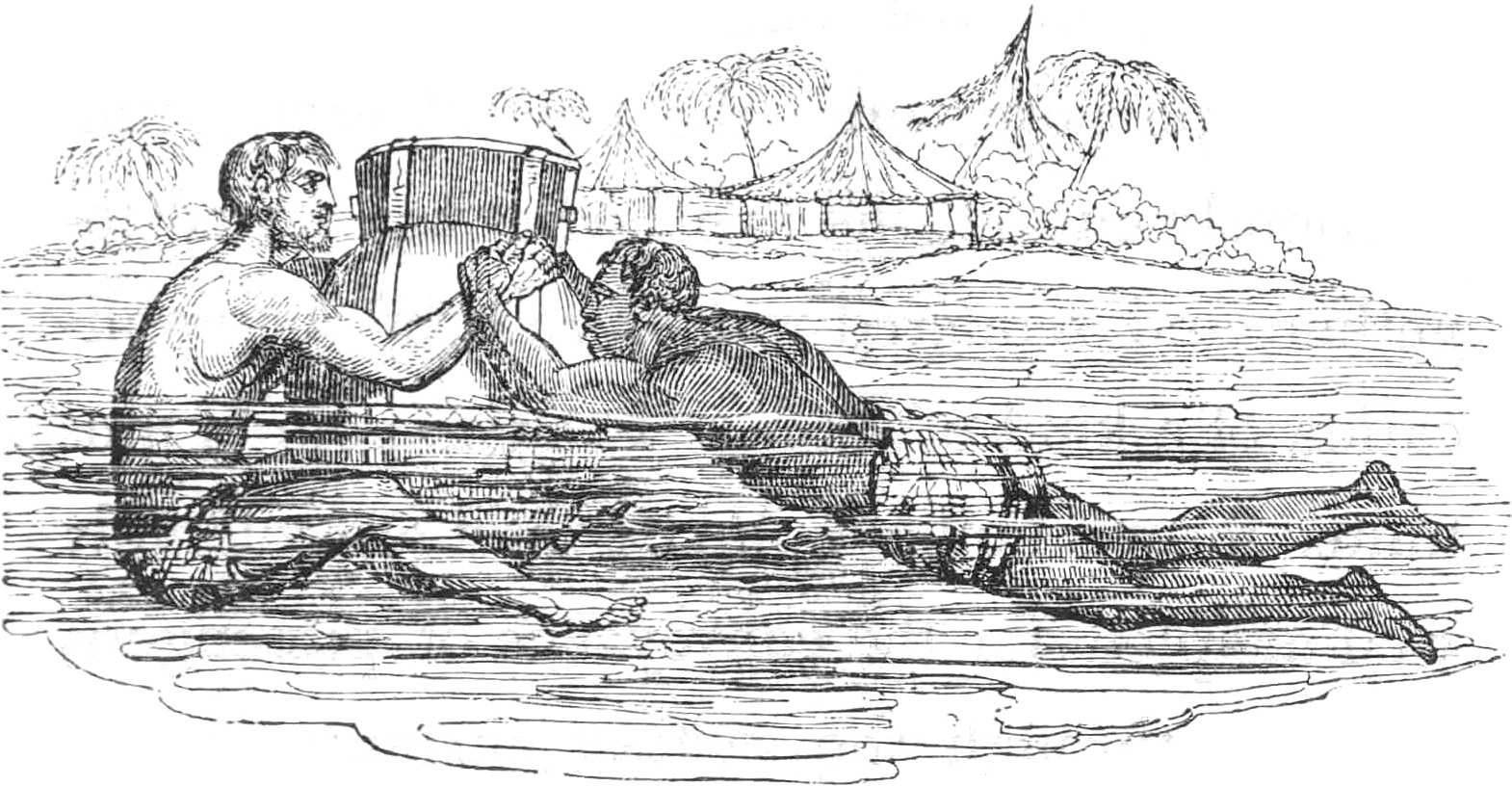
TATTOOING.
The operation of tattooing, by which the different races in Africa are distinguished from each other much more easily than by any natural peculiarity in the colour of the skin, or their general appearance, is performed by a sharp iron instrument, somewhat larger than, but certainly not unlike the blade of a common English pen-knife; and children generally, at the age of six or seven years, undergo this painful process, which indeed cannot be effected without[216] putting the poor creatures to excruciating torture. I saw two girls tattooed at Katunga, in the following manner: The hands and feet of each being first bound, the head was held by the father, and the operator began his work by making five incisions on the forehead with the instrument above described; the little sufferer uttering the most piercing screams, till from hoarseness she was unable longer to cry aloud, or speak so as to be understood. This being done, the man cut eight other deep gashes on the left cheek; and the only means by which one could then judge of the child’s distress was by observing a large pool of mingled blood and tears on the ground, fed by a copious stream flowing from the face of the little innocent.
The patients are invariably left to bleed till they become insensible; and death frequently occurs in weakly cases. After some days, when their strength is in a measure restored, they are privileged to beg in the streets till their wounds completely heal; and this does not take place oftentimes for four or five months after the operation, the children, during that long period,[217] carry slender branches of trees in their hands, in order to scare away flies, which, on alighting upon the lacerated face, cause considerable pain, and occasion it to swell prodigiously. This imparts to the countenance an unsightly appearance; one than which nothing can be more truly disgusting; and many of these pitiable objects we observed in the deepest misery, wandering through the streets of Katunga, and other cities, and almost starving for want of food.
When a Yaribean perpetrates ever so trivial a crime, the tattoo mark of his nation is so crossed by other incisions, inflicted upon him by the ministers of justice, that it becomes utterly undistinguishable, and the impression of another people is substituted on the other side of the face in its stead. With this brand, which can never be erased, he quits his native country, in which he was looked upon as
and dies in a foreign land, unpitied and unknown.
Circumcision, which is generally performed[218] on both sexes at an early age, is universally adopted in all the interior countries.
The subjoined are the tattoo marks of the natives of the most considerable countries in Western and Central Africa.
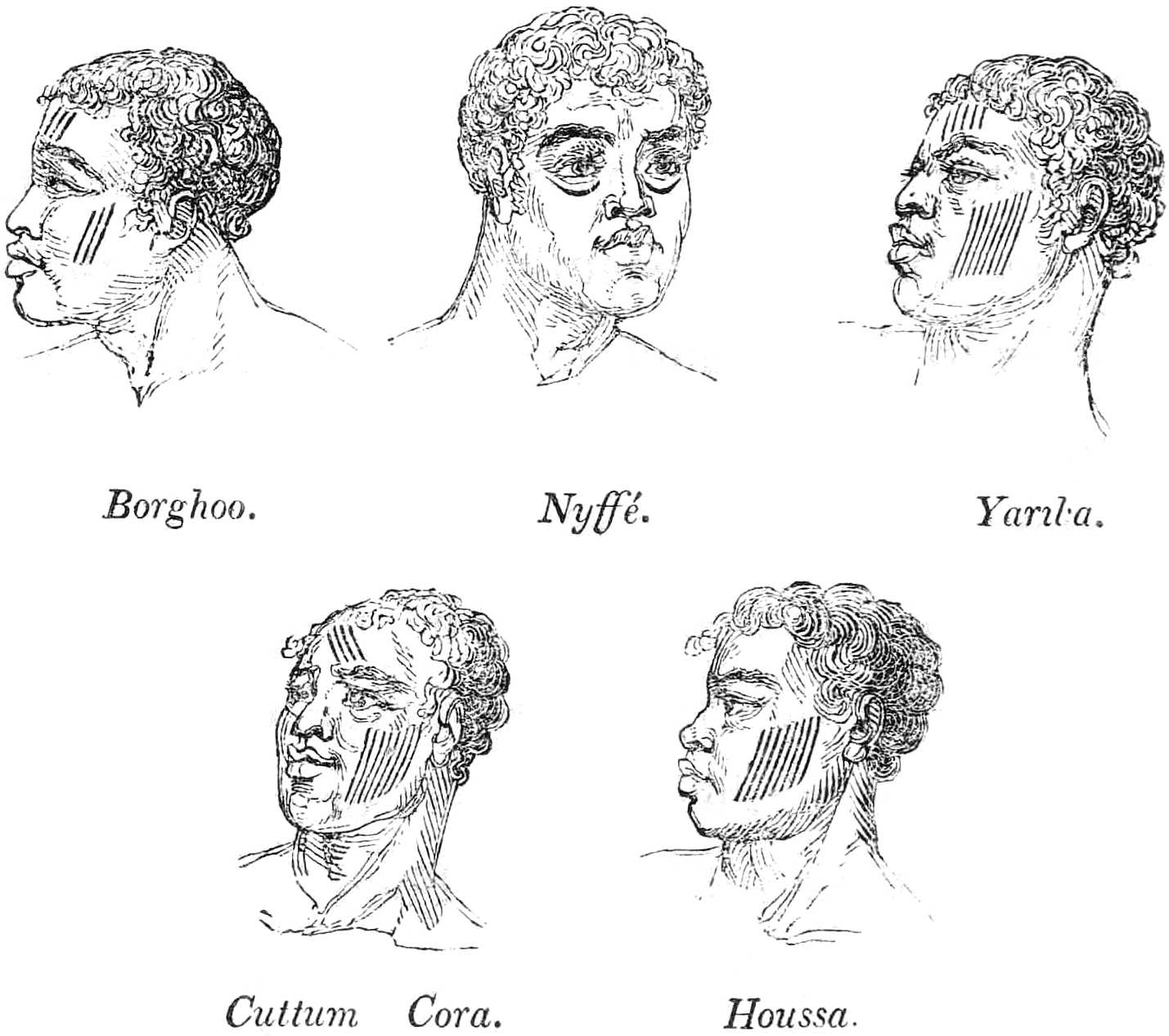
Borghoo. — Nyffé. — Yariba. — Cuttum Cora. — Houssa.
The Bowchee people have no mark whatever on the face, but in lieu thereof pierce the lobe of the ear, and the soft part of the septum of the nose, with a sharp instrument; and hang divers ornaments from holes so formed.
The wives of the great people of Katunga are distinguished by having the hair cut and shaved[219] into a number of small patches like the ace of diamonds, but larger; and that of the wives of the humbler classes is cut entirely off, leaving the head as bald and bright as a barber’s basin.
In the empire of Yariba the sick are treated with neglect, and even cruelty. The moment a man, woman, or child, is attacked with illness, no matter what the nature of the complaint may be, they are instantly conveyed by their relatives to the distance of half a mile from the town, and left to lie along the bare ground, in a state of the most perfect nudity, underneath the branches of trees; and the people are acquainted with no remedy whatever to alleviate the virulence of their disorder, or assuage the intensity of their sufferings. Food is sometimes conveyed to them by their nearest of kin, the law obliging them to do so; but sometimes they die from actual starvation. Often the lower class of people are so very poor that they have not a sufficiency to satisfy the appetites of their healthy offspring, and therefore feel no disposition to part with the little they have, to those (perhaps aged parents) who are sinking under[220] the influence of a contagious disease. It sometimes happens, too, that these miserable outcasts are snatched from their insecure asylum under the trees, and devoured by wild beasts. Native travellers are now and then moved to compassionate their sufferings, by reason of the piteous lamentations which they make; but, shrinking with terror from the distressed objects, they throw yams to them at the distance of twenty or thirty yards, and never go near enough to inquire into the nature of their malady, or further relieve their wants. Whenever an unhappy invalid is carried off by wild beasts, his countrymen believe him to have been a very wicked man, so bad indeed as to have been unworthy the succour and protection of their gods, and consequently deserving the fate which his supposed evil conduct and irreligious life had so signally occasioned. Many of these poor creatures, whose hollow groans and moanings of distress have attracted me to the spot, have I seen in the last stage of existence, some of them rolling in the dust, and convulsively writhing from excessive pain, and some reduced to perfect[221] skeletons for want of food, their bones jutting out of their diseased flesh, and exhibiting a more ghastly spectacle than can well we imagined: others again have I found speechless and almost cold; and on one occasion in particular, whilst I was gazing on a poor wretch who was far beyond the reach of succour, he fixed his hollow eyes so piteously upon my countenance, seeming to implore me to let him die in peace, that I could not refrain from shedding tears.
This barbarous and inhuman custom of exposing invalids in the open air, under the shade of trees, is confined to Yariba, the people of Badagry, and the natives of Borghoo, Nyffé, and Houssa, suffering their sick to expire quietly in their own houses, if, after swallowing a liquid which is prepared for them by their priests, or the expounders of the Moslem faith, the patients derive no apparent benefit from the medicine. This preparation consists either of a bowl of water into which a charm written with ochre on a bit of wood, has been previously washed off, or else a decoction of the bark of a tree, rendered holy by an incantation of a fetish priest.
[222]The Yaribeans have the reputation of being the best bowmen in Africa; and the young men soon become excellent marksmen by frequent practice and steady perseverance, which latter is a virtue that falls to the lot of but few nations in the central parts. They amuse themselves daily by attempting to discharge arrows through a small hole made for the purpose in a wall, at a great distance from the standing ground, and I have frequently seen individuals accomplish this difficult task three successive times, when upwards of a hundred yards from the spot; but it requires great and unceasing practice to attain to so much perfection in the art. Quantities of muskets are procured from the coast, but they are of comparatively little use to the people, who know not how to handle them with effect; and it is not unusual for them to carry these weapons to battle without either powder or ball. If worsted in an engagement, however, in order to accelerate their speed, they throw them away, and their enemies eagerly lay hold of the empty muskets for their own use.
Besides other sources of revenue, the King of[223] Yariba levies a tax on every one that enters the gates of Katunga with a load, of whatever it may consist, and also appoints persons to collect a tribute from every person attending the market with any saleable commodity. The amount of duty is always governed by the value of the beast or article sold, which is decided by accredited agents: for example, a handsome horse imported from Borghoo, or any other country, is liable in the market to a tax of two thousand cowries; whereas if the animal so exposed for sale be less handsome, or of inferior value, the sum demanded decreases regressively in amount. The same rule holds good in regard to bullocks, country cloth, &c.
We were mistaken in supposing the crown of Yariba to be hereditary, the chiefs invariably electing, from among the wisest and most sagacious of their own body, an individual who is invested with the supreme dignity, immediately after the decease of a monarch. On the dissolution of a ruling prince, his eldest son, together with his favourite wife, and several head men of[224] the kingdom, voluntarily destroy themselves by swallowing poison, and are inhumed in the same grave with their sovereign, to assist him in his wanderings in the other world. At their solemn sacrifices, the Yaribeans slay for the occasion old and infirm persons, whose life, say they, is a burden to them; and who manifest no reluctance whatever to yield up their pain and misery for the honour of the gods. With this solitary exception, the people may be considered as mild in their manners and charitable in their dealings.
The king strongly urged upon me to remain in Katunga with him, and tried every means to accomplish his wishes. Amongst other inducements held out, Mansolah was graciously pleased to introduce me to his daughters, four of the most beautiful of whom he desired me to select, and make my wives. He also offered me the enviable situations of prime minister and great war-chief, or generalissimo of his forces (both of which offices are highly respectable in Yariba), and in case I accepted them, his majesty would make me a present of slaves, horses, and indeed[225] every thing needful to maintain an establishment correspondent to the splendour of my rank, and the dignity of my appearance. It being entirely out of my power to resist the pressing solicitations of the king, I pointed at four of the princesses (who stood bolt upright before me, giggling and laughing,) as being the most lovely of their sex, and as worthy to share the bed and fortune of the prime minister of Yariba! I desired that the ladies might resume their apparel, and take care of themselves till my return from England, for that it was absolutely necessary I should visit the country of my fathers before I could think of settling permanently in a strange and distant land. “But will your king,” eagerly inquired Mansolah, “will your king give you permission to come back again?” “Without doubt,” I replied. “I shall then be master of my own actions, and follow the bent of my inclination in all things.” “That is right, that is right,” replied the monarch; “you shall be my son-in-law, and have the administration of my affairs, both foreign and domestic; you shall drive my adversaries[226] from my country: it will then be a good country, and peace will reign in the land.” I thanked Mansolah for his kindness, and observed that I sincerely hoped, on my return, I should not be dazzled by the acquisition of so much glory and power as his good nature and condescension would necessarily confer upon me!
As soon as I had done speaking, a loud noise was heard of peals of laughter, cracking of fingers, whistling, and clapping of hands, proceeding from the quarter in which the princesses of the blood were huddled together, who took the opportunity my silence afforded them, of expressing the rapture they felt at the hope of my so soon becoming their near relative, and of a white man superintending the domestic policy of their government, and leading their countrymen to battle and to victory. The favourite queen, who was present at the interview, as soon as the tumult had subsided, begged me to bring her a looking-glass from England; and Ebo, the fat eunuch, who was also present, evinced not the least spark of jealousy, but hinted that a good sword from the same country would be more than acceptable;[227] whilst Mansolah, the heroic prince of all the Yaribeans, was so much overpowered at the very idea of my becoming his son-in-law, that he stood moping and whimpering by himself, deprived of the power of asking for a single favour!
An Englishman, tired of his country, would be delighted with Yariba, for it is a fine kingdom, peopled with a mild, affectionate, and unassuming race, by whom he would be regarded almost as a deity, and amongst whom he could end his days with pleasure. At the decease of the reigning monarch, with very little art, and, I may venture to say, no opposition, he might cause himself to be proclaimed king, and thus be sultan of the mighty empire of Yariba! Becoming familiar with the usages of his sable subjects, with two pieces of cannon he might drive every Falatah out of his dominions, and restore the kingdom to its ancient splendour. But above all things, if he felt so inclined, the slave-trade, by his influence and example, would gradually be abhorred by his subjects, who, if they saw that their monarch professed the same[228] principles, would besides eagerly embrace the mild and simple precepts of the Christian religion. The people of Katunga had become so familiarized to me during my residence amongst them, that I had ceased to excite that intense curiosity displayed on my first arrival; and, next to their sovereign, I was treated with the highest respect by all ranks and ages, and interrupted in long rambles only by prostrations, and other demonstrations of veneration, peculiar to the Yaribeans.
The names of towns in Africa, as well as of individuals, have something descriptive and significant in them; for instance—Wow Wow, a great fool;—Inguazhilligee, ferry-boat;—Boussa, a kind of ale;—Fullindushie, a white stone;—Kassagebubba, a large fowl, &c. &c. Slaves are called by all manner of names; sometimes from any singularity in their appearance, or defect in their understandings—and sometimes by terms expressive of abhorrence or contempt; but much more frequently they have the names of birds, beasts, or reptiles, bestowed upon them by their masters,—thus one is called[229] simply “woman vulture,” or “man vulture;”—“woman snake,” or “man snake;” and Pasko’s Soccatoo wife was generally known by the elegant appellation of “woman elephant;” whilst others are distinguished by the name of a certain river, tree, mountain, or other natural object.
I remained at Katunga nearly a month, experiencing every species of friendship and good nature from its inhabitants; and on the 21st, when I intimated my desire to pursue my journey to the sea-coast, Mansolah sent me four thousand cowries, with a quantity of trona to sell on the road. The king also ordered his head messengers to accompany me, commanding them to desire the chiefs of every town through which the main path lay, to contribute, according to their ability, to the support of myself and attendants; which command we afterwards found on various occasions to be eminently serviceable.
The following morning early, I paid my respects to the prince, and having taken an affectionate leave of him, once more continued my course, in good spirits, and better health than I had enjoyed for a long period previously. Journeying[230] till the 8th of November, and meeting with few incidents worth relating, we arrived at Engwâ, the town in which it will be recollected Captain Pearce died and was buried, on his way to Katunga. I found the railing and fence, which had been placed round the grave, washed away by the rains, and the piece of wood, on which I had engraved his name, &c., had disappeared, most probably from a similar cause. The only means by which I was enabled to recognize the spot, was the circumstance of the earth over the grave having sunk considerably, and being quite destitute of vegetation, whilst the soil near it was covered with luxuriant herbage. The chief told me that having received no orders to repair the damage, occasioned by the floods, he had suffered the fence to fall to decay; but, at my own suggestion, he promised to erect a shed over the spot as soon as the sun had dried the grass. I made him a trifling present to encourage him in his intention, and preparations for that purpose had already commenced previously to my departure from Engwâ.
Leaving Tschow, a day’s journey on the Katunga[231] side of Jannah, on the 11th, I met, a few miles only from the town, a gaffle of merchants, hastening with the utmost speed and confusion towards it. They suddenly stopped on perceiving me, and a great number of them bawled out at the same moment, that they had been attacked by a band of robbers, who had overcome them, carrying off all their goods; and that if I did not go back to Tschow, with them, I should be murdered in a few moments, as the desperadoes were close at their heels. Instead of returning, however, I entreated them to go on with me, assuring them that with their assistance, the property, of which they had been so unlawfully deprived, should be recovered, and restored within half an hour; but the timid merchants, being afraid to expose their persons to so imminent a danger, politely declined the invitation, on the plea of being too much fatigued. My party consisted only of ten individuals, four of whom were women, and all unarmed, with the exception of Pasko and myself, who were furnished with a damaged pistol and an old rusty musket, borrowed of the king of[232] Katunga. With these weapons I resolved to proceed on the road at all hazards, and had the good fortune, about twenty minutes afterwards, to come in sight of the so much dreaded banditti. They were seated on the grass, dividing their ill-gotten spoil, and appeared to take no notice of me till I came within fifty or sixty yards of the spot, when, desiring Pasko to fire, I struck spurs into the horse’s sides, making him gallop with great swiftness, and the path being rocky and hollow, the sound produced seemed as if a thousand horses were prancing over the ground. At that moment, discharging my pistol, I completed the general consternation of the highwaymen, who, without looking behind them, fled in all directions, and concealed themselves in some rank grass, that was growing at a short distance, to the height of nine or ten feet, leaving their booty behind them, which consisted of upwards of three hundred pounds of salt, besides country cloth, cowries, &c.; and the captured articles, by the laws of the country, thus became my own property.
The merchants who had, unknown to me,[233] followed at a respectful distance, as soon as they saw the utter discomfiture of the thieves, made their appearance, and asserted, with a most amusing solemnity, that having determined to share my good or bad fortune, they were making all haste to my assistance, when the freebooters, by their precipitate, and to them unlucky retreat, had prevented them from displaying the courage which animated every bosom. I accepted their courtly apology, and praised their heroic resolution, but being determined not to give them the value of a single cowry, ordered my party to return with the captured goods to Tschow. The chief of that town himself purchased the different articles, and Pasko and his companions divided the money equally among themselves, I having refused to accept of any, although urged to take the whole.
In the afternoon of the same day we arrived at Jannah, and instantly visited the grave of Dr. Morrison, which I found in a perfect condition. The king was to have been rewarded by Mr. Houtson, for preserving the fence which[234] surrounded it, from decay; but that gentleman having himself died near Accra, on his return to the coast, the monarch had received no acknowledgment for his trouble till my arrival at Jannah, when I fully satisfied his demands.
On the 13th the horses which the kings of Wow Wow and Khiama had given me, both died, and the one I had left was in a weak and diseased state.
The son of Mr. Park, the celebrated African traveller, died in a small town two days’ journey in the interior from Accra, only three days before my arrival on the coast. I first ascertained his name by reason of a shirt sent in mistake for one of my own which I had given a female to wash,—“Thomas Park,” being marked in legible characters at the bottom. This young Englishman, on coming into the country, used no precautions with regard to the preservation of his health, but, adopting the habits of the people with whom he mingled, anointed his head and body with clay and oil, ate unreservedly the food of the natives, and exposed himself, with[235] scarcely any clothing, to the heat of the sun by day, and the influence of the pernicious dews by night,—in consequence whereof, as might have been expected, he was attacked with fever, which put an end to his existence after a very short illness. Mr. Thomas Park had formed the pious resolution of discovering the spot where his intrepid father had met his fate, and of ascertaining, if possible, the cause and manner of his death; in which attempt he was defeated only by his own dissolution. Had the young gentleman survived a few days longer, I could have fully satisfied him in these particulars, and given him directions, in case of his recovery, for proceeding to the island of Boussa.
On the 21st of November we entered Badagry, having been a month on the road from Katunga; and I am compelled to acknowledge that in no town were we received with unkindness, the people every where welcoming us back again with vociferous expressions of pleasure. Sometimes indeed, particularly between Jannah and Badagry, they howled so dreadfully on[236] seeing me, that the horse on which I rode trembled with fear; but this was the means which the natives took to congratulate me on my safe return. Adólee the king of Badagry, was glad to see me, and resigned his mansion (constructed of bamboo, and two stories in height) to me, whilst he contented himself with a small miserable hut, in which he took up his residence. Like every other prince in Africa, he was grieved to learn the decease of Captain Clapperton, and expressed his sorrow in a feeling manner. I gave his majesty my little horse, which had accompanied me the whole of the way from Soccatoo, together with all the articles for presents that were left, consisting of light blue scarlet damask, scarlet and blue silk, and two dozen pairs of cotton stockings. A week after my arrival, I waited on Captain Morrison, a Portuguese slave merchant, and obtained of him goods, the value of which amounted to ninety-four dollars, with a barrel of gunpowder, which I paid for myself. With these presents I dismissed the messengers of the[237] kings of Jannah and Katunga, whom I could not afford to maintain any longer in provisions, and they returned to their respective sovereigns in high spirits.
[238]CHAPTER XVII.
Novel method adopted by Europeans for conveying slaves on board their vessels — Conduct of the Portuguese Merchants, resident at Badagry, towards the Author — The White Negroes — Manners and Ceremonies of the Badagrians — Horrid indifference with respect to the shedding of Human Blood — Murder of two of the King’s wives by moonlight.
By reason of the vigilance of British men-of-war on the coast, merchants are obliged to use much greater caution than formerly, for eluding observation, and embarking their purchased slaves. The plan now generally adopted is as follows: as soon as a vessel arrives at her place of destination, the crew discharge her light cargo, with the manacles intended for the slaves, and land the captain at the same time. The vessel then cruises along the coast to take in country cloth, ivory, a little gold dust, &c.; and, if a British man-of-war be near, the crew having[239] nothing on board to excite suspicion, in most cases contrive to get their vessel searched whilst trading with the natives. At such time as they fancy their presence would be necessary, they return to the place where the cargo had been landed, and communicate with the captain on shore, who, during their absence had not been idle; and who then takes the opportunity of acquainting his crew with the exact time in which he will be in readiness to embark. The vessel then cruises a second time up and down the coast, till the appointed day approaches, when she proceeds to take in her living cargo.
Immediately on sight of her every canoe for miles near is put in requisition by the captain; provisions and water are speedily conveyed on board; and last of all, the wretched slaves are dragged forcibly towards the boats, and received by the European crew, who, as soon as this is effected, crowd all sail, and the vessel quickly disappears. I saw four hundred slaves at Badagry crammed into a small schooner of eighty tons; and the appearance of these unhappy human beings was squalid and miserable in the extreme.[240] They were fastened by the neck in pairs, only a quarter of a yard of chain being allowed for each, and driven to the beach by a parcel of hired scoundrels, whilst their associates in cruelty were in front of the party, pulling them along by a narrow band, their only apparel, which encircled the waist.
On leaving their native shore in the canoes, the wretched slaves set up a wild and dismal lament, which rent the air, and might have been heard at a considerable distance; but their tears failed to soften the hearts of the relentless Christians, who huddled them hastily into the hold of their vessel; and the cries of the Africans were heard no more.
Captain Morrison was the only Portuguese in the town that behaved with even common civility to me; the others, seven or eight in number, evidently viewed me with suspicion and alarm, and actively exerted themselves to persuade Adólee and his people that it would be necessary to destroy me, asserting that I was a spy sent by the English Government, and if suffered to leave the city, would return with numbers of my countrymen,[241] and enslave its inhabitants. What success these insinuations met with, will hereafter be related; but in the mean time these very men kept up an outward show of friendship and esteem for me during a long period, and strove all in their power to lull suspicion asleep, by endeavouring to strengthen the favourable opinion they flattered themselves I entertained for their merits; and, by apparent frankness of manner and openness of conduct, to do away any evil impression which the rumour of their clandestine practices might have awakened in my bosom. But although I maintained the profoundest taciturnity on the subject, I was perfectly well acquainted with the whole of their manœuvring, and prepared to encounter it in whatever way it might at first annoy me.
Amongst other things, the Portuguese at Badagry earnestly entreated me to sell my poor slaves, and offered ninety-five dollars for each of them; but of course I rejected their proposal with the contempt it merited. I went to see one of these slave-merchants one day by special invitation: he was at[242] breakfast on my entering his hut; and wheaten rolls and tea and sugar, were smoking and giving odour before him. I ardently wished at the time to seat myself at his side, and partake of the good things spread out so temptingly in my sight; for I had not tasted bread for nearly two years previously, nor tea or sugar for eighteen months; so that my childish propensity is not to be wondered at. The Portuguese, however, although he looked first at me and then on his breakfast, did not seem to be in a hurry to invite me to share it with him: so, fancying he felt some delicacy and bashfulness about the matter, which his eyes seemed to confirm, I was preparing very unceremoniously to help myself, but thought I might as well in the first place ask his permission. This I did in the best-tempered manner in the world; but the surly, ill-natured European, dropping the tea he was conveying to his lips, almost frightened me out of my wits, by exclaiming, “Stay your hand for a moment, if you please, Mr. Englishman; you have three fine slaves in your possession, for each of whom I will immediately pay you a hundred dollars,[243] and also send you as many wheaten cakes as will serve you for a twelvemonth; but, unless you consent to this proposal, you will have neither rolls nor tea of mine, I assure you.” I could not think of gratifying my appetite at the expense of my poor slaves, the faithful companions of my pilgrimage; so concealing, as well as I was able, the disappointment I could not help feeling, I arose, and bestowing on the Portuguese the epithets of a heartless, unfeeling scoundrel, hastily quitted his inhospitable roof, and repaired to my own dwelling. There I breakfasted more contentedly on a little boiled Indian corn, mixed with palm-oil and water, my usual fare, than if I had enjoyed all the luxuries in the world by wounding my conscience, and doing violence to the best feelings of my nature.
The same individual, however, three days after, sent me a loaf of bread and a cheese, with a bottle of English porter, articles of which I had dreamt repeatedly in the interior, but of which I never expected to partake in Africa. The merchant held out the same inducements as before to obtain my slaves; but although I obstinately[244] refused to accede to his reiterated request, I could not, for the life of me, resist the strong temptation I felt to claim a more familiar acquaintance with the presents placed so provokingly within my reach; and instead of returning them, which was to be the consequence of my refusal, I desired the bearer to acquaint his master with my high admiration of his noble conduct, and my extreme gratitude for a favour so unexpected and undeserved on my part; but to add, that, being determined not to be outdone by him in acts of generosity, I should take the liberty, on the arrival of a British vessel on the coast, of returning the compliment by a suitable acknowledgment.
My decided determination not to part with my slaves for any consideration, and the answer the messenger delivered to the slave-dealer, so greatly exasperated both him and the whole of the Portuguese in the place, that on meeting me in the streets, they used to pour out, in broken English, a whole volley of oaths and curses; and took care not to bestow on me further proofs of their good nature and benevolence, till the arrival[245] of the brig Maria of London at Badagry again opened the sluices of their amiable and charitable feelings, and I was favoured a second time with a present, yet more acceptable than the first, which was sent on condition that I would not make my countrymen acquainted with the fact of any Portuguese being in the town.
I saw two milk white negroes, male and female, with red hair and eyes, on my return from the interior; the one at Tschow, and the other at Badagry. Having examined their bodies pretty minutely, I am confident that they laboured under no disease whatever; indeed they told me themselves that they entered the world in the condition in which I beheld them. Neither of these unsightly individuals appeared to attract a large portion of the curiosity of their sable countrymen; nor did their singular and loathsome appearance excite in their breasts any emotion of horror or disgust. The skin of these white Africans was by no means like that of a fair European, having a much paler and more[246] unearthly hue; but without tumours or scrofulous affection of any kind.
I had retired to rest rather earlier than usual one evening, being greatly fatigued, when about the midnight hour a loud, long, and piercing shriek awoke me with a start, and springing hastily from my couch, I turned aside the slight mat which served instead of glass for my window, to ascertain the cause of it. The moon shone in the heavens with peculiar lustre and beauty, rivalling in splendour the brilliant orb whence she receives her light, so that I was enabled to distinguish clearly every object for some distance from the hut. Another fearful scream at the moment arrested my undivided attention upon a group of persons about ten or twelve yards from my window, in the midst of whom I could perceive two females struggling violently to get loose from the iron gripe with which they were held by their merciless guardians. I called as loudly as I could to the fellows, (who, as well as the perturbation of my mind, and the confusion of the scene would allow me to discern, were eight in number,) to demand the[247] reason of their ill-treatment of the defenceless women at that unseasonable hour, when one of them answered with the greatest unconcern, that the females whom I saw were the King’s wives, who, having spoken their mind with too much frankness in the royal presence an hour before, had been ordered by their husband to make expiation for the offence by having their throats cut,—that being considered as the mildest punishment which could be inflicted for the consummation of so heinous a crime, by the laws of Badagry; a punishment which none but Adólee’s favourites ever underwent! Whilst the man was yet speaking, the trembling criminals shrieked long and bitterly; but from exhaustion their struggles were less vehement than before. At length I saw their hands bound, next their feet; and lastly their heads, bent forcibly backwards, by four of the ruffians, were held tightly by the hair in that painful position. I then heard the poor creatures utter their last thrilling cry of anguish, which caused my blood to run cold in my veins, and a shudder to creep over every limb; and at that moment, the gleam of the uplifted[248] daggers shot across my vision, and as quick as lightning the poinards were buried in the throat and bosom of each, severing the windpipe in their course. A faint gargling sound like water issuing from the mouth of a bottle, was the only noise produced; the ruthless assassins glided like spectres from before my window, trailing their bleeding victims along the earth; and all was as still and solemn as the grave, the moon alone (to my imagination) blushing to be a spectatress of the atrocious deed.
As soon as this bloody tragedy had been enacted, the spell that had bound me motionless to the window, dissolved, and, flinging myself on my mat, I endeavoured to obtain a little repose, and calm the agitation of my mind; but the dreadful scene I had witnessed awakened a host of phantoms in my disordered imagination, and obliged me to walk to and from the apartment till the morning, when, on taking a stroll through the town, my eyes were saluted with the revolting spectacle of the murdered women hanging on the branches of the fetish-tree!
The manners and ceremonies of the Badagrians,[249] although they appeared so simple and engaging to us whilst we continued amongst them, on first leaving the Brazen, are without comparison the most rude and barbarous of those of any of the people on the whole continent of Africa. The murder of a slave is not considered even in the light of a misdemeanor amongst them; and the frequency of this crime has not only taken away all sense of its enormity, but steeled the breasts of the multitude against every compassionate feeling; whilst the king and government encourage savage principles and pastimes by setting them the example.
The following particulars were gleaned principally from personal observation, whilst I remained in that city of blood, called by the inhabitants Badàg (or Woman); and, in the absence of that source, from repeated conversations held with the king, his eldest son, and his great chiefs or generals, Bombanee, Poser, and Accra, whom I questioned separately, and at different periods, concerning the celebration of their sacrifices and other religious rites. I found no discrepancies whatever in the information thus[250] obtained; and, after I had swallowed the fetish, the before-named individuals communicated freely, and without suspicion, any thing connected with their religion or manners that I evinced the slightest wish to have explained.
Badagry being a general mart for the sale of slaves to European merchants, (who are now, I believe, almost exclusively confined to agents belonging to the Portuguese nation,) it not unfrequently happens that the market is either overstocked with human beings, or no buyers are to be found; in which case the maintenance of the unhappy slaves devolves solely on the government. The expense incurred by this means is oftentimes murmured against by the king, who shortly afterwards causes an examination to be made, when the sickly, as well as the old and infirm, are carefully selected, and chained by themselves in one of the factories, (five of which, containing upwards of one thousand slaves of both sexes, were at Badagry during my residence there,) and next day the majority of these poor wretches are pinioned, and conveyed to the banks of the river that runs[251] up the country, where, having arrived, a weight of some sort is appended to their necks, and, being rowed in canoes to the middle of the stream, they are flung into the water, and left to perish by the pitiless Badagrians. Slaves who, for other reasons, are rejected by the merchants, undergo the same punishment, or are left to endure more lively torture at the sacrifices: by which means hundreds of human beings are annually destroyed.
[252]CHAPTER XVIII.
The Fetish-huts and tree at Badagry — Owing to the insinuations of the Portuguese the Author is compelled by the priests of the Fetish, to swallow bitter water, being the only European that ever underwent that dreadful ordeal — His reflections when informed of the circumstance — Astonishing preservation from an expected cruel death — Sacrifices of human beings under the branches of the Fetish-tree, exceeding in atrocity all previous accounts — Song of the inhabitants with Adólee at their head, on the occasion — The Author, on his visit to a Portuguese pirate, discovers the sacred Fetish-tree of the Badagrians growing in the heart of a forest, and covered with the dismembered corpses of human beings — Remarks on the Portuguese.
In the private fetish-hut of the King Adólee, at Badagry, the skull of that monarch’s father is preserved in a clay vessel, placed in the earth. Human blood, as well as the blood of birds and beasts, is occasionally sprinkled on it; and when the king goes to war, that same skull is invariably carried with him, with which he frequently converses,[253] and gently rebukes it, if his success does not happen to answer his expectations. “If this custom be neglected,” said Adólee, “the virtues and martial energy of my deceased father would cease to influence my actions, and defeat and disgrace would attend all my warlike undertakings.” The people of Badagry regard this skull with the same veneration as the Turks do the sacred banner of their Prophet; and believe, that should it be missed through any casualty, or captured by the enemy, the destiny of their prince would be sealed for ever, and the pillars of their monarchy crumble into dust, so that they would no longer be a people!
There is another fetish-hut at Badagry, the interior of which is positively ornamented with rows of human skulls, and other emblems of mortality, whitened by time, and having a most terrific appearance. In this Pagan sanctuary all suspected persons go through the ordeal of bitter (poisonous) water, in order to ascertain their guilt or innocence; and death, which in almost all cases ensues shortly after the prisoner receives the fatal draught into his stomach, is[254] considered by the people as a sure criterion of the former; whilst, if the culprit has the good fortune to escape with life, which rarely happens, he is pronounced free of the allegations brought against him, and immediately acquitted.
At a short distance from this gloomy hut stands a fetish-tree, on the branches of which the headless bodies of human beings, slaughtered under them, are invariably suspended.
I did not think, as I strolled one day to the spot, and scrutinized the exterior of the fetish-hut, that I myself was so shortly to enter its doors, and be tried with bitter water by its inexorable priests, in order to prove whether I was a good or bad man, a friend or foe to their nation!
But the calumnies of the Portuguese had recently begun to display their effects very strikingly; Adólee had latterly behaved in a cold and distant manner to me; and his chiefs studiously shunned my presence whenever they observed me approaching them.
One morning, as I was taking my solitary breakfast of palm oil and Indian corn, I was startled by a message from the king, commanding[255] me to repair at noon-tide to the fetish-hut, and be examined by the priests, who would be there assembled, to answer certain charges that would be brought against me. I was well aware in what manner my trial was to be conducted; and I could not forbear exclaiming to myself, as I mused on the dreadful fate which I imagined awaited me: “Well, then, here will be an end to my wanderings and my life; yet, having escaped so many dangers, and encountered such grievous afflictions, it is hard, after all, to cast off the fardel of existence thus prematurely; it is hard, when almost within hearing of my countrymen, that my life should be destroyed; that my skull should be preserved as a trophy by heartless savages, and my body be devoured by ravens and other birds of prey.” As I was making this saddening, and perhaps unmanly soliloquy, tears rushed involuntarily into my eyes, but, hastily wiping them off, I employed the little time allotted me in making my peace with Heaven, so that when the fellows came to conduct me to the fetish-hut, I was calm and collected, and prepared to undergo the severest[256] punishment which the power of man could inflict upon me.
The news of the white man’s arrest, and approaching trial, spread like wild-fire through the town, and the inhabitants, assembling from all parts, armed with axes, spears, clubs, and bows and arrows, followed the procession to the dismal spot. On entering the hut, I beheld a number of priests and elders of the people, seated in a circle, who desired me to stand in the midst of them. When I had complied with their request, one of the priests arose, and presenting me with a bowl, containing about a quart of a clear liquid, scarcely distinguishable from water, cried out in a loud voice, and with much emphasis, “You are accused, white man, of designs against our king and his government, and are therefore desired to drink the contents of this vessel, which, if the reports to your prejudice be true, will surely destroy you; whereas, if they be without foundation, you need not fear, Christian; the fetish will do you no injury, for our gods will do that which is right.”
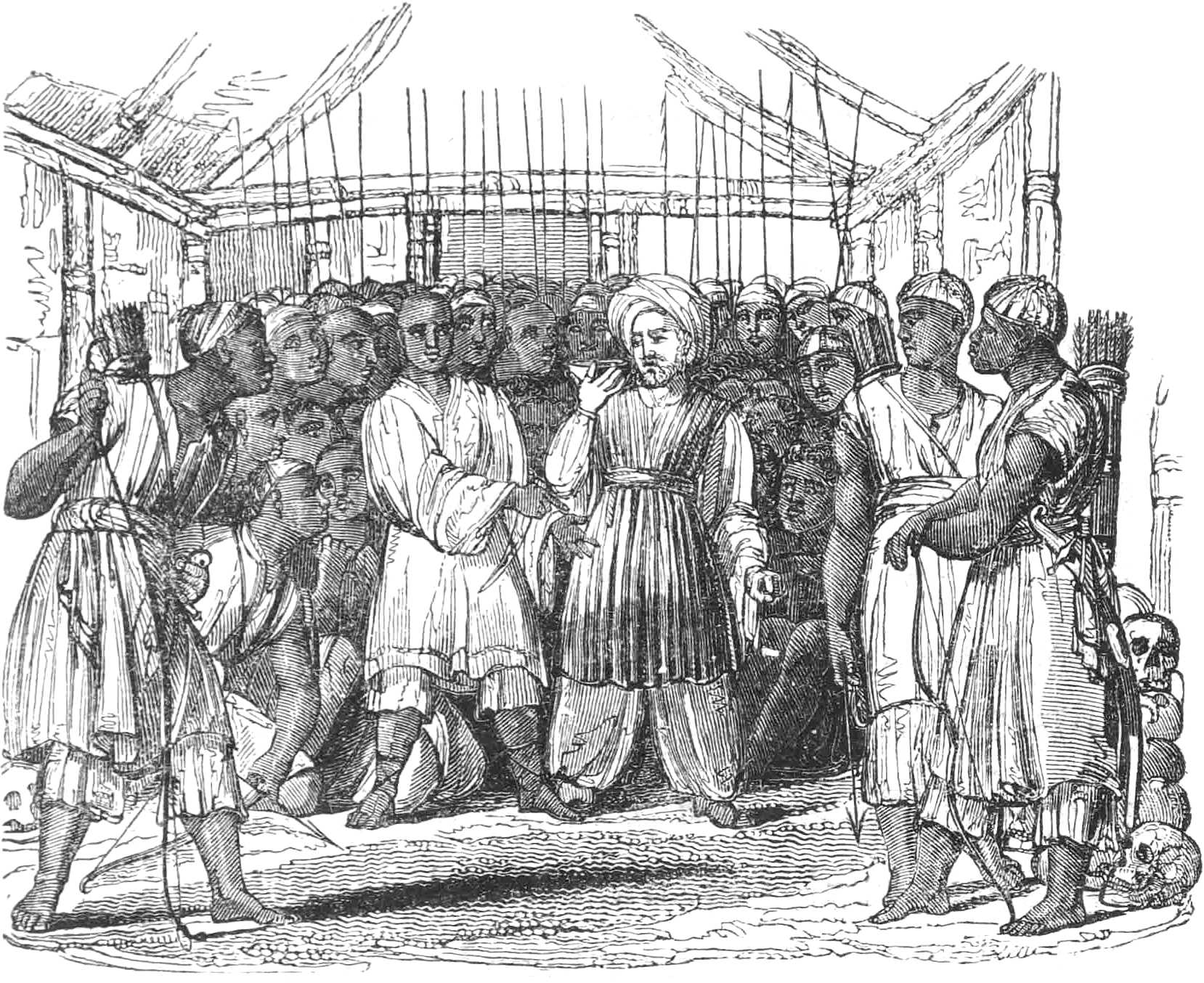
I took the bowl in my trembling hand, and gazed for a moment on the sable countenances of my judges; but not a single look of compassion shone upon any of them; a dead silence prevailed in the gloomy sanctuary of skulls; every eye was intently fixed upon me; and seeing no possibility of escape, or of evading the piercing glance of the priests and elders, I offered up, internally, a short prayer to the Throne of Mercy,—to the God of Christians,—and hastily swallowed the fetish, dashing the poison-chalice to the ground. A low murmur ran through the assembly;[258] they all thought I should instantly have expired, or at least have discovered symptoms of severe agony, but detecting no such tokens, they arose simultaneously, and made way for me to leave the hut. On getting into the open air, I found my poor slaves in tears; they had come, they said, to catch a last glimpse of their master; but when they saw me alive and at liberty, they leaped and danced for joy, and prepared a path for me through the dense mass of armed people. These, set up an astounding shout at my unexpected appearance, and seemed greatly pleased, (if I might be allowed to judge,) that I had not fallen a victim to the influence of their fearful fetish. On arriving at my dwelling, I took instant and powerful means to eject the venomous potion from my stomach, and happily succeeded in the attempt.
I was told that the liquid I had swallowed was a decoction of the bark of a tree abounding in the neighbourhood, and that I was the only individual who, for a long season, had escaped its poisonous qualities. It had a disagreeably bitter taste, but I experienced no other ill effects from it than a slight dizziness, which wore off[259] completely a few hours after the conclusion of the trial.
The dreadful charm having been thus providentially broken, all the cold reserve and stiffness of Adólee and his chiefs suddenly disappeared; and they visited me voluntarily a few days afterwards with presents of provisions, &c. observing frequently that the Portuguese were wicked men, but that I was a good man, under the special protection of the white man’s God, who would suffer no evil to come near me. The Houssa mallams were also permitted to introduce themselves into my society; neither did they come empty-handed, so that I scarcely regretted having drunk the fetish; for instead of suffering and death, from which I had not entertained even a hope of escaping, the most pleasing and flattering results were the consequence of my conforming to the customs of the inhabitants. On walking through the streets I was pointed at as the wonderful man, whom it would be dangerous to insult; my society was courted by all ranks; and from that hour my reputation stood singularly high with the people of Badagry, to the infinite chagrin of the[260] malicious Portuguese, who thus saw the complete failure of their artfully laid plot, by the very means which they had fondly hoped would have been the instruments of my destruction.
Thieves, and other offenders, together with the remnant of the unpurchased slaves who are not drowned along with their companions in misfortune and misery, are reserved by the Badagrians to sacrifice to their gods; which horrid ceremony takes place at least once a month. Prisoners taken in war are also immolated, to appease the manes of the soldiers of Adólee slain in battle; and as, of all atrocities, the manner in which these wretches are slaughtered is the most barbarous, it may not perhaps be improper or ill-timed to give a detailed account of it in this place. Each criminal being conducted to the fetish-tree, a flask of rum is given him to drink, whilst he is in the act of swallowing which a fellow steals imperceptibly behind him, with a heavy club or bludgeon, and inflicts a violent blow on the back of the head with the murderous weapon, and, as it often happens, dashes out his brains; so that the executioner has no occasion to repeat his stroke. The senseless[261] being is then taken to the fetish-hut, and a calabash or gourd having been previously got ready, the head is severed from the trunk with an axe, and the smoking blood gurgles into it. Whilst this is in hand, other wretches, furnished with knives, &c. cut and mangle the body, in order to extract the heart entire from the breast, which being done, although it be yet warm and quivering with life, it is presented to the king first, and afterwards to his wives and generals, who always attend at the celebration of these sacrifices; and his majesty and suite making an incision in it with their teeth, and partaking of the foamy blood, which is likewise offered, the heart is exhibited to the surrounding multitude. From the commencement of the proceedings under the tree, the chiefs begin to sing or chaunt, the king’s wives and the spectators assisting and joining in the chorus; and they never cease till the body, with its head, heart, and blood, is borne from the spot, when the multitude themselves take up the strain. The following lines will serve to give an idea of the subject and nature of the song used on the above occasions, which seldom, if ever, vary.
[262]SONG OF THE BADAGRIANS AT THEIR HUMAN SACRIFICES.
The bleeding heart, after being bitten by the king, and his principal wives and head men, is affixed to the point of a tall spear, and, with the calabash of blood and headless body, paraded through the town, and followed by hundreds of spearmen and a dense crowd of people. Whoever may express an inclination to bite the heart, or drink of the blood, has it immediately presented to him for that purpose, the multitude dancing, and singing:
What remains of the heart is then flung to the dogs, and the body, cut in pieces, is stuck on the fetish-tree, where it is left till wholly devoured by birds of prey.
Besides these butcheries, the Badagrians make a grand sacrifice, once a year, under their[265] sacred fetish-tree, growing in a wood, a few miles from the city. These are offered to their malevolent Demon, or Spirit of Evil, at whose shrine hundreds of human beings are annually immolated, their corpses undergoing the same horrid process as that which has already been described; only in this instance they are not removed from the spot, but quartered and hung on the gigantic branches of the venerable tree; and the skulls of the victims suffered to bleach in the sun round the trunk of it.
By accident I had an opportunity of seeing this much-talked-of tree, a day or two only after the celebration of one of the grand yearly sacrifices, and it was the most ghastly and appalling object which I had ever beheld. I was informed in the town one day that a Portuguese schooner had proceeded along the coast towards the Bight of Benin, and was then lying at Adjeedore, which is about fourteen miles from Badagry. Of course I was anxious to get out of the country, by any means, as quickly as possible, for, as may be supposed, I was heartily and completely tired of my long[266] residence in it, and eagerly grasped at even the shadow of an opportunity that promised to bring about so desirable a good. I resolved, at any rate, to have an interview with the captain of the schooner; and, for this purpose, taking Pasko and Jowdie with me, one cloudless morning I proceeded to Adjeedore. The path leading to the place, however, winding through a thick wood, and being crossed by other roads in all directions, we struck out of the right one into another; and journeyed onwards without discovering our error for some time afterwards. We had not advanced many miles into the country before our noses were saluted with the most overpowering effluvia, like those exhaled from putrid substances; but, notwithstanding this warning, it did not occur to me at the time that the sacred fetish-tree of the Badagrians lay in that direction. The air became more strongly impregnated the further we proceeded; till at length it was wholly insupportable, and I was obliged to cover my mouth and nose with a thick handkerchief, which relieved, in some measure, its disagreeable effects, We had travelled in this[267] manner, as nearly as I could guess, about half way to the place of our destination, or seven miles from Badagry, when the so much dreaded fetish-tree suddenly burst upon my sight, its enormous branches literally covered with fragments of human bodies, and its majestic trunk surrounded by irregular heaps of hideous skulls, which had been suffered to accumulate for many years previously. It was standing in the centre of a large piece of open ground in the heart of the forest; and was actually the largest tree I had ever seen. Thousands of vultures, which had been scared away by our unwelcome intrusion, were yet hovering round and over their disgusting food, and now and then pouncing fearlessly upon a half-devoured arm or leg. Although scenes of horror had become habitual and familiar to me, my feelings, nevertheless, were not entirely blunted, and I encountered a more violent shock, whilst staring at the overwhelming scene, than I ever before experienced. I stood as if fascinated to the spot by the influence of a torpedo, and stupidly gazed on the ghastly spectacle before me, without the power of withdrawing[268] my sight to more agreeable objects, or even of moving hand or foot.
The huge branches of the fetish-tree, groaning beneath their burden of human flesh and bones, and sluggishly waving in consequence of the hasty retreat of the birds of prey; the intense and almost insufferable heat of a vertical sun; the intolerable odour of the corrupt corpses; the heaps of human heads, many of them apparently staring at me from hollows which had once sparkled with living eyes; the awful stillness and solitude of the place, disturbed only by the sighing of the conscious wind through the sombre foliage, or at intervals by the frightful screaming of voracious vultures, as they flapped their sable wings almost in my face—all tended to overpower me; my heart sickened within my bosom, a dimness came over my eyes, an irrepressible quivering agitated my whole frame, my legs refused to support me, and, turning my head, I fell senseless into the arms of Jowdie, my faithful slave! Pasko assisted to bear me away from the scene of blood; and the two blacks emptying a calabash of water they had brought with them on[269] my head, face, and breast, I slowly revived, and after a slight refreshment, pursued my journey by another path.
On reaching Adjeedore, I did indeed meet with the vessel I had been informed of at Badagry; but the ferocious appearance of her crew startled me not a little. The men were a mixture of Portuguese and Brazilians, completely armed with pistols, cutlasses, and dirks; and each furnished with a long black beard, which heightened, perhaps, the fierceness of their looks. The Captain (Don Pedro he called himself,) received me politely; and after I had made him acquainted with my errand, which was simply to ask if he had any objection to convey me and my slaves to Cape Coast Castle without delay, he took me into his cabin, and treated me with the best his ship afforded. In the course of our conversation I thought he was rather too inquisitive as to the amount of property I had at Badagry; but this, I concluded, arose from a spirit of curiosity, rather than from any other reason. Every arrangement having been entered into to the apparent satisfaction of both[270] parties, I shook hands with the Captain, and towards evening returned to Badagry. On making inquiries in the town next day, I learnt from the Portuguese that the said Don Pedro was a noted pirate who had infested the seas for a long period previously, and that his sole intention, after getting me and my property on board his vessel, was to compel me to “walk the plank,”[8] and by that means secure the latter to himself. Although I was disposed to doubt the asseverations of these men, who I well knew bore me no good will, yet Adólee confirmed their testimony; besides which I had myself heard of the existence of a pirate in the neighbourhood some weeks before; and the dubious appearance of Don Pedro and his bearded crew, certainly tended to strengthen instead of dissipating a suspicion that the pirate and the Captain were one and the same individual. Agreeably to promise, Don Pedro paid me a visit on the following Monday, to ascertain[271] how long it would be before I should be ready to embark; but I frankly acquainted him with my change of resolution, and my reasons for adopting that alteration in my intentions; on hearing which he appeared thunderstruck, and, instead of attempting to clear his character of the aspersion cast upon it, contented himself with calling his countrymen, the Portuguese, by a variety of hard names. Rising abruptly a few minutes afterwards, he bade me a hasty adieu, and I never saw or heard any thing more of the piratical captain, Don Pedro.
I turned my thoughts with greater warmth than ever to my native country, after swallowing the fetish; but so effectually had the rascally slave merchants performed the base part they had laid down for themselves, that although I repeatedly offered a tempting reward, no one was found bold enough to brave their resentment by proceeding in a canoe to Cape Coast Castle, and informing my countrymen that an Englishman was at Badagry. The Portuguese not only shut the portal of hope in that direction, but, when they found their malicious designs so[272] completely counteracted, actually threatened to take my life in the hearing of Adólee, who, on acquainting me with the circumstance, said, that although I bore a charmed existence as far as regarded my dealing with black people, that virtue did not extend to persons of the same hue and religion as myself; and he therefore strongly advised me never to leave my dwelling unarmed, for that the Portuguese would assuredly embrace the first opportunity of carrying their menace into effect. The intensity of my misfortunes had not entirely deadened the principle of self-preservation that resided within my bosom, particularly when so near my escape from all; and the information which the king gratuitously imparted to me, gave me considerable uneasiness, and filled me with groundless suspicions. Damocles was not more unhappy on beholding the sword suspended over his head by a single hair in the palace of Dionysius, than was I whilst I remained at Badagry. All was apprehension and anxiety on my part; and as if positive calamities had not been enough to afflict and sadden me, imaginary dangers crossed[273] my path, and lent their aid to render my days superlatively miserable. Obliged to take numberless precautions for the safety of my person, I was a prey to fear and unceasing inquietude, and was a stranger to a moment’s ease.
I was met in the streets one day by a Portuguese, whom I considered more friendly-disposed towards me than his vicious coadjutors; and after chatting a few minutes, he invited me to go along with him to his habitation. On entering it, I found the whole of his countrymen assembled, drinking grog; and all hands appeared to be obstreperously merry. A glass of spirit was immediately poured out for my acceptance, which they urgently pressed me to drink; and on my refusal, I observed them laying their heads together, and conversing earnestly in whispers, pointing every now and then to the dirks stuck in their belts. My suspicions, ever alive, immediately caught the alarm at these significant proceedings; and looking wistfully round, I attempted in vain to steal unobserved from the society of my disagreeable companions. Seeing, therefore, no other resource, I told the[274] Portuguese, in as bold a tone as I could command, that my presence being required at home, it was absolutely necessary that I should immediately quit their social circle and repair thither. They all arose on my making this declaration; and I saw their right hands inclining instinctively towards their belts. Following their example, I laid my left hand on the hilt of a dagger concealed in my bosom, and with the other grasped a loaded pistol that was appended to my waist. In this manner, we eyeing each other with mutual distrust, I retreated backwards out of the apartment; and felt the burden that had oppressed me suddenly relieved, on being again at liberty.
I mention this little incident simply to give an idea how greatly my mind was harassed by a host of vexatious circumstances combined, which, taken singly, would only serve as matter for pleasant raillery. But whom had I to make merry with at Badagry? I looked around me in vain for a single being to share my confidence there; and my wandering mind, flung back upon its own resources, encouraged only perplexing doubts, vague suspicious, and saddening[275] reflections to arise within me, and caused me to misconstrue every word and deed of both friends and enemies; in fact it was utterly impossible to prevent such unpleasant sensations having considerable influence over all my thoughts and actions.
[276]CHAPTER XIX.
Captain Laing, of the brig Maria, of London, hearing that an Englishman is at Badagry, comes from Whydah to fetch the Author — His reflections on leaving Badagry, and on reaching the British vessel — The Maria sails for Cape Coast, where the Author lands, and is taken on board the Esk sloop of war, which vessel sails for England — Tale of the turtles — Arrival in England, &c.
I had heard it rumoured some days before that an English vessel had been seen trading on the coast, and I waited with trembling anxiety and a palpitating heart till accident might make her captain acquainted with the circumstance of my being shut up in Badagry. My most flattering anticipations were amply realized, for on the 20th of January, two months after my arrival, a fellow came running in breathless haste towards me, with a letter and a bottle of gin from the master of a British vessel then lying[277] off the town, directed to “The Englishman at Badagry.” No one can express the pleasure that thrilled through every nerve, as I was perusing lines traced by the fingers of a countryman, and containing the transporting intelligence that “Captain Laing,[9] of the brig Maria of London, hearing that a white man was resident at Badagry, and strongly suspecting that he must belong to the African Mission of exploration under Captain Clapperton, had come from Whydah, and would feel pleasure, if such proved to be the case, in being serviceable to him in any manner that might be suggested, or in transporting him to a British settlement on the coast.” Scarcely knowing what I did, and almost beside myself with joy, I wrote a hasty scrawl of thanks to the generous Englishman; and, desiring Pasko and the slaves to get every thing in readiness for starting immediately,[278] I paid my respects to the king, and his wives and chiefs, and bade them a last farewell.
Returning instantly to my habitation, I left the town of Badagry, and bent my way directly for the beach. My heart bounded within me at sight of the proud banner of my country, streaming from the stately mast of the Maria; and a signal being made, a boat was without loss of time despatched to my assistance. I was soon on the water; and as the little bark moved swiftly towards the ship, although my appearance was pitiable in the extreme, the yards were instantly ordered to be manned, and three tremendous cheers from the throats of British seamen, welcomed me once more to the dear society of my gallant countrymen. This was ravishing melody in my ears; it was the happiest, most rapturous moment of my life. I hastily climbed the sides of the vessel, and springing delighted upon the conscious deck, returned thanks to the Almighty for my preservation, and shook hands heartily with the captain and crew. But as sudden and violent transport is seldom lasting, so I could not help reflecting, a[279] very few minutes afterwards, how different, how very different had been my feelings in the same place about two years before;—so nearly is joy allied to sorrow, pleasure to pain, cheerfulness to melancholy. As a noble tree, growing in strength, and flourishing in beauty, is suddenly blasted by lightning, which scathes its verdant foliage, and destroys the vital principle; even so had I seen a party of British officers, proud as their native rocks, wither and die. They had planted their feet on African soil full of fine spirit and noble enthusiasm, scoffing at peril, and determined to overcome every human obstacle that might arrest their progress in the accomplishment of their hazardous undertaking, that great object of their ambition, to which the eyes of millions were directed. A few months only had elapsed, when their elevated hopes and buoyant feelings were quenched in darkness; their manly frames shrivelled like the tree, from irremediable causes; till, unable longer to “drag their slow length along,” they had languished and fallen, and the sound of their voices was heard no more—they had resigned their[280] burden of life, sorrow, and suffering; and were transplanted to that unknown country where “the wicked cease from troubling, and the weary are at rest.” I, of all, was left to tell the sorrowful tale to their countrymen. I had certainly cause for self-gratulation at the almost miraculous preservation of my own life; but I had also matter for gloomy reflections in the mournful fate of so many brave and enterprising British officers, who had died prematurely in a savage land; and I sighed when the Maria sailed from Badagry, to look back on departed times, and recall the hearty, thoughtless merriment that burst vociferously from the hearts of the dauntless Englishmen an evening or two preceding their landing at that place; nor could I refrain from asking myself: “And where is their merriment; where is their laughter, now?”
On arriving at Cape Coast, I was received in the most cordial manner by the Governor, Colonel Lumley (since dead), and the British merchants then in the place, with whom I dined, and who vied with each other in showing me[281] every mark of kindness and respect. As soon as they learnt my arrival, the Houssa inhabitants flocked around me, and were delighted that a white man could converse with them in their own language; which feeling was infinitely increased by my assuring their sceptical companions that Houssa was a good land—for even in the breasts of these rude Africans a love of country was not the least distinguishable sentiment. These poor people stood with mouths open, to be informed of what was transacting in the land of their birth; and were variously agitated, in proportion as the accounts were of a good or bad nature.
At Cape Coast I gave my faithful slaves, Aboudah, Jowdie, and Pasko’s wife, their freedom; but when they were made acquainted with the fact that the boon offered them was on condition of their remaining behind, they could not conceal their disappointment and regret, and were unwilling to accept it, saying it was the greatest evil that could befall them. They came to me in a body on the morning of my departure, making the air ring with their lamentations;[282] and, covering their heads with sand and dust, they intreated me with tears to take them with me to my country. I consoled the poor creatures as well as I could, with the hope of seeing them again in a couple of months; and they left me in better spirits. Colonel Lumley, with the most laudable generosity, presented each of them with a sum of money and a plot of ground, with which they built huts for themselves, and formed their land into gardens; so that they can now boast of greater comfort and convenience than most of their emancipated countrymen residing on the coast.
On the 13th of February, I embarked with Pasko on board the Esk sloop of war, Captain Purchase, which set sail the same day for Fernando Po, where I had a long interview with Major Denham, the only survivor of the previous mission of discovery (but since deceased), who expressed infinite concern to hear of the fate of his coadjutor in that expedition.
The Esk visited the island of St. Helena, (where I landed, with others, to see the tomb of Bonaparte,) and that of Ascension, from whence[283] a number of huge turtles was taken on board; and afterwards we sailed direct for England.
During the voyage, finding it impossible to sleep in a seaman’s hammock, in consequence of having been accustomed, for so long a period to repose on hard mats, an awning was prepared for me upon the deck of the vessel, under which I lay down every night; and slept soundly till the arrival of the Esk at Portsmouth on the 30th of April. Whether it was owing to change of air, or alteration of diet, or both of these causes combined, I know not, but I became exceedingly ill on ship-board, which continued some time after my arrival in England; and this, together with intermittent fever and general debility, damped considerably the joy I should otherwise have felt on placing my foot once more on British soil.
After our catching the turtle at Ascension, to which I have already alluded, some of them had the misfortune to die, and their companions in confinement and misery were hourly expected to follow their example; insomuch that the captain ordered their eyes to be bathed in water[284] morning and evening, as the only means of preserving the poor creatures’ lives. This cleanly and responsible office was proposed for my acceptance; but could I, who had so recently shaken hands with majesty, and lodged in the palaces of kings; who had been waited on by the queen of Boussa, and walked delighted with the proud princess of Nyffé; could I, who might have become the master of a thousand slaves, and lord of the high-minded and lovely Zuma; who had been solicited to wed the daughters of a mighty monarch, as well as become premier of his Councils and commander-in-chief of his armies;—could I so suddenly fall from the towering elevation to which my consequence had raised me, forget all my dignity and all my laurels, and descend to the menial, grovelling occupation of washing the filthy eyes of turtles? Surely, no. But for the first time I felt that I was amongst my good-for-nothing countrymen; that the astonishing “Nassarah Curramee” of Africa, the god, the prophet, the enchanter, had degenerated into the simple Richard Lander of former years; and that all my glory and[285] all my consequence had vanished into air. Alas!
Well, I put the best face upon the matter that I could assume, and respectfully insinuated that, considering myself in the light of a passenger, I did not think it to be altogether honorable that so disagreeable a task should be imposed upon me in particular; and that although no one could feel a more lively degree of sorrow for the sufferings and forlorn condition of the unfortunate animals in question than myself, the duty of ministering to their wants, ought, in common fairness, to devolve on a person of less consideration, and one on whose services they had a more lawful claim than on mine. My scruples were respected, and the turtles died!
On arriving in London, I was met in the streets by a Jew, who ran forth and cordially embraced me, asking how I had left our Hebrew brethren in Jerusalem. The fellow, by my beard, and singular appearance, had taken it into his head that I belonged to his own fraternity, and was just returned from visiting the holy city; but, being convinced of his ludicrous[286] mistake, my affectionate would-be brother sneaked off without further “palavering;” and I hastened to my late master’s agents, Messrs. Evans and Eaton, George-street, Adelphi. Agreeably to the Captain’s dying injunction, his uncle, Col. Clapperton, was sent for; but that officer being in the country, did not arrive in time; and I thought it advisable that a private gentleman (Mr. M‘Gougan), my master’s esteemed friend, should accompany me to the Colonial office in his stead. In the presence of this individual I deposited my charge safely in the hands of the Secretary, together with the gold and silver watches—without having lost a single article from the moment I left Soccatoo, twelve months previously, although I had travelled throughout the most violent rainy season that had been remembered by the natives for many years. Pasko was sent back to his wife at Cape Coast Castle, but not till, after much entreaty, I had given him permission to pay his addresses also to Aboudah, the young woman the prince of Zeg Zeg had offered me for a spouse;—whilst I, when I had[287] remained in the metropolis three or four weeks, in order to prepare a rough copy of my journal, returned to my friends at Truro, in Cornwall, after an absence from them of nearly thirteen years.
[289]APPENDIX.
A Vocabulary of the Short Phrases of the Houssa Tongue.
| English. | Houssa. |
|---|---|
| One | Deah. |
| Two | Bew. |
| Three | Booko. |
| Four | Foodo. |
| Five | Beaha |
| Six | Shedah. |
| Seven | Buckevee. |
| Eight | Togus. |
| Nine | Farra. |
| Ten | Gomma. |
| Eleven | Gommashadeah. |
| Twelve | Gommashabew. |
| Thirteen | Gommashahooko. |
| Fourteen | Gommashafoodo. |
| [290]Fifteen | Gommashabeah. |
| Sixteen | Gommashashidah. |
| Seventeen | Gommashabuckwee. |
| Eighteen | Gommashatogus. |
| Nineteen | Gommashatarra. |
| Twenty | Ashareen. |
| Thirty | Thallateen. |
| Forty | Harbine. |
| Fifty | Humpseen. |
| Sixty | Setteen. |
| Seventy | Sabine. |
| Eighty | Tissine. |
| Ninety | Tamaneene. |
| One Hundred | Duree. |
| One Thousand | Zumbrudayah. |
| One day | Gunah deah. |
| One month | Wâtah deah. |
| This minute | Yonsoo. |
| Silver | Zinnariyea. |
| Gold | Hasraffa. |
| Brass | Becken Murraffee. |
| Beads | Dushee. |
| Salt | Gesharie. |
| A woman’s girdle | Zanié. |
| A rogue | Mogue. |
| The sun | Ramah. |
| [291]The moon | Wâttah. |
| The stars | Dula. |
| Morning | De Saffey. |
| Noon | Rangah. |
| Night | Nooway. |
| Day | Yow. |
| A box | Sundook. |
| Wild (a.) | Dowah. |
| An antelope | Naming. |
| A needle | Allurah. |
| A looking glass | Mydubee. |
| A knife | Hooker. |
| A sword | Tacobee. |
| A gun | Bindegah. |
| Curdled milk squeezed and dried in the sun—a kind of cheese | Chuckkumarra. |
| To-morrow morning early | Sigovey da Saffey. |
| Go on as fast as you can for there are robbers in the path | Tuffee muzzah muzzah acqui mugo chiken talabah. |
| Sweep the house | Bally gidah. |
| Wash my shirt | Wankee regar. |
| Mix a little flour and water | Damma mossa fouro du boo. |
| Bring my mat into the hut | Kow shimpidah chiken giddah. |
| [292]Any river | Golabee. |
| The river Niger | Golabee Quarra. |
| Put the baggage on the camel | Sadu kiah besah du ba comme. |
| A wild hog | Mugen dowah. |
| Soldiers of the Sultan | Doggalee du Sulakee. |
| The Sultan’s slaves | Bowah de Sulakee. |
| I am going to my house | Ne tuffee giddah. |
| There are fine horses for sale in the market | Acqui dorkee nuggree chikeen caswâh. |
| What’s the news? | Ah fiel—ah bour on donnaih. |
| Nothing particular, all’s well | Baboo coome sa laf fare. |
| There is war on the road near the city of Kano | Acqui yiki chikeen tulabah couso bernee Kano. |
| Against whom are the people of Kano fighting? Against the sons of dogs and unbelievers? | Menenee mutanee birnee Kano yikee yon zu duncollen Caffrée? |
| Who’s there | Maneni acka? |
| I do not know | Ba sanni ba. |
| Tell him that I should like to see him | Fuddee moossa nee shee nashá dubàah. |
| What’s this town called? | Whaso neen du bernee? |
| It is the town of Catshenah | Bernee Catsheenah. |
| [293]O dear, O dear, O dear, it’s very warm to-day | Ki, ki, ki, zafey yow. |
| I will take a ride in the East to-morrow | Ni how dorkee tuffee gubu Sigovey. |
| How many days’ journey is it from hence to Kano | Quanah nowah ranah acka bernee Kano? |
| There is much water in the path | Acqui rowah chikeen talabah daywowa. |
THE END.
J. B. NICHOLS AND
SON,
25, Parliament Street.
FOOTNOTES:
[1]Thus the hieroglyphical message of the Scythian Ambassador, who, without making any comment, presented Darius with five arrows, a bird, a frog, and a mouse, is pretty generally known. The Chief of the Narraghanset Indians also made himself understood, by sending the first settlers of New England a rattlesnake’s skin stuffed with arrows. This was answered as intelligibly by the settlers returning the same skin filled with powder and bullets.
[2]A venerable man in Wow Wow, whose sable locks had changed to grey, a sure sign, amongst the Africans, either of severe distress or extreme old age.
[3]Nasarah Curramee (Little Christian), an appellation by which I was generally known in Africa, on account of my diminutive stature.
[4]A shrub from the seeds of which the natives extract the deadly venom in which the points of their arrows are invariably dipped.
[5]Bebbo.—Great or big white man. Captain Clapperton was generally known in Africa as bebba; and I, a curramee (little).
[6]The inhabitants of Katunga, and indeed all the Yaribeans, are persuaded that when the dead awake from their long sleep, they will need companions and servants in the other world; and, on the strength of this belief, at the burial of any person of consequence, many of his friends swallow poison, and, with a number of slaves that are slain for the purpose, are inhumed in the same grave as the deceased.
[7]Neither Mansolah, nor any of his subjects, would believe but that Captain Clapperton came to his death by violent means.
[8]Seamen, when captured by pirates, are sometimes compelled to walk blindfolded from a board into the sea, and so left to perish. This is termed “walking the plank.”
[9]Captain Laing, and not “Morrison,” as mentioned by mistake in my printed Journal, conveyed me from Badagry; and I take this opportunity of expressing my deep sense of gratitude to that gentleman, for the very handsome treatment I received at his hands, and the truly British feeling he displayed after receiving me on board his vessel.
Transcriber's note:
- pg 11 Changed: "he got into open gronnd" to: "ground"
- pg 14 Changed: "as in all ropical countries" to: "tropical"
- pg 21 Changed: "he money concerns of the" to: "the money"
- pg 45 Changed: "the diappointed Falatahs boasted" to: "disappointed"
- pg 46 Changed: "that they they did not think it worth while" to: "that they did"
- pg 88 Changed: "owing to the illnesss of" to: "illness"
- pg 104 Changed: "it will he recollected Pasko" to: "be"
- pg 176 Added missing line: "stirrups of his horse’s saddle, is thrown from its back, and" after: "crossing a river, in the"
- pg 202 Changed: "Ebo did not uage his request" to: "urge"
- pg 207 Changed: "which state it is is hawked through" to: "it is hawked"
- pg 258 Changed: "who, for a ong season" to: "long"
- pg 291 Changed: "Abox" to: "A box"
- pg 293 Changed: "a ride in thee East" to: "the"
- New original cover art included with this eBook is granted to the public domain.